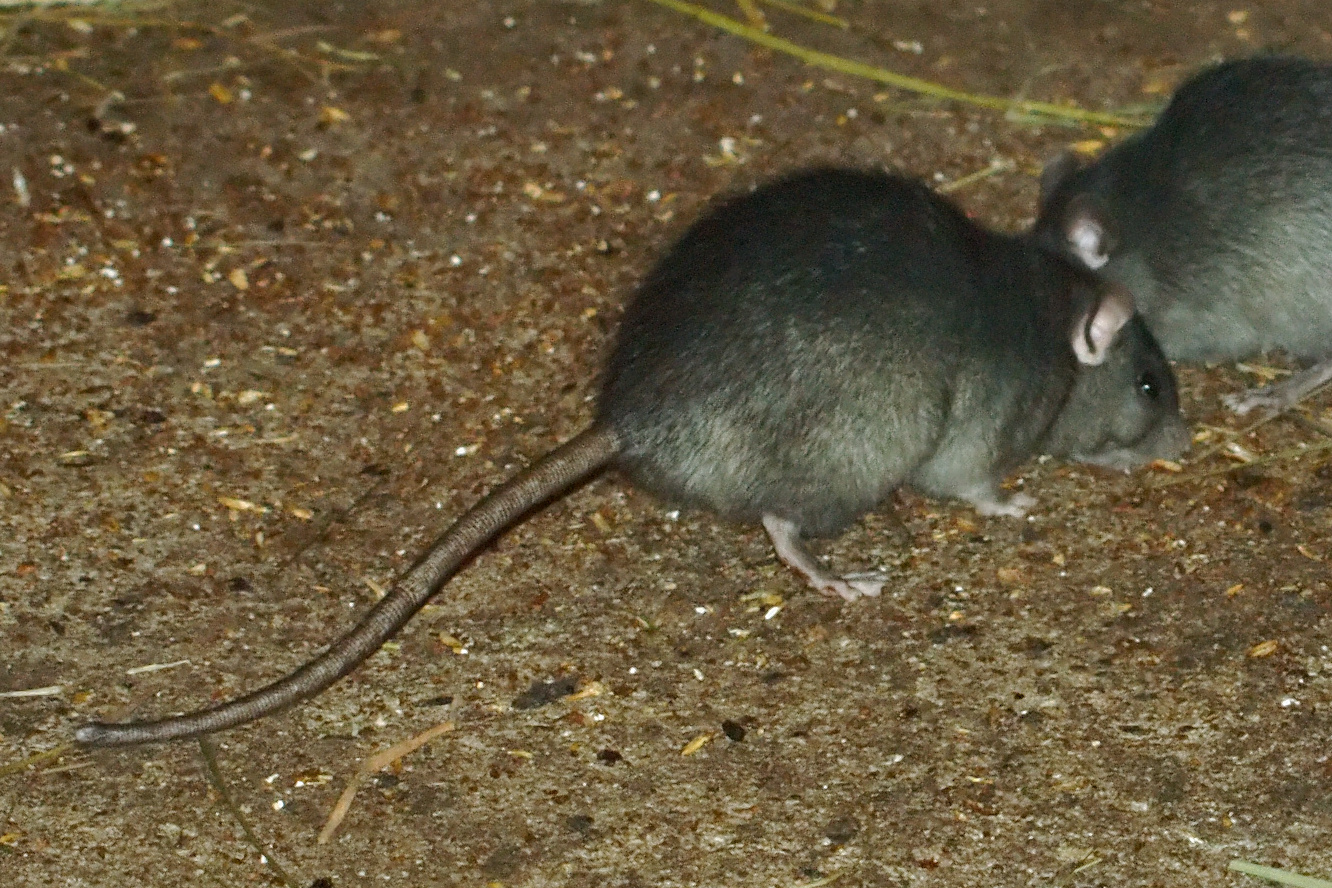
Black Rat
Rattus rattus
Characteristics
Temperament
A nocturnal, social, intelligent and extraordinarily adaptable rodent. It is NOT a common pet (domestic fancy rats derive from the brown rat): the black rat is a wild, commensal species, shy and wary, with a marked neophobia (fear of novelty) that makes it cautious toward new objects and foods. It is a very agile climber, active mainly at night, preferring dry, elevated places. It lives in social groups and breeds very rapidly. Its intelligence and adaptability make it biologically fascinating, but also hard to control as a pest and dangerous as an invasive species for island wildlife.
Diet
An opportunistic omnivore, with a marked preference for plants compared to the brown rat: it prefers fruit, seeds and grains, but also eats shoots, roots, insects, small invertebrates, food scraps and, especially on islands where it is introduced, eggs and nestlings. Its extraordinary dietary flexibility explains its enormous success as a commensal species. It shows food neophobia, however: it distrusts new foods and at first tastes only small amounts, a behaviour that makes it hard to eliminate with baits. It is a great consumer and contaminator of stored foodstuffs.
The Black Rat (Rattus rattus), also known as the ship rat, roof rat or house rat, is one of the most widespread, adaptable and historically influential rodents on the planet. Though often feared and persecuted, it is an animal of extraordinary evolutionary success. Characterized by:
- The slender, agile body: more streamlined and lighter than the brown rat, it is an exceptional climber
- The very long tail: longer than the head and body together, unlike the brown rat's
- The large ears and prominent eyes, signs of its nocturnal adaptation
- Life "up high": it prefers roofs, attics, trees and upper floors (hence "roof rat")
- The worldwide spread: it has followed humans everywhere aboard ships
- The historical role: it is classically associated with the spread of the plague
It enters the portal among the murids (murini), alongside the Brown Rat: with it, it completes the pair of two great commensal rats of humankind, the two Rattus species that, more than any other, have tied their fate to ours.
Classification and category
The Black Rat belongs to the order Rodentia, family Muridae (the murids, the largest family of mammals), genus Rattus. The species is Rattus rattus. In the portal it is placed among the murids, alongside other murids such as the brown rat, the house mouse, the wood mouse and the harvest mouse. It is essential to tell it apart from its larger "cousin", also in the portal: the Brown Rat (Rattus norvegicus, or Norway rat) — larger, stockier and heavier, with small ears, a blunt muzzle and a tail shorter than the body; it lives mostly on the ground, in burrows, sewers and cellars; the Black Rat is instead smaller and more slender, with large ears, a pointed muzzle and a tail longer than the body; it is a climber that prefers the upper levels. The practical rule: tail longer than body + large ears + slender body = black rat; shorter tail + small ears + massive body = brown rat. The combination of slender body + very long tail + large ears + climbing habits is the black rat's "identity card". Etymology: the scientific name Rattus rattus simply repeats the Latin word for "rat"; the common name "ship rat" recalls its historical spread by sea. Despite the name "black", the coat colour is variable and not always dark. Parameters: Body length about 16-24 cm, plus an even longer tail. Weight usually about 75-230 g, in any case less than the brown rat. Appearance a slim, agile rodent, with a pointed muzzle and a long, naked tail. Longevity: in the wild it usually lives about a year, rarely more, because of heavy predation; in captivity it can reach 2-3 years. Reproduction: extremely prolific, with several litters a year of numerous young each.
Habitat and distribution
The Black Rat is a commensal species of humans, native to tropical Asia but now present across much of the world: its origin lies in the Indian subcontinent and Southeast Asia; its spread is cosmopolitan, thanks to involuntary transport aboard ships and human means. Preferred habitats — varied environments, often linked to humans and elevated places: buildings (attics, roofs, warehouses and upper floors, hence the name "roof rat"); trees and vegetation (thanks to its climbing skills); ports, ships and coastal areas, historic points of spread; and islands, where as an introduced species it can cause serious damage. It is a nocturnal, social and extremely agile animal. Unlike the brown rat, which prefers the ground and damp environments (sewers, cellars), the black rat likes dry, elevated places, moving with great ease along ropes, cables, branches and vertical structures. It is shy and wary, and tends to avoid novelties in its environment (neophobia). From a conservation standpoint, the Black Rat is far from threatened: it is one of the most successful species in the world. On the contrary, as an invasive species it poses a serious threat to native wildlife on many islands, where it preys on eggs, nesting birds, reptiles and invertebrates, contributing to the extinction of numerous species. It is also an important disease carrier and a damaging pest of foodstuffs.
Diet
The Black Rat is omnivorous, but with a marked preference for plants compared to the more carnivorous brown rat. Its diet includes: fruit, seeds and grains (the favourite component of the diet); shoots, roots and plant material of various kinds; insects and small invertebrates; scraps and foodstuffs in human environments; and eggs and nestlings, especially on islands where it is introduced. Features of its feeding behaviour: opportunistic and adaptable (it can exploit the most varied resources, which explains its enormous success); a "frugivorous" tendency (it prefers fruit and seeds, and is a great consumer of stored plant products); and food neophobia (it distrusts new foods, at first tasting small amounts — a behaviour that makes it hard to eliminate with baits). It is precisely this extraordinary dietary flexibility, combined with climbing ability and prolific breeding, that has made the black rat one of the most widespread and successful mammals on the planet, but also a fearsome pest of food stores.
Physical features
The Black Rat is a slender, in its own way elegant rodent, built for agility. The climber's body: a slim, light build, more tapered than the brown rat's; a very long, naked tail, longer than the head and body, essential for balance; agile limbs, suited to climbing vertical surfaces. The head and senses: a pointed, expressive muzzle; large, thin, almost hairless ears, proportionally wider than the brown rat's; prominent eyes adapted to nocturnal life; very developed hearing and smell. The coat: a variable colour (despite the name, it can be grey-black, brown or paler, often with a paler belly); dense, short fur, typical of murids.
Curiosities, history and impact
The Black Rat is an animal whose history is deeply intertwined with that of humans: however detested, it has travelled with us for millennia and has left an enormous mark, for good and ill, on history and ecosystems.
The ship rat: the extraordinary worldwide spread of the black rat is due almost entirely to humans; boarding merchant ships, this rodent has travelled along trade routes since antiquity, colonizing ports, cities and islands on every continent; it is one of the most striking examples of a species "transported" by humans across the planet. The link with the plague: the black rat is sadly famous for the role historically attributed to it in spreading the plague, in particular the great medieval pandemic (the "Black Death"); it was not the rat itself that directly transmitted the disease, but the fleas that lived on it, the vector of the responsible bacterium; moving with goods and people, rats and their fleas helped spread the contagion along trade routes; modern studies debate the details of this role, but the association between black rat and plague remains one of the best-known chapters in the history of epidemics. The misleading name: despite being called "black rat", the colour of its coat is in fact very variable, and many individuals are not black at all but brown or greyish; the scientific name, Rattus rattus, merely repeats the Latin word for "rat". The acrobatic climber: unlike the ground-bound brown rat, the black rat is an extraordinary tightrope walker; it can run along cables, ropes and thin branches, climb rough walls and reach the highest floors of buildings; this skill has earned it the name "roof rat" and lets it exploit niches inaccessible to other rodents. The scourge of islands: accidentally introduced to islands worldwide, the black rat has become one of the worst invasive species for wildlife; by preying on eggs, chicks, reptiles and invertebrates, it has contributed to the decline and extinction of numerous island species, especially seabirds unable to defend their nests; for this reason, many conservation projects now aim to eradicate it from the most vulnerable islands. Impact and coexistence: the Black Rat remains, together with the brown rat, one of the most important rodents from a health and ecological standpoint; on the one hand it is a pest of stores and a potential disease carrier; on the other it is an intelligent, adaptable and fascinating animal, a symbol of rodents' extraordinary ability to thrive alongside humans; understanding its biology and behaviour is essential both to manage its populations and to protect the ecosystems it can threaten.
Pros
- Roditore intelligente, agilissimo e di straordinario successo evolutivo
- Arrampicatore eccezionale, capace di sfruttare nicchie inaccessibili ad altri
- Fa parte, con il ratto norvegese, della coppia dei grandi ratti commensali
- Di grande interesse storico, sanitario ed ecologico
Cons
- NON è un animale da compagnia: è una specie selvatica e commensale
- Parassita delle derrate e potenziale portatore di malattie
- Tra le peggiori specie invasive per la fauna delle isole (preda uova e nidiacei)
- Neofobia e prolificità lo rendono difficile da controllare