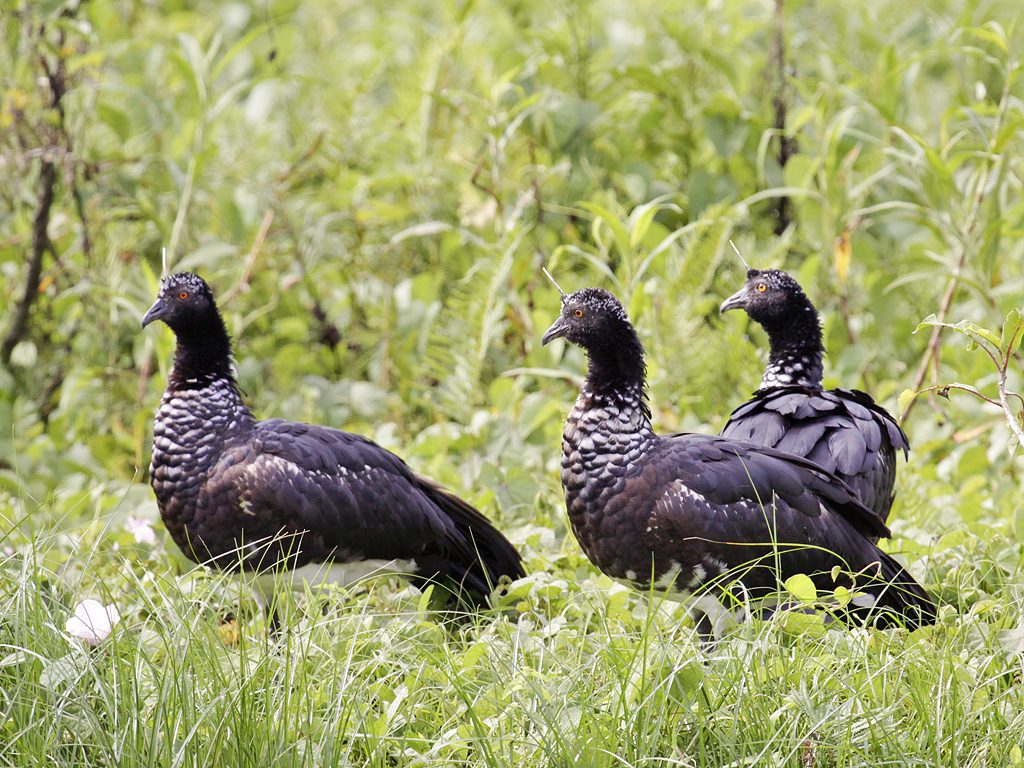
Horned screamer
Anhima cornuta
A large bird of South American wetlands, the horned screamer bears a long keratin 'horn' on its forehead and gives resonant calls audible for kilometres.
Characteristics
Temperament
Territorial, monogamous, with very powerful calls
Diet
Herbivore: leaves, shoots, flowers, aquatic plants
The bird with a horn
The horned screamer is a large waterbird, related to ducks, geese and swans but very different in appearance: a massive black-and-white body, a small head and a bill more like that of game birds. Its most curious feature is a long, slender, curved horny structure sprouting from the forehead: it is not a true bony horn but a keratin appendage that grows throughout life and can break off and regrow. Beneath its wings it conceals sturdy spurs, used in fights.
Habitat and distribution
It lives in the tropical wetlands of South America — marshes, riverbanks and lagoons — from Colombia and Venezuela to Bolivia and Brazil, including the Guianas. It favours open habitats with abundant aquatic vegetation.
Behaviour and voice
It is mostly herbivorous, feeding on leaves, shoots, flowers and aquatic plants. It owes its name to its powerful voice: the thunderous calls, repeated in duet by pairs, carry for kilometres across the marshes and serve to advertise territory. An anatomical peculiarity is the presence of air sacs under the skin that crackle when pressed.
Curiosities
Despite its unwebbed toes, it swims well and walks easily over floating vegetation. It is the emblem bird of the Colombian department of Arauca. Pairs are monogamous and defend their stretch of marsh vigorously.
Conservation
The IUCN lists the species as Least Concern: it has a very wide range and stable populations. Wetland drainage and hunting can nonetheless have local effects.
Pros
- Keratin forehead horn unique among birds
- Thunderous calls audible for kilometres
- Wide range and stable populations
Cons
- Depends on wetlands, sensitive to their drainage
- Not a pet: highly specialised wild needs
- Deafening voice at close range