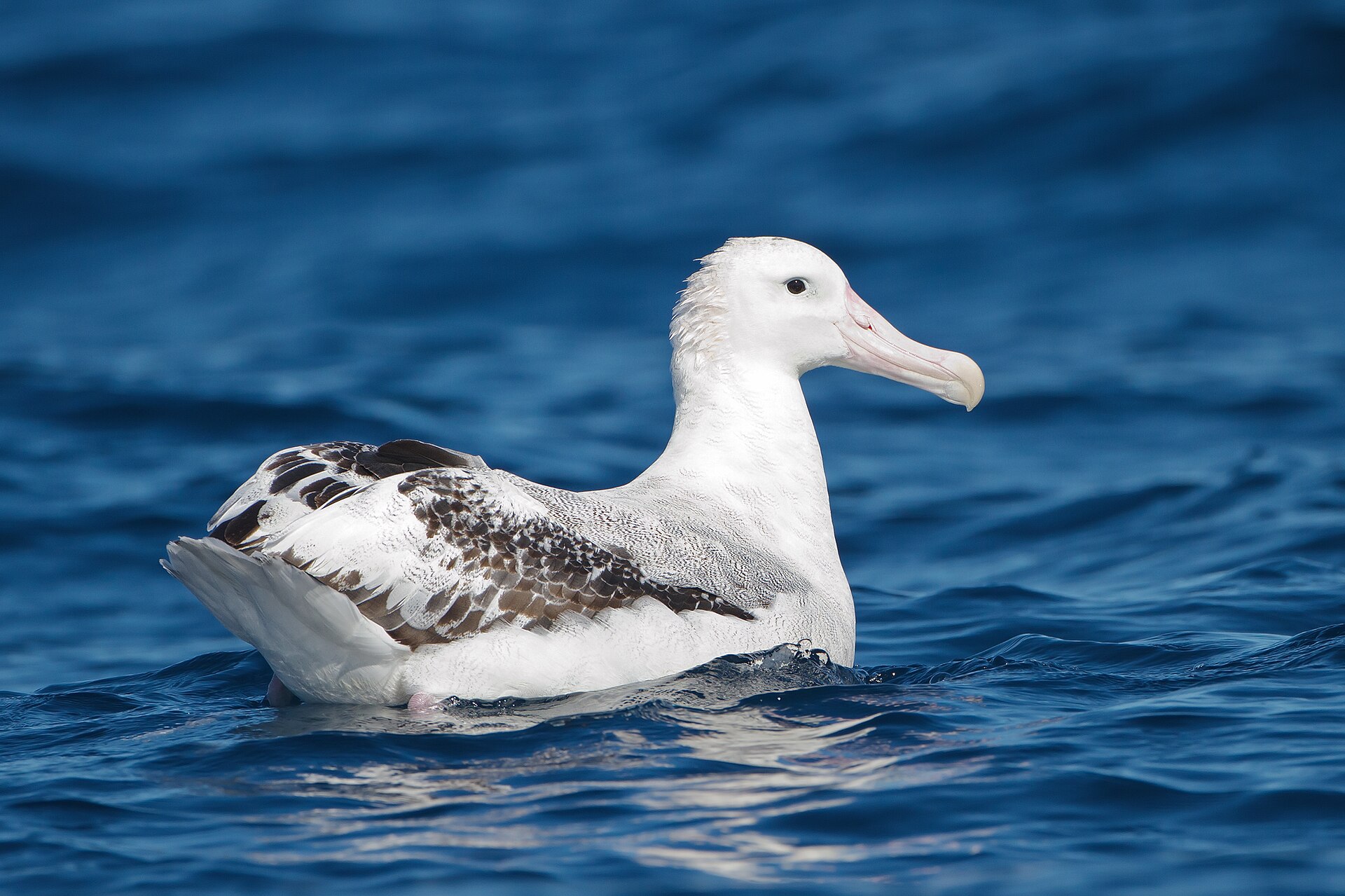
Wandering Albatross
Diomedea exulans
Characteristics
Temperament
Lifelong monogamous, long-lived (30-50 years). Flies in open sea 10-20 consecutive days without landing. Can "sleep" while flying (locking tendon). Sees and smells squid at 20 km. Spectacular courtship dance.
Diet
Pelagic carnivore: squid (60-70%), fish, krill, carrion, fishing boat discards. 1-2 kg/day. Low-consumption gliding flight (120,000 km/year). Salt glands expel salt from nostrils.
The Wandering Albatross (Diomedea exulans), also known as the Snowy Albatross or White-winged Albatross, is one of the most majestic birds on the planet. It has the largest wingspan of any living bird, with a documented record of 3.7 metres. Ruler of the circumpolar Antarctic Southern Ocean, it can travel over 120,000 km a year in low-energy gliding flight, exploiting the winds of the Roaring Forties and Furious Fifties to sustain flights of weeks practically without flapping its wings. Its extreme physical characteristics — body of 10-12 kg, wingspan double that of a Golden Eagle, longevity exceeding 60 years, strict monogamy — make it one of the most fascinating animals studied by biology. Protagonist of the legendary poem "The Rime of the Ancient Mariner" by Samuel Taylor Coleridge (1798), today it is classified as Vulnerable by IUCN: gravely threatened by accidental catches in longline fishing nets.
Classification and category
The Wandering Albatross belongs to the order Procellariiformes (the "tube-nosed birds", family that also includes petrels and fulmars), family Diomedeidae, genus Diomedea. The genus comprises 4 species of "great albatrosses". D. exulans is the type species of the genus and is divided into 3-5 cryptic species recently separated by molecular genetics (Wandering Albatross sensu stricto, Antipodean Albatross, Tristan Albatross). The size is imposing: body length 1.1-1.4 m, wingspan 2.5-3.5 m (record 3.7 m, specimen captured in Tasmania in 1965), weight 6-12 kg. Males are on average larger and heavier than females (moderate sexual dimorphism). The species was scientifically described by Linnaeus in 1758 with the term "exulans" which means "in exile", referring to its incessant wandering in the oceans.
Habitat and distribution
The habitat of the Wandering Albatross is exclusively the circumpolar Antarctic oceans of the southern hemisphere: Southern Ocean, Antarctic Ocean, South Atlantic Ocean, South Indian Ocean, South Pacific Ocean. It lives in the open sea for almost the entirety of the year (over 95% of life time), landing only to nest. They are found in the open sea between latitudes 30°S and 60°S, the so-called "wind latitudes" where the Roaring Forties (40-50° S), the Furious Fifties (50-60° S) and the Shrieking Sixties (60-70° S) generate constant winds that albatrosses exploit for gliding flight.
Nesting takes place on a few remote subantarctic islands: South Georgia (main population), Crozet Islands, Kerguelen, Macquarie, Auckland, Antipodes, Prince Edward. The global population is estimated at 20,000-25,000 breeding pairs. Conservation status is listed as Vulnerable (VU) by IUCN since 2018 (previously Endangered in 2003-2017, downgraded due to slight recovery). Threats are very serious: accidental catch in longline nets of industrial fishing vessels (estimated 100,000 annual deaths of Procellariformes, of which 2,000-3,000 wandering albatrosses — the birds dive on longline baits and drown), plastic pollution of oceans (albatrosses ingest up to 6 kg of plastic in their lives), climate change (alteration of ocean currents and prey availability). International programmes (ACAP — Agreement on the Conservation of Albatrosses and Procellariformes, 2001) provide exclusion devices (BIRDS) on longlines, now mandatory in 15 countries.
Diet
The Wandering Albatross is a pelagic carnivore with varied diet: squid (main prey, about 60-70%), epipelagic fish (anchovies, sardines, small cod), krill and pelagic crustaceans, carrion of marine mammals (seals, whales, penguins), fishing vessel discards (often follows fleets to feed on discards). A unique characteristic of the genus Diomedea is the ability to catch live giant squid through surface dives (up to 2-3 m depth, rarely deeper).
The foraging technique is very special: the Wandering Albatross is capable of low-consumption gliding flight (dynamic soaring), exploiting differences in wind speed at different heights above the waves. It can travel 120,000 km a year (3 trips around the world) consuming energy comparable to a terrestrial bird of its size. A single foraging excursion lasts 7-30 days and can cover 10,000-15,000 km. Smell is exceptionally developed: it detects olfactory molecules (DMS, dimethyl sulfide) emitted by krill and squid up to 20 km away. Daily requirement is 1-2 kg of food. It has large salt glands on the head that eliminate excess salt from seawater (necessary to feed almost exclusively at sea), expelling it from the nostrils as a "saline tear".
Physical features
The Wandering Albatross is the largest of flying birds (by wingspan). The adult plumage is predominantly pure white with dark black wing tips and edges; juveniles are born entirely brown and take up to 9 years to reach the adult white plumage (progressive mutation from brown to white). The wings are long, narrow, rigid (unlike terrestrial birds that have flexible wings), with a wingspan of 2.5-3.5 m (record 3.7 m). The wing structure is optimised for long-distance gliding flight: a locking tendon in the shoulder joint allows keeping the wings extended without tiring the muscles (the albatross can "sleep" while flying!).
The beak is massive, long, curved downwards, of pink-yellowish colour, with characteristic nasal tubes on the upper sides (diagnostic feature of Procellariiformes, hence the name "tube-nosed"). The tubular nostrils improve smell and help in salt elimination. The legs are webbed, short, fragile (the albatross is clumsy on land: to take off it must run into the wind, and to land it often "rolls" on its belly). The forehead and neck feathers are slightly protruding, giving a "wise" and majestic expression. The average flight speed is 30-60 km/h, with peaks of 130 km/h with favourable winds. It can remain in the air for 10-20 consecutive days without landing, sleeping for brief periods while flying.
Behaviour and curiosities
The Wandering Albatross is a lifelong monogamous, social only during nesting, long-lived animal. The pair maintains the same partner for decades (some cases documented up to 50 years of union). During the non-breeding year the two partners travel separately in the ocean, but always meet again at the same nesting site for courtship. The courtship dance is one of the most spectacular in the avian kingdom: adults perform a complex ritual of 10-15 minutes that includes "sky-pointing" (pointing the beak to the sky), synchronised wing openings, screaming vocalisations (hence the nickname "Screaming Albatross"), bows and beak claps.
Nesting is biennial: the pair reproduces only every 2 years because the cycle is extremely long. The nest is a platform of grass and mud built on subantarctic slopes, always in the same spot generation after generation. The female lays only 1 white egg (350 g, the largest among living birds along with that of kiwi and ostrich), which is incubated for 78-79 days by both parents in turn (every 2-15 days they alternate, while the other goes hunting in the ocean). The chick takes 278 days (over 9 months) to learn to fly and depends on parents for this entire period. Sexual maturity is reached late: 9-11 years. Longevity is exceptional: 30-50 years in nature, with specimens documented up to 60+ years (the record is "Wisdom" — a Laysan albatross, related species — of 73 years in 2024, and for the Wandering similar cases exist). Cultural curiosities: in the poem "The Rime of the Ancient Mariner" by Samuel Taylor Coleridge (1798), an albatross is killed by the sailor and becomes a symbol of guilt and curse ("Albatross around the neck" is an English expression indicating an unbearable moral burden). Charles Baudelaire in "Les Fleurs du Mal" (1857) dedicates a poem to the albatross as a metaphor for the misunderstood poet-genius. The species is the subject of scientific studies on longevity, on the evolution of soaring flight, on bio-mimetics of gliding flight (inspires the design of fixed-wing UAVs for environmental surveillance applications).
Pros
- Più grande apertura alare del mondo (record 3,7 m)
- Longevità eccezionale (30-50 anni, record 60+)
- Monogamo a vita, danze di corteggiamento spettacolari
- Percorre 120.000 km/anno (3 giri del mondo)
Cons
- Vietato come pet (specie CITES)
- IUCN Vulnerable: 100.000 morti annue per palangari
- Mortalità da ingestione plastica oceanica (6 kg vita)
- Maturità sessuale a 9-11 anni, riproduzione biennale