Photo: Wikimedia Commons · CC BY-SA 1.0
Golden pheasant
Chrysolophus pictus
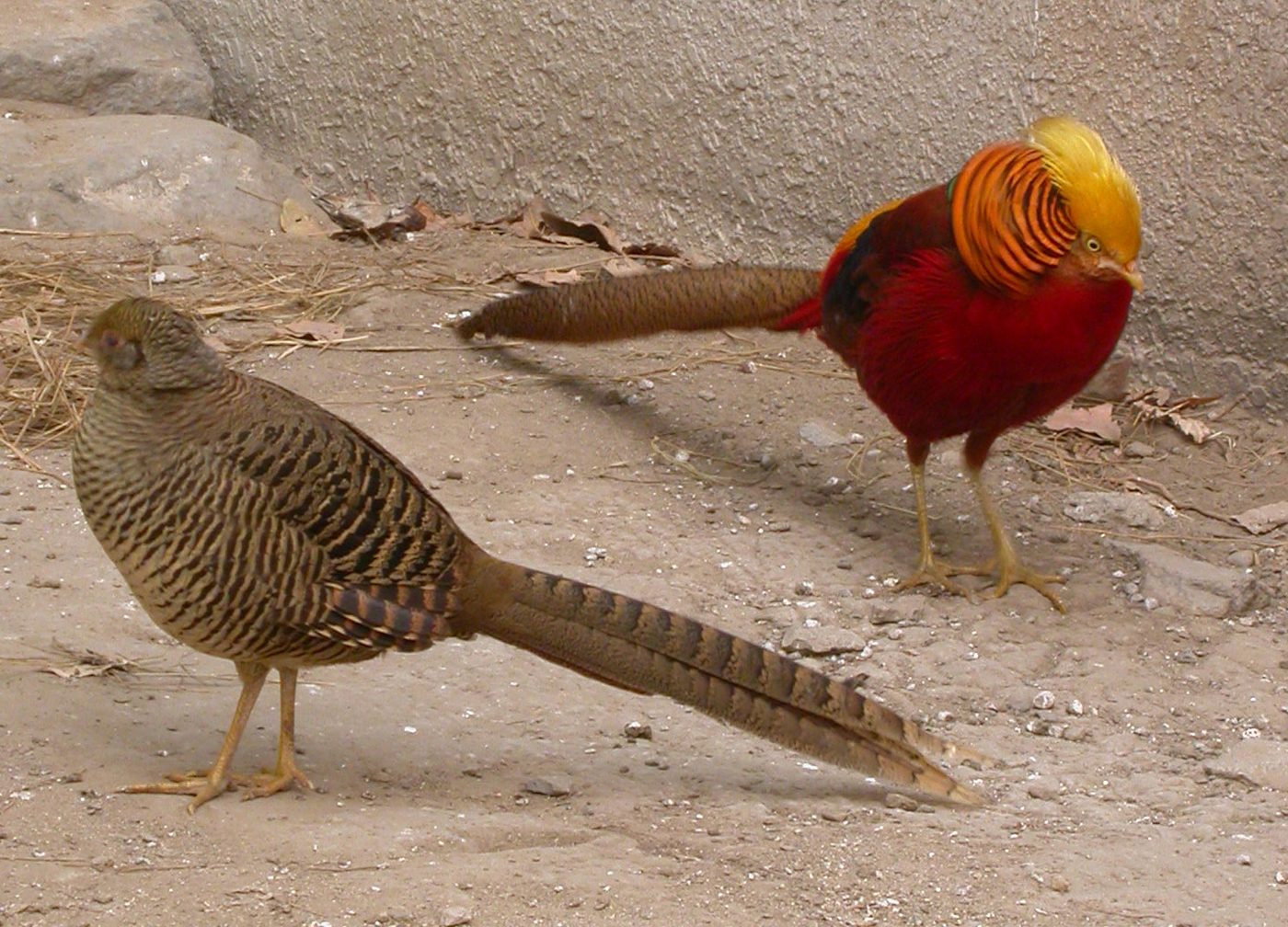
A mountain bird of blazing colours, the golden pheasant's male has a golden crest, an orange cape and a fiery red belly: one of the most beautiful birds in the world.
Characteristics
Temperament
Shy, ground-dwelling; showy courting male
Diet
Omnivore: seeds, shoots, berries, invertebrates
A pheasant painted in gold
The golden pheasant is one of the most spectacular birds in the world. The male is a riot of colour: a crest of golden-yellow feathers on the head, a broad orange cape barred with black that can spread into a fan, a flaming red belly, an iridescent green and blue back and a very long mottled tail. The female, by contrast, is buff-brown barred with dark, discreet and cryptic to protect the nest. At just under a kilogram, it is a medium-sized pheasant.
(Note: the mass value given by Wikidata, 725 kg, is plainly wrong for a bird of this size; its true weight is about 600–700 grams.)
Habitat and distribution
It is native to the mountain forests of central China, where it lives in hilly and subtropical woodland up to over 2,000 metres altitude. It is a shy bird, hard to observe in the wild. Introduced populations live feral in Great Britain.
Behaviour and courtship
It is ground-dwelling: it spends most of its time on the ground, seeking seeds, shoots, berries and small invertebrates, but roosts in trees. During courtship the male spreads its orange cape like a fan in front of the female's head, covering one side of its face and showing off its brightest colours in a sideways dance.
Keeping
Thanks to its beauty it is one of the most widely kept ornamental pheasants in the world, present in many parks and aviaries. It is relatively hardy and cold-resistant but needs space, shelter and a balanced diet. In captivity it can live several years.
Conservation
The IUCN lists the species as Least Concern: it has a wide range and stable populations, and is extremely common in captivity. The destruction of Chinese mountain forests nonetheless remains a possible local threat.
Pros
- Among the most colourful birds in the world
- Spectacular courtship with the fanned cape
- Hardy and widely kept
Cons
- The male is showy, the female very plain
- Needs space, shelter and a balanced diet
- Shy and hard to observe in the wild