Aye-aye
Daubentonia madagascariensis
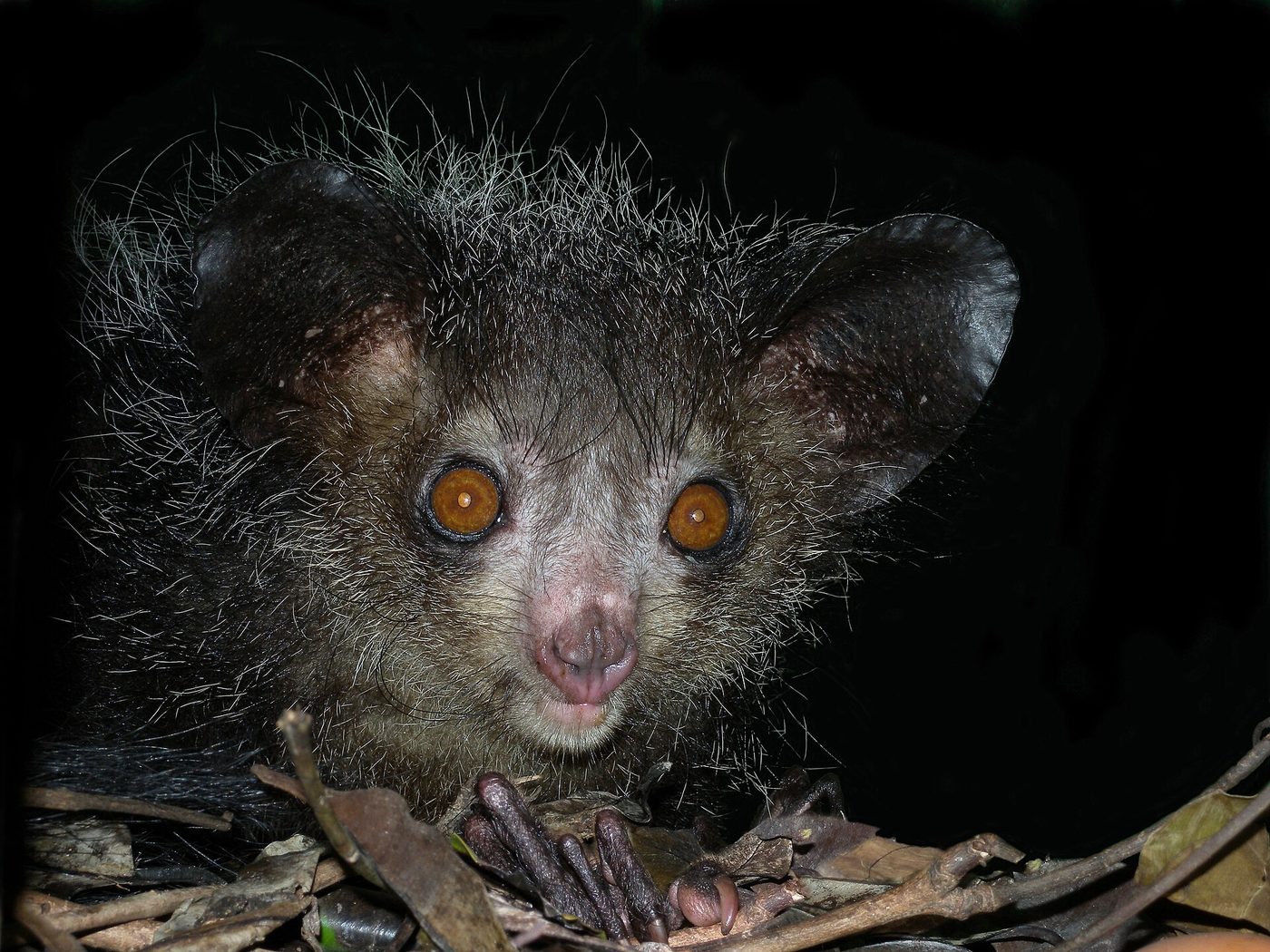
With its large eyes, enormous ears and a skeletal, elongated middle finger, the aye-aye is one of the most unusual and fascinating lemurs of Madagascar.
Characteristics
Temperament
Nocturnal, solitary, arboreal, shy
Diet
Omnivore: larvae, fruit, seeds, nectar
The lemur with a magic finger
The aye-aye is one of the most extraordinary and unmistakable primates in the world, a nocturnal lemur endemic to Madagascar. It has an almost bizarre appearance: thick, dark, shaggy fur, large protruding eyes suited to night vision, enormous mobile ears, incisors that grow continuously as in rodents and, above all, an incredibly long, thin, skeletal middle finger. It is precisely this finger that is the key to its unique way of life.
Habitat and distribution
The aye-aye lives exclusively in Madagascar, the island-continent famous for its wildlife unique in the world. It is an inhabitant of the forests, where it spends its life among the branches of the trees. It is strictly nocturnal: during the day it rests in spherical nests built among the foliage, and becomes active at night to search for food.
A unique hunting method
The aye-aye has developed a feeding technique with no equal among primates, called 'percussive foraging'. It rapidly taps the bark of trees with its middle finger and listens with its large ears to the echo produced, to locate the cavities where insect larvae are hidden. Once found, it gnaws the wood with its powerful incisors and uses its long finger, agile as a probe, to extract the prey. It also feeds on fruit, seeds and nectar.
Curiosities and superstitions
Unfortunately, its unusual appearance has in the past made it a victim of superstitions: in some local traditions it was considered an omen of misfortune, and for this reason it was killed. In reality it is a completely harmless animal and valuable to the ecosystem. Its ecological niche is similar to that of woodpeckers on other continents, which also search for larvae in wood.
Conservation
The aye-aye is classified as an endangered species. The main threats are the destruction of Madagascar's forests and persecution by humans, fuelled by superstitions. Protecting the island's forests and raising awareness among local communities are essential to save this unique and extraordinary primate.
Pros
- Hunting technique unique among primates
- Extraordinarily specialised elongated finger
- Fascinating nocturnal adaptations
- Valuable to the Madagascar ecosystem
Cons
- Endangered species
- Victim of superstitions and persecution
- Threatened by the destruction of forests