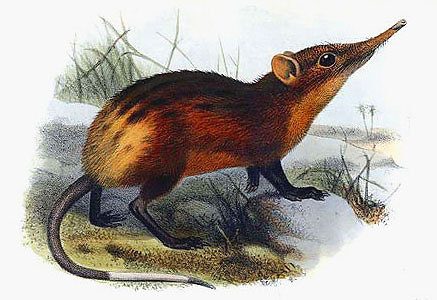
Photo: Joseph Smit · Public domain
Golden-rumped sengi
Rhynchocyon chrysopygus
A small mammal with a flexible trunk-like snout and a striking golden rump, the golden-rumped sengi is the largest elephant shrew and lives only on Kenya's coast.
Characteristics
Temperament
Diurnal, ground-dwelling, monogamous, shy
Diet
Insectivore: beetles, termites, spiders, earthworms
Not a shrew, but an afrothere
Despite its name, the golden-rumped sengi is not related to true shrews: it belongs to the macroscelids, a group of afrotheres sharing ancestry with elephants, hyraxes and manatees. Its most striking feature is a brilliant golden rump that stands out against a dark coat, possibly a signal that diverts predators' bites towards the toughest part of the body. The snout extends into a small, flexible, constantly moving trunk used to probe the ground. Weighing around 540 grams, it is the largest species in its family.
(Note: the mass value given by Wikidata, 80 kg, is plainly wrong for an animal of this size; its true weight is little more than half a kilogram.)
Habitat and distribution
It lives in a narrow strip of coastal forest in eastern and south-eastern Kenya, notably the Arabuko-Sokoke Forest. It favours closed woodland with a deep leaf litter, where it spends much of its time foraging on the ground. Its range is highly fragmented, which makes the species especially vulnerable.
Behaviour
It is diurnal and ground-dwelling. It forms lifelong monogamous pairs: male and female share the same territory but lead largely separate lives, coming together mainly to breed. It feeds on invertebrates — beetles, termites, spiders, earthworms — which it roots out of the litter with its snout. It builds nests of plant material on the ground, using them as refuges to rest and escape predators.
Curiosities
When it senses danger, the sengi may slap its tail rhythmically against the litter to signal to a predator that it has been spotted, discouraging pursuit; if pressed, it bolts in swift dashes along trails it keeps clear. The female usually gives birth to a single young at a time, several times a year, and raises it without help from the male.
Conservation
The IUCN classifies the species as Endangered. The main threats are the destruction and fragmentation of coastal forest and disturbance of its habitat. Protecting the last Arabuko-Sokoke forests is crucial to its survival.
Pros
- The largest of the elephant shrews, with an unmistakable coat
- Lifelong monogamous pair bonds
- Unusual and fascinating anti-predator behaviour
Cons
- Tiny, fragmented range; highly vulnerable species
- Endangered by loss of coastal forest
- Not a pet: highly specialised wild needs