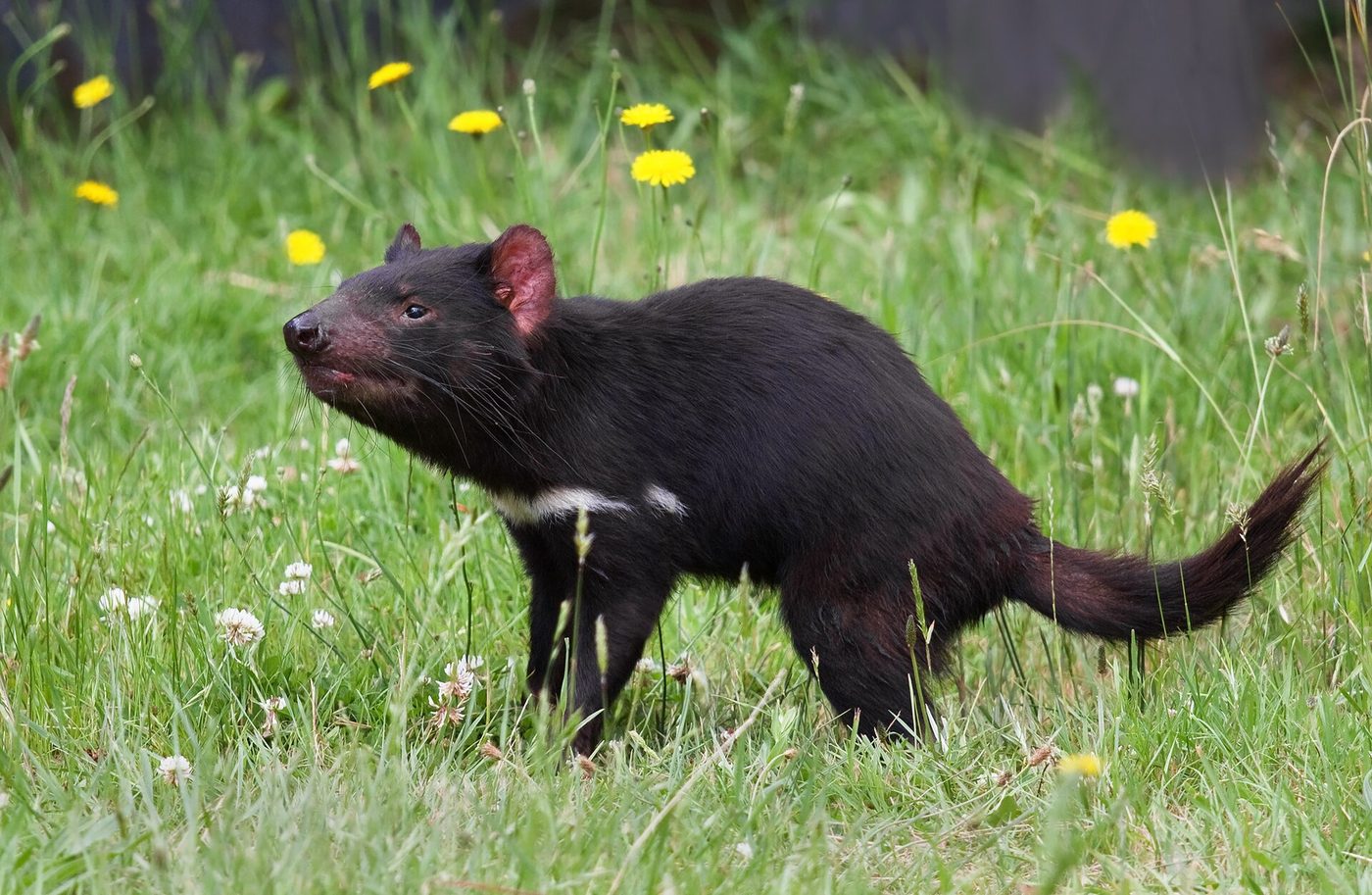
Tasmanian devil
Sarcophilus harrisii
Small but fierce, with an immensely powerful bite and chilling calls, the Tasmanian devil is the largest living carnivorous marsupial.
Characteristics
Temperament
Nocturnal, solitary, noisy and territorial
Diet
Carnivore and scavenger: prey and carrion
A small predator with a powerful bite
The Tasmanian devil is the largest carnivorous marsupial in existence today. It is the size of a small dog, with a stocky, muscular body, black fur often marked with white patches on the chest and back, and a broad head with surprisingly powerful jaws. Its bite is, in proportion to its size, among the most powerful in the animal kingdom: it is able to crush bones and to devour its prey entirely. The name 'devil' was given to it by the first European settlers, struck by its shrill, unsettling calls and its appearance when agitated.
Habitat and distribution
Today the Tasmanian devil lives in the wild only on the island of Tasmania, in Australia, having become extinct on the Australian mainland long ago. It frequents forests, scrubland and coastal areas, adapting to different environments as long as they offer shelter and prey. It finds refuge in dens, hollows and dense bushes during the day.
Behaviour
It is a mainly nocturnal and solitary animal. Although a hunter, it behaves above all as a scavenger: it feeds on carrion, helping to clear the environment of the remains of dead animals. Around a carcass several individuals may gather, giving rise to noisy 'feasts' accompanied by cries, growls and threatening yawns that serve to establish a hierarchy rather than to truly fight. Like all marsupials, the female raises her young in a pouch.
Curiosities
Despite its fierce reputation, much of its aggressive behaviour is in fact 'theatre': spectacular cries and yawns serve to frighten rivals and avoid physical clashes. It has become famous around the world partly thanks to popular culture, which has made it a recognisable character.
Conservation
The Tasmanian devil is classified as an endangered species. The gravest threat is a rare and devastating contagious disease, a transmissible facial tumour that spreads between individuals through bites and has caused a sharp decline in populations. Conservation programmes, protected populations and scientific research are today essential to save this symbol of Australian wildlife.
Pros
- The largest living carnivorous marsupial
- Valuable 'scavenger' that cleans up the environment
- Extremely powerful bite relative to its size
Cons
- Endangered species
- Threatened by a rare transmissible facial tumour
- Survives in the wild only in Tasmania