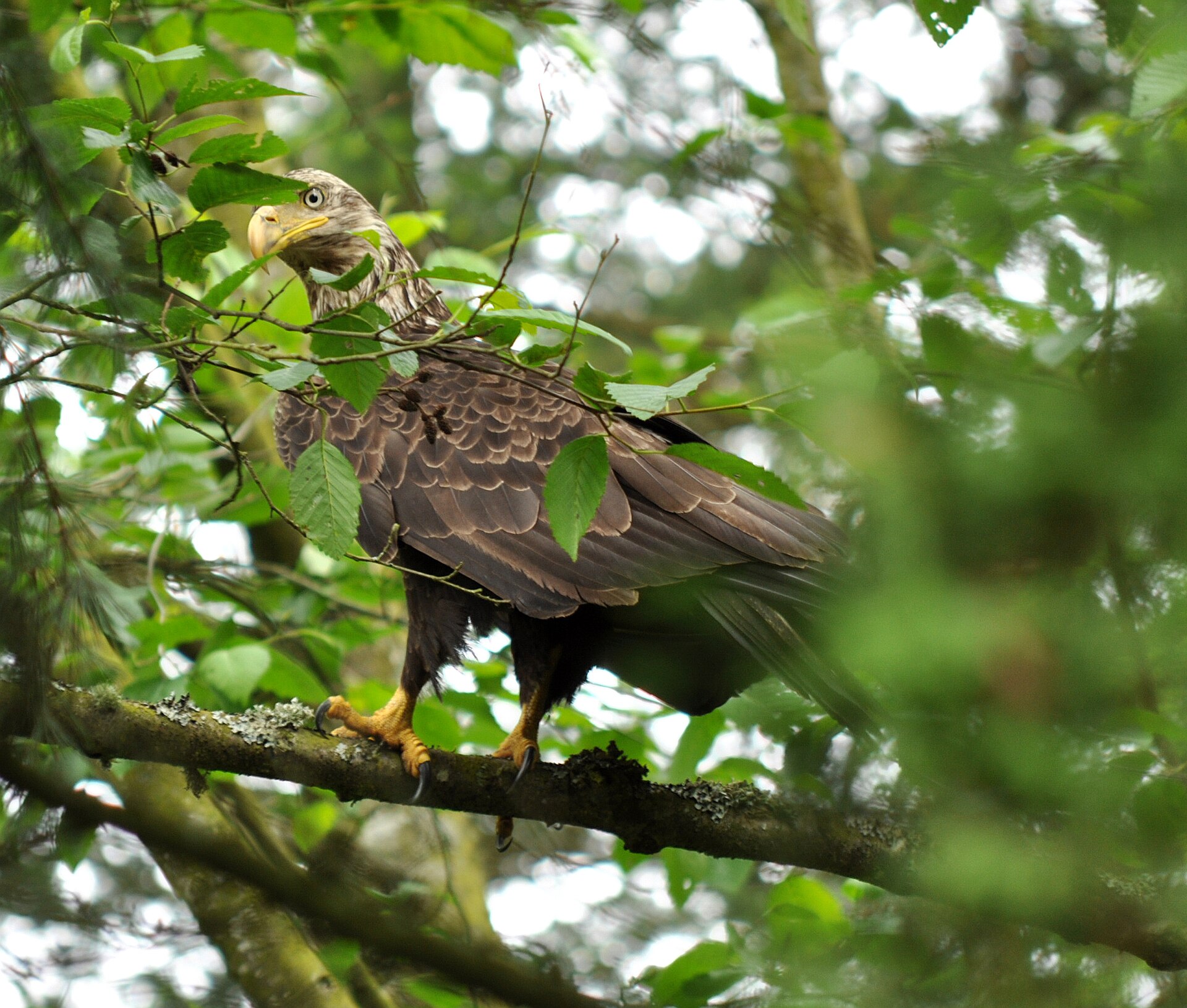
Bald Eagle
Haliaeetus leucocephalus
Characteristics
Temperament
Lifelong monogamous, diurnal, fish-eating predator. National symbol of USA since 1782. Builds among the largest nests in the world (record 6 m deep, 2,700 kg). Successful conservation history: from 412 pairs (1963, DDT) to 71,000+ (2019).
Diet
Specialised fish-eating carnivore: 60-90% fish (salmon preferred), + water birds, small mammals, carrion. Hunts by aerial dive from heights (50-100 m), speed 160 km/h. Kleptoparasite: steals prey from ospreys, storks, even humans.
The Bald Eagle (Haliaeetus leucocephalus) is a large fish-eating raptor native to North America. It is famous for being the national symbol of the United States of America since 1782, present on the National Seal, on the 25-cent coin (quarter), on the dollar, and on practically every American federal emblem. Characterised by a striking white head and tail contrasted with the dark brown body, and by the large yellow beak, it is one of the most recognisable raptors in the world. The name "Bald" actually does not mean "without feathers": it derives from Old English "balde" meaning "white" (recall of "piebald" = patchy). It weighs 3-7 kg (females larger) with wingspan of 1.8-2.3 metres. It lives in close contact with large bodies of water: in North America from Alaska to Florida. After having risked extinction in the 1960s-1970s (DDT, only 412 pairs survived in continental USA), today the population has recovered spectacularly: over 300,000 specimens and 71,000 breeding pairs (2019 census). Global IUCN conservation status: Least Concern (LC).
Classification and category
The Bald Eagle belongs to the order Accipitriformes (diurnal raptors), family Accipitridae, subfamily Buteoninae, genus Haliaeetus. The genus Haliaeetus (from Greek "halios" = of the sea + "aetos" = eagle) comprises 8 species of "sea eagles" or "fish-eating eagles" distributed throughout the world: in addition to the American Bald, there are H. albicilla (European White-tailed Sea Eagle), H. leucoryphus (Pallas's Sea Eagle, Asia), H. vocifer (African Fish Eagle), H. vociferoides (Madagascar Eagle — the rarest, ~120 pairs), H. pelagicus (Steller's Sea Eagle, the largest), H. sanfordi (Solomon Sea Eagle), H. humilis (Lesser Asian Grey-headed Fish Eagle).
The species was scientifically described by Linnaeus in 1766. There are 2 subspecies:
- H. l. leucocephalus — southern (south-central USA, northern Mexico)
- H. l. washingtoniensis — northern (Alaska, Canada, northern USA) — larger
Adult dimensions show marked reverse sexual dimorphism (characteristic in raptors): females 4.8-7 kg, length 78-100 cm, wingspan 2.1-2.3 m; males 3-4.5 kg, length 71-90 cm, wingspan 1.8-2.1 m. Females are 20-30% larger than males (Bergmann's rule + cooperative hunting hypothesis). Specimens from Alaska are notably larger (record: 7.5 kg, wingspan 2.4 m). Longevity is 20-30 years in nature, up to 50 years in captivity (record: the specimen "Ben Franklin" at Stone Mountain Park, Georgia, reached 48 years in 2018).
Habitat and distribution
The Bald Eagle's habitat is closely linked to water: it lives near large lakes, rivers, estuaries, ocean coasts, where it can hunt fish (its main diet). It prefers coniferous or mixed forests with mature giant trees (usually black cottonwood, white pines, douglas-fir) for nesting: large nests require trees 30-40 m tall, robust, near water. It tolerates intense cold well: in Alaska there are resident populations that withstand -40°C; some northern populations (Canada, Alaska) migrate south in winter, others remain resident.
Current distribution includes:
- Alaska: largest population, 50,000-70,000 specimens, especially on coastal islands (Kodiak, Aleutians, Chichagof)
- Canada: 100,000+ specimens, especially British Columbia, Manitoba, Ontario, Yukon
- Continental USA (48 states): ~140,000 specimens (2019), distributed in all 48 states. Largest populations in: Minnesota, Florida, Washington, Maine, Wisconsin
- Northern Mexico: small residual populations (Baja California, Sonora)
The conservation history of the Bald Eagle is one of the most dramatic and successful in American environmental history. In the 1940s-60s, the massive use of DDT (insecticide) in American agricultural cultures caused toxic biomagnification through the food chain: DDT accumulated in fish, and from fish in eagles, where it caused egg shell thinning. Eggs broke under the mother's weight during brooding. The population collapsed: in 1963, only 412 breeding pairs remained in continental USA (48 states, Alaska excluded). The Bald Eagle was declared in "danger of extinction" in 1967. The DDT ban in 1972 (USA) and 1978 (Canada), thanks to the environmental revolution triggered by the book "Silent Spring" by Rachel Carson (1962), allowed recovery. The population recovered spectacularly: 1,875 pairs in 1987, 20,000 pairs in 2007 (removed from endangered species list), 71,467 pairs in 2019 (latest official US Fish & Wildlife Service census). The global IUCN conservation status is Least Concern (LC) since 2007. However, bald eagles are still protected by the Bald and Golden Eagle Protection Act (1940) and the Migratory Bird Treaty Act (1918): capture, killing, possession of live or dead specimens (or even fallen feathers!) without federal permission is a federal crime punishable by $250,000 fine and/or 2 years in prison.
Diet
The Bald Eagle is a strict carnivore, specialised fish-eating predator. The diet is composed mainly of fish (60-90% of food, depending on region): salmon (preferred), trout, catfish, perch, lake trout, scapodo. It also hunts water birds (ducks, young swans, gulls, geese), small mammals (hares, squirrels, young marmots, rats), occasionally water turtles, snakes, crabs. An important characteristic: the bald eagle is also a scavenger (eats carrion), which earned it a "negative" reputation among some American founding fathers (Benjamin Franklin wrote to his daughter that the eagle was "an unfortunate choice as a national symbol, because it is of bad moral character, lives by robbery and carrion" — preferring the wild turkey!).
The fishing hunting technique is spectacular:
- The eagle flies high over the water (50-100 m altitude), scanning the surface with exceptional vision (4× sharper than human).
- Having located a fish near the surface, the eagle dives at an angle of 45-60° towards the water.
- At 1-2 metres from the surface, it extends its legs forward.
- It grabs the fish with its claws (4 cm long, curved, powerful) — it does not submerge underwater, it takes the fish from the surface.
- It flaps its wings powerfully to lift up.
- It flies to a perch (robust branch) to consume the prey.
Unique feature of "sea eagles": the soles of the feet have horny spicules called "spicules" — tiny hooks that help hold slippery fish. "Itticide" (fish catching) is almost always by aerial fishing, rarely diving (unlike the osprey, which dives completely). The bald eagle is also famous for "kleptoparasitism" (stealing prey from other birds): it steals fish from ospreys, fishing eagles, storks, even from humans (in Alaska famous are the eagles that steal salmon from sport fishermen). An average prey is 0.5-3 kg; an adult eagle consumes 0.5-1 kg of food per day (in winter it can go without eating for 1-2 weeks without problems thanks to fat reserves). The most fastest hunting flight documented: 160 km/h in dive; cruising flight 50-70 km/h.
Physical features
The Bald Eagle has a massive, powerful, dominant physique, typical of large raptors. The body length is 71-100 cm (females 78-100 cm, males 71-90 cm), the wingspan 1.8-2.3 m (record 2.4 m, Alaska 1992), the weight 3-7 kg (females 4.8-7 kg, males 3-4.5 kg). Sexual dimorphism is reverse (females 20-30% larger, common in raptors but marked in eagles).
The most iconic feature is the plumage of juveniles vs adults: adults (4+ years) have white head and tail contrasted with dark brown/black body, and yellow beak and legs — the classic "bald eagle" look. Juveniles (0-4 years) are completely dark brown with scattered light patches, and dark beak and legs (dark grey). The transition from juvenile to adult plumage occurs gradually through 5 moult stages (Basic I, II, III, IV, V) between 4 and 5 years of age. Juveniles are often confused with the golden eagle (Aquila chrysaetos) — even birdwatching enthusiasts make this mistake.
The beak is enormous, bright yellow in colour, strongly hooked, 4-5 cm long. It is perfectly designed for tearing flesh: it has sharp edges that work like scissors and a pointed tip for piercing tissues. The cere (membrane at the base of the beak) is yellow. The eyes are a characteristic golden yellow, of dimensions almost equal to the human ones (4× more voluminous than our brain relative to the skull). Sight is exceptional: visual acuity 4-5× higher than ours, can see a rabbit at 1.5 km, distinguish minimal movements on water from 1 km. The legs are robust, of bright yellow colour, with 4 toes per foot equipped with black curved claws 4-6 cm long. The horny spicules of the soles (to hold slippery fish) are unique to the genus Haliaeetus. The wings are long, broad, with "fingers" at the tips (separated primary feathers to reduce turbulence). The flight is characteristic: plane and majestic, with powerful wing beats alternated with glides.
Behaviour and curiosities
The Bald Eagle is a lifelong monogamous animal, social during salmon hunting (forms large groupings), territorial during nesting. Monogamy lasts a lifetime: a pair remains united for 20-30 years; research on tagged specimens has shown that pairs separate only if one of the partners dies or if they lose the nest for many consecutive years.
The Bald Eagle's nest is one of the largest in the world for a bird: usually 1.5-2 m in diameter, 1 m deep, built with large branches and lined with grass, moss, straw. Pairs use the same nest for years, expanding it each year with new material. The absolute record was a nest in St. Petersburg (Florida): after 35 years of continuous use, it reached 3 m in diameter, 6 m deep, and weight of 2,700 kg (the largest bird nest ever documented). The nest falls when the tree gives way under the weight. Reproduction: the season varies with latitude — in Florida from September, in Alaska from April. The female lays 1-3 eggs (usually 2) of white-grey colour. Incubation lasts 35-40 days, conducted by both parents. Chicks ("eaglets") are born covered with white down, completely dependent. Cainism (sibling rivalry): the first chick born often kills or pushes out of the nest its younger siblings — highly competitive evolutionary strategy that ensures at least 1 survives when food is scarce. Chicks become "fledglings" (able to fly) at 10-14 weeks, are autonomous at 5-6 months. Sexual maturity: 4-5 years.
Famous curiosities: the Bald Eagle is the national symbol of the USA since June 20, 1782, after a 6-year debate of the Continental Congress. The choice was controversial: Benjamin Franklin proposed the wild turkey ("a bird much more respectable, and in addition a native American"). The legendary emblem chosen: eagle with claws holding 13 arrows (the 13 colonies/military) and an olive branch with 13 leaves (peace), with in its beak a scroll "E pluribus unum" ("Out of many, one"). The design of the Great Seal of the United States is due to Charles Thomson (June 1782). Linguistic curiosity: "bald" does not mean "without feathers". It derives from Old English "balde" or "piebald" which meant "white" or "streaked with white" (reference to the white head against the dark body). So "Bald Eagle" literally means "white-headed eagle", not "featherless eagle". Environmental curiosity: the Bald Eagle recovery story is considered one of the greatest successes of the Endangered Species Act (1973). It is a classic example in conservation biology textbooks: from 412 pairs in 1963 to 71,467 in 2019 — an increase of 17,000% in 56 years. Ethological curiosity: bald eagles are known for the "cartwheel display" — a spectacular courtship behaviour: the two partners fly high together, lock claws in mid-air, and let themselves fall rotating in free fall ("cartwheeling") for hundreds of meters, separating only just before touching the ground. It is one of the most dramatic courtship rituals in the animal kingdom. Anatomical curiosity: the "call" characteristic of bald eagles in western films is not the real bald eagle call — it is the call of the Peregrine Falcon! The real bald eagle call is a high-pitched and weak chatter, similar to a gull cry — very disappointing for those who expect it to be epic. The famous loud "scream" in films has been artificially replaced by the Peregrine Falcon. Anatomical curiosity II: the bald eagle has trichromatic + UV vision — sees colours we don't see, particularly in ultraviolet. This allows it to see traces of prey urine on the ground (the same applies to many raptors). Longevity curiosity: the oldest documented eagle, "Ben Franklin" from Stone Mountain Park (Georgia, USA), died in 2018 at the age of 48 years. He was an injured specimen recovered in 1970 by a hunter, rehabilitated and kept in semi-freedom until death.
Pros
- Simbolo nazionale degli USA dal 1782 (Great Seal)
- Storia di conservazione di successo: da 412 a 71.000+ coppie in 60 anni
- Longevità eccezionale (20-30 anni natura, 50+ cattività)
- Vista 4-5× più acuta dell'umana + visione UV
Cons
- Specie strettamente protetta USA: detenzione, anche piume, è crimine federale (250.000 $ multa)
- Dimensioni richiedono ambiente molto vasto e cibo abbondante
- Cariniscoide: anche reputazione di rubatore (kleptoparassita)
- Cainismo nei pulcini: il primo nato uccide spesso i fratelli