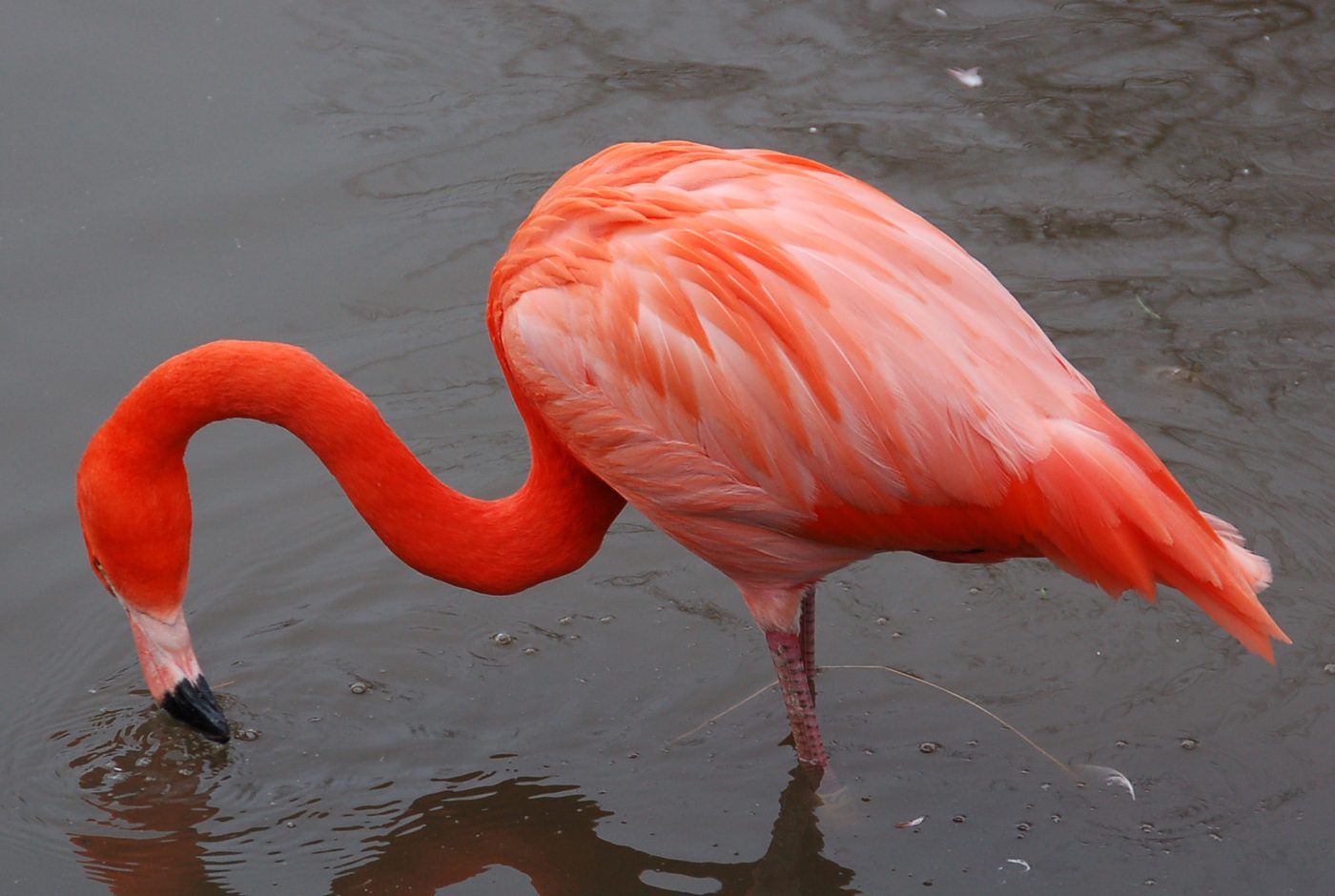
Photo: Adrian Pingstone (Arpingstone) · Public domain
American flamingo
Phoenicopterus ruber
The American flamingo is the reddest of all flamingos, an elegant wader of Caribbean salt lagoons with vivid pink plumage.
Characteristics
Temperament
Social, gregarious, lives in large colonies
Diet
Filter-feeder: crustaceans, algae and invertebrates
The reddest of the flamingos
The American flamingo, or Caribbean flamingo, is the most intensely coloured flamingo species: its plumage ranges from bright pink to red-orange, far more vivid than that of the European greater flamingo. It has the classic flamingo form: a long, sinuous neck, very tall webbed legs, and a distinctive downward-curved bill, pink with a black tip. It is the only flamingo that naturally lives in North America. (Note: the mass value reported by Wikidata, 142 kg, is clearly erroneous: this bird actually weighs about 2 to 3.5 kg.)
Habitat and range
It lives in the West Indies, along the coasts of the Yucatán Peninsula, in northern South America, in the far south of Florida and on the Galápagos Islands. It frequents coastal lagoons, salt pans and shallow salt lakes, where it finds abundant food.
Behaviour and diet
It is a social bird that lives in large colonies, sometimes of thousands of individuals. It feeds upside down, filtering water and mud with a bill specialised to trap small crustaceans, algae and invertebrates. It is precisely this diet, rich in carotenoid pigments from the shrimp it eats, that gives it its pink-red colour: without them the plumage would fade toward white.
Notable facts
Flamingos are serially monogamous: they form a new pair each breeding season. They nest on small mud mounds and feed their chicks a red "milk" produced in the crop. The famous group displays, in which hundreds of birds march and turn their necks in unison, serve to synchronise mating.
Conservation
The species is listed as Least Concern and remains widespread. It benefits from the protection of many wetlands, but locally it is affected by disturbance to colonies, pollution and the alteration of brackish habitats.
Pros
- The most intensely coloured flamingo
- Very long-lived, can exceed 40 years
- Spectacular group displays
Cons
- Sensitive to disturbance of colonies
- Depends on shallow brackish habitats