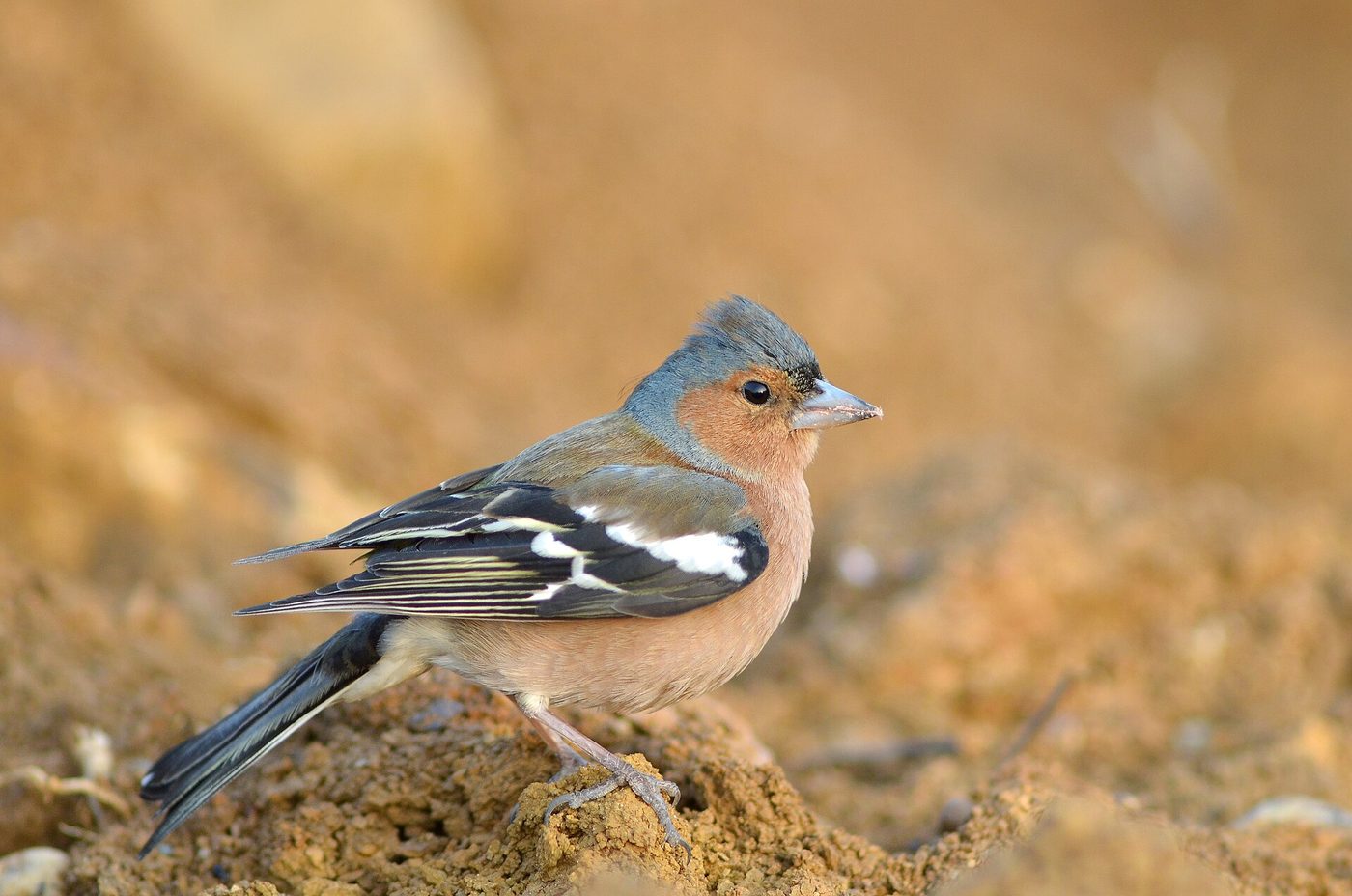
Common chaffinch
Fringilla coelebs
The chaffinch is one of Europe's commonest and most widespread birds: the male sports a bright plumage with blue-grey cap and rusty-red breast.
Characteristics
Temperament
Lively, tuneful, sociable in winter
Diet
Seeds and, in summer, insects for the young
Description
The chaffinch is a small passerine of the finch family, among the commonest and most widespread birds in Europe. It shows marked sexual dimorphism: the male has a blue-grey cap, warm pinkish-brick cheeks and breast and a brown back, while the female is plainer, in brownish-green tones. Both sexes show two clear white wing bars and white sides to the tail, well seen in flight.
Habitat and distribution
It occurs across almost all of Europe, in North Africa and western Asia as far as central Siberia. It frequents woods, parks, orchards, hedgerows and gardens. It is an adaptable bird, common in both countryside and urban areas, where it readily visits feeders in winter.
Behaviour and song
It feeds on seeds, gathered mainly on the ground, and in spring and summer on insects, important for feeding the young. The male has a loud, cheerful song, a rhythmic phrase repeated tirelessly from an exposed perch to mark territory and attract a mate. In winter it often gathers in flocks.
Did you know?
The scientific name coelebs means "bachelor": Linnaeus gave it because in some northern regions the females migrate further south in winter, leaving the males "bachelors". The chaffinch's song has genuine regional dialects.
Conservation
It is classed as least concern and is very abundant. It benefits from varied habitats with hedges and copses, while it can suffer locally from habitat loss and pesticide use.
(Note: the mass value given by Wikidata, 2.16 kg, is clearly wrong: the chaffinch actually weighs about 18–29 grams.)
Pros
- Very common and easy to observe
- Cheerful, melodious song
- Readily visits winter feeders
Cons
- Can suffer from loss of hedges and copses
- Sensitive to pesticide use
- Vulnerable to a viral disease of the legs