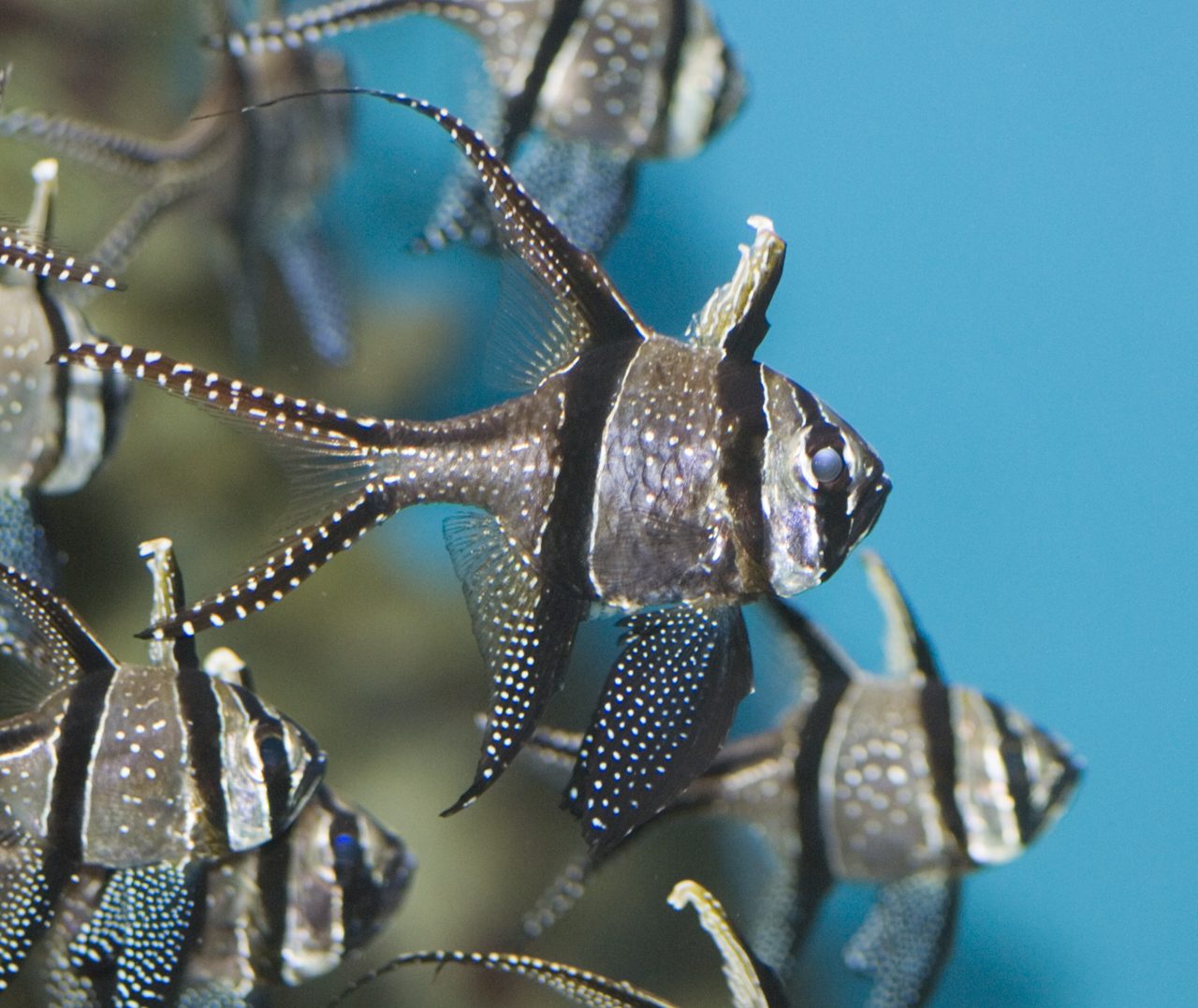
Photo: jon hanson from london, UK · CC BY-SA 2.0
Banggai cardinalfish
Pterapogon kauderni
The Banggai cardinalfish is an elegant silvery marine fish with black bars and white spots, famous for brooding its young in the mouth.
Characteristics
Temperament
Social, calm, sedentary
Diet
Small crustaceans, plankton and zooplankton
Description
The Banggai cardinalfish is a small marine fish with an elegant, unmistakable look. Its silvery body is crossed by three broad black vertical bars and dotted with bright white spots. Its broad, tapering fins and deeply forked tail give it a refined profile. It reaches about 8 centimetres and is the only species in its genus.
Habitat and distribution
It has an extremely restricted range: it lives only around the Banggai Islands, a small archipelago east of Sulawesi in Indonesia. It frequents the shallow, sheltered waters of lagoons, often associating with sea urchins, anemones and corals, among whose spines and tentacles it finds protection.
Behaviour and reproduction
It is known for extraordinary parental care: the male incubates the eggs, and then the newly hatched young, inside its own mouth for several weeks, without feeding. This form of reproduction produces well-developed young that do not go through a dispersive larval stage. This limits the species' ability to colonise new areas.
Aquarium care
It is much appreciated in marine aquariums for its elegant pattern and social behaviour. It is among the few marine fish regularly bred in captivity, which makes it a more sustainable choice than wild collection.
Conservation
It is classed as Endangered. Its tiny range, poorly dispersive reproduction, intensive collection for the aquarium trade and certain viral diseases have greatly reduced wild populations. Captive breeding is now essential to relieve pressure on the species.
Pros
- Elegant barred, spotted pattern
- Can be bred in captivity, a sustainable choice
- Extraordinary oral parental care
Cons
- Endangered species with a tiny range
- Poorly dispersive reproduction, slow to recolonise
- Wild populations threatened by collection