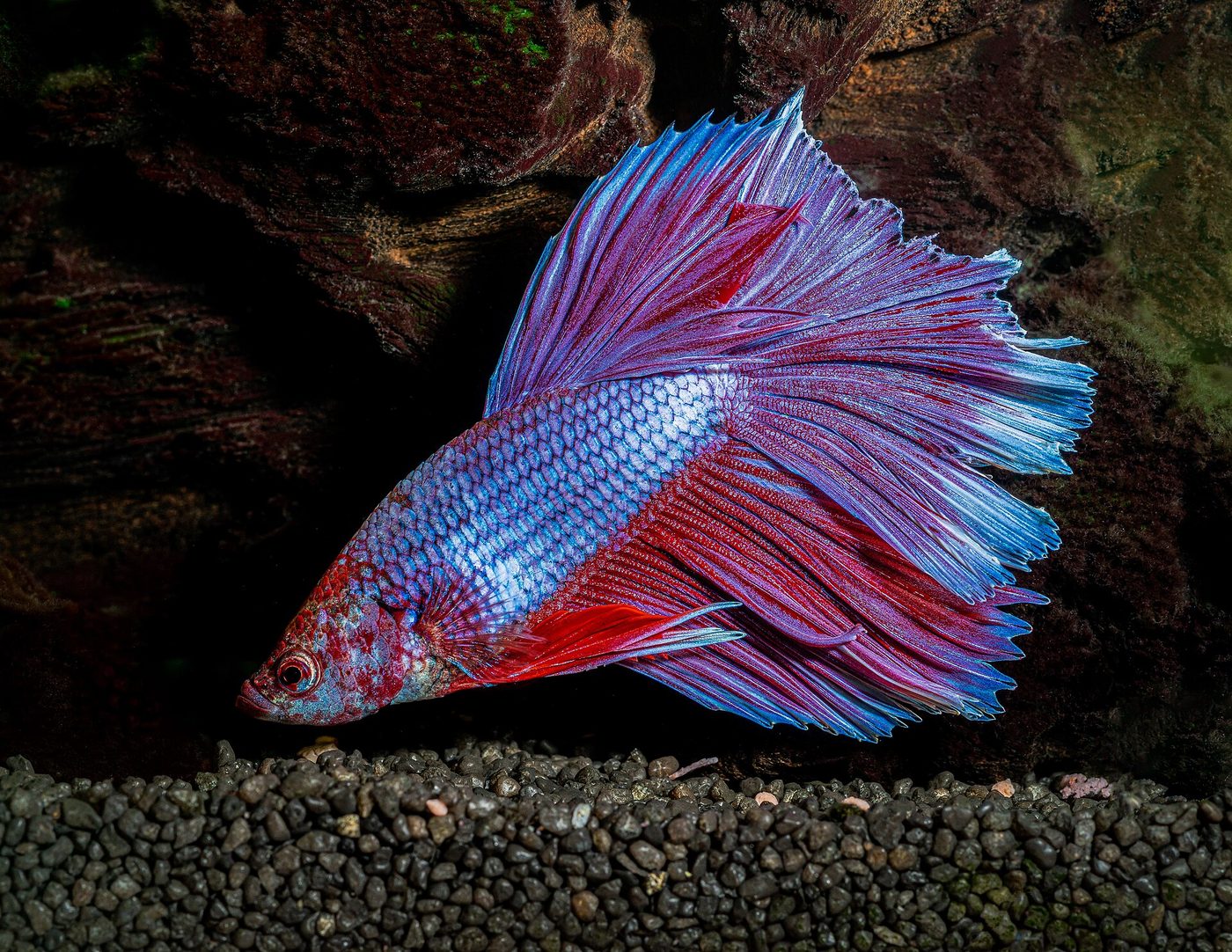
Photo: Henryk Niestrój · CC BY 4.0
Siamese fighting fish
Betta splendens
With its vivid colours and flowing fins, the Siamese fighting fish is one of the most beloved aquarium fish, famous for its beauty and its territorial nature.
Characteristics
Temperament
Territorial, males are aggressive towards each other
Diet
Carnivore: specific food, small invertebrates
A fish of extraordinary beauty
The Siamese fighting fish, or Betta, is one of the best-known and most appreciated aquarium fish in the world. It is a small fish, famous above all for the spectacular variety of colours and fin shapes selected in captivity: from intense red to blue, from purple to white, often with long, broad, flowing fins that give it an elegant and regal appearance. In the wild, the wild form is more sober, with less showy colours than the many captive-bred specimens.
Origin and habitat
Native to Southeast Asia, the fighting fish lives in the wild in warm, still, shallow waters: rice paddies, ponds, canals and marshes rich in vegetation. These environments are often poor in oxygen, and the fish has developed an extraordinary adaptation: a special organ, called the labyrinth, which allows it to breathe air directly from the surface, in addition to through its gills.
Behaviour and temperament
The name 'fighting fish' comes from the territorial behaviour of the males, which are very aggressive towards each other: two males placed in the same space tend to fight. For this reason, in the aquarium, males must be kept singly or with extreme care. The males also build curious 'bubble nests' on the water's surface, made of air bubbles and saliva, where they guard and protect the eggs.
Aquarium care
Despite its reputation as an 'easy' fish, the fighting fish has precise needs that must be respected. Contrary to an old cliché, it must not be kept in tiny bowls or jars: it needs an aquarium of adequate size, with warm water heated to a stable temperature, clean and with some plants and shelter. It should be fed with specific food and without excess. With the right care, it is a fascinating and long-lived companion.
Conservation
While the bred forms are extremely widespread, the wild species in nature is considered vulnerable, threatened by the loss and pollution of the wetlands where it lives. The contrast between its enormous spread in aquariums and the fragility of the wild populations is a reminder of the importance of protecting the natural habitats of origin.
Pros
- Colours and fins of extraordinary beauty
- Breathes air thanks to the labyrinth organ
- Fascinating and relatively long-lived
- Curious behaviours such as the bubble nest
Cons
- Males cannot cohabit: they are aggressive
- Must not be kept in bowls: a real heated aquarium is needed
- The wild species is vulnerable in nature