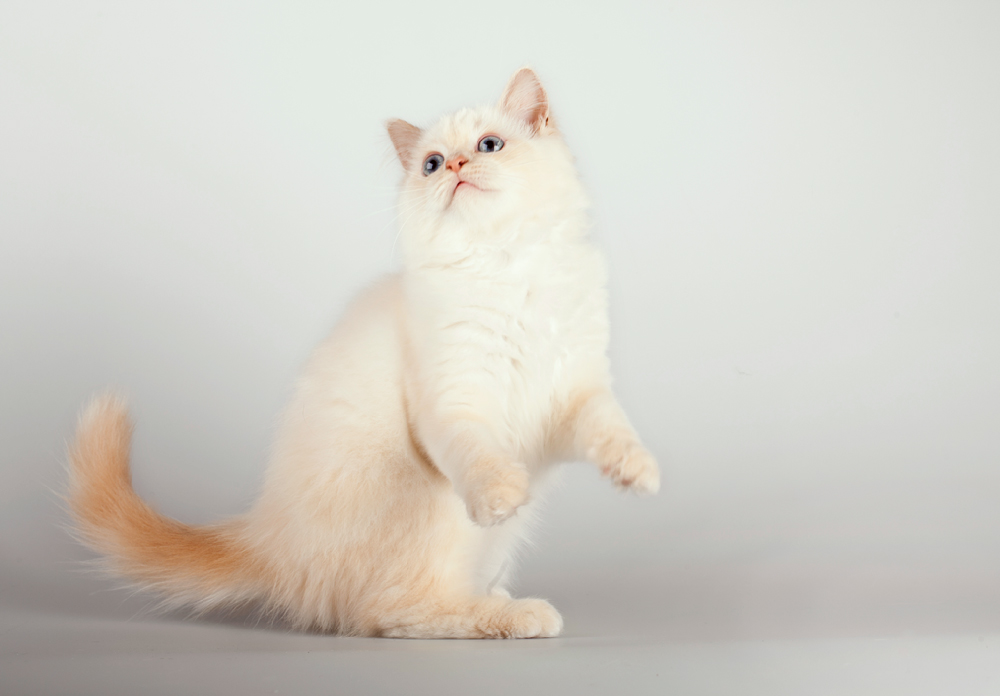
Birman
Felis catus
Characteristics
Temperament
Very sweet, affectionate, gentle, balanced. "Perfect cat" for personality. Sociable with everyone, follows the owner, loves to be picked up. Silent, rare and melodious meowing. Empathic towards humans.
Diet
Obligate carnivore, medium metabolism. 250-350 kcal/day in 2-3 meals. High-quality kibble (35-40% protein) or wet/BARF. Omega-3/6 supplements for shiny coat. Daily eye cleaning.
The Birman (Felis catus), also known as the Sacred Cat of Burma, is one of the most fascinating cat breeds in the world, wrapped in a legend of spiritual origin that links it to the Buddhist temples of Southeast Asia. Its unmistakable appearance — semi-long colourpoint coat, intense sapphire blue eyes, characteristic white "gloves" on the four paws — is the result of a combination of unique genetic traits that legend attributes to the divine blessing of a Burmese cat-goddess. With an extremely sweet, affectionate, balanced temperament, it is considered one of the "easiest" pedigree cats to manage and has spread globally since the 1920s. It should not be confused with the Burmese, a completely different breed even if the names can be misleading.
Classification and category
The Birman belongs to the species Felis catus, the domestic subspecies derived from the African wildcat (Felis silvestris lybica). It is classified by FIFe in Category II — Semi-longhair Cats (code SBI), by the British GCCF in Group 1 (Persian and Exotic), by TICA as Traditional. The standard provides for a medium-large size: weight 4-7 kg for males, 3-5 kg for females, withers height 28-32 cm. The structure is elegant but robust, with elongated body, straight back, solid but not massive bone structure. Physical maturity is reached late (3 years). The breed was officially recognised in France in 1925 (it is the first colourpoint breed recognised in Europe), by FIFe in 1959, by the British GCCF in 1966. There are variant subcategories based on colour: seal point (original), blue point, chocolate point, lilac point, red point, cream point, tortie point, tabby point (lynx point).
Habitat and distribution
The Birman is a completely domestic breed, perfectly adapted to apartment life. Its calm, social and human-dependent nature makes it ideal for urban families, even small ones, with children, elderly people and other animals. It is not a breed that lives well outdoors in freedom: it has excessive trust in strangers (theft/escape risk) and its light coat makes it poorly camouflaged. It suffers greatly from prolonged solitude (over 5-6 hours) and can develop compulsive behaviours (over-grooming, vocalisations).
The history of the breed is wrapped in a mystical legend that connects it to the Buddhist temples of ancient Burma (now Myanmar). According to tradition, over 2,000 years ago in the temple of Lao-Tsun, located on top of Mount Lugh, lived a group of kittah monks dedicated to the cult of the lion-goddess Tsun-Kyan-Kse. Each monk had a companion-cat with golden body and yellow eyes. When the head monk, Mun-Ha, was killed during an invasion by raiders, his cat Sinh jumped on his corpse to defend his spirit; at that moment the goddess Tsun-Kyan-Kse miraculously transformed Sinh: the eyes became sapphire blue like those of the goddess, the coat became golden like her body, while the paws remained pure white in contact with the dead master, symbol of purity. Sinh survived 7 days, then he too died, and all the other cats of the temple magically took on the same appearance. The breed was introduced in Europe in 1919, according to legend gifted to two French explorers (Auguste Pavie and Major Gordon Russell) in gratitude after they had saved the temple of Lao-Tsun from another attack. Historical reality is less romantic: it is thought that the breed derives from crossbreedings between Siamese and Persians that took place in France in the 1920s. Today it is widespread globally, with concentrations in France (country of "re-creation"), Germany, Italy, Britain, USA. The average price of a pedigree FIFe kitten is 800-1,500 euros; show line specimens 2,000-3,500 euros.
Diet
The Birman is an obligate carnivore with medium metabolism and low tendency to obesity (compared to Persian and British Shorthair). The daily caloric requirement of an adult is 250-350 kcal, distributed in 2-3 small meals. The ideal diet consists of high-quality kibble rich in animal protein (35-40%), or wet feeding (cans) or BARF under veterinary supervision. The semi-long hair requires omega-3 and omega-6 supplements to maintain shine.
The breed is generally robust, with few specific genetic predispositions, but some pathologies are present: hypertrophic cardiomyopathy (HCM) (DNA test available), hip dysplasia rare but documented, hypocalcaemic tissue congestion of kittens (rare). Annual cardio screening from 3 years onwards is recommended. The eye cleaning requires daily attention: tear secretions are frequent and tend to stain the white hair of the muzzle (dry with cotton-bud moistened in warm water). Water must always be available, fresh. Portions must be controlled after sterilisation (30% metabolism drop).
Physical features
The Birman has an elegant, semi-massive, well-proportioned body. The head has a rounded triangular shape with slightly bulging forehead, full cheeks, strong chin. The ears are medium, wide at the base, spaced, with slightly rounded tips. The eyes are the most iconic trait: large, slightly oval, of intense sapphire blue colour (darker in seal points, lighter in blue points and lilac points). The eye colour does not fade with age (distinctive trait compared to other colourpoints).
The coat is the most distinctive feature: semi-long hair (4-6 cm), silky, dense, with abundant undercoat that gives it feathery consistency. The base body colour is light (cream, beige, magnolia), with darker "points" on muzzle, ears, paws and tail: seal points (original, similar to Siamese seal) are the most common, but there are also blue, chocolate, lilac, red, cream, tortie and tabby points. The unique and diagnostic characteristic of the breed are the "white gloves" on the four paws: the front paws have white up to the wrist (glove shape), the back paws have white that rises along the back of the foot up to mid-tibia (shape of "laces" or "spur"). The gloves must be symmetrical and well defined: rigorous standards exclude from reproduction specimens with asymmetrical or excessively extended gloves. The tail is medium length, well-haired, brush-like. The legs are medium length, robust. Birman kittens are born completely white; the points and gloves develop gradually in the first weeks and complete the definitive pattern at 2 years.
Behaviour and curiosities
The Birman has a balanced, very sweet, gentle temperament. It is often described as "the perfect cat" for personality: affectionate without being intrusive, playful without being destructive, silent with rare and melodious meowing. It bonds deeply with the owner, follows everywhere, loves to be cuddled and held in arms (unlike British Shorthair or Norwegian who prefer autonomy). It is social with everyone: children, elderly people, other cats, calm dogs. It is not territorial or aggressive.
Intelligence is high: it easily understands domestic routines, can learn simple tricks, recognises its own name and that of family members. The breed is considered particularly "empathic": it perceives human moods and tries to comfort stressed family members. The literary history is rich: in the novel "Tao" by David Wisniewski, a Birman is the protagonist; the famous "Cat in the Hat" by Dr. Seuss has been indirectly inspired by a Birman, and numerous celebrities (Elton John, Cameron Diaz, Carl Reiner) have had Birmans as companions. Health and historical curiosities: during World War II, the breed was brought close to extinction (only two specimens survived in Europe: the male "Orloff" and the female "Xenia de Kaabaa"). All modern Birmans descend from these two specimens, with introgressed Persian and Siamese blood to recover genetic diversity. The breed has an excellent longevity: 12-16 years on average, with well-cared specimens reaching 18-20 years. The semi-long coat does not knot like that of Persian, but still requires weekly brushing (intensified in spring for moulting) and occasional baths (4-6 per year).
Pros
- Carattere dolcissimo, ideale per famiglie con bambini
- Occhi azzurro zaffiro mantengono il colore con l'età
- Leggenda spirituale buddista, simbolo di purezza
- Salute robusta, longevità 12-16 anni (18-20 max)
Cons
- Predisposto a HCM (cardiomiopatia ipertrofica) - test DNA consigliato
- Secrezioni lacrimali frequenti che macchiano il pelo bianco
- Manto semilungo richiede spazzolatura settimanale
- Soffre molto la solitudine prolungata