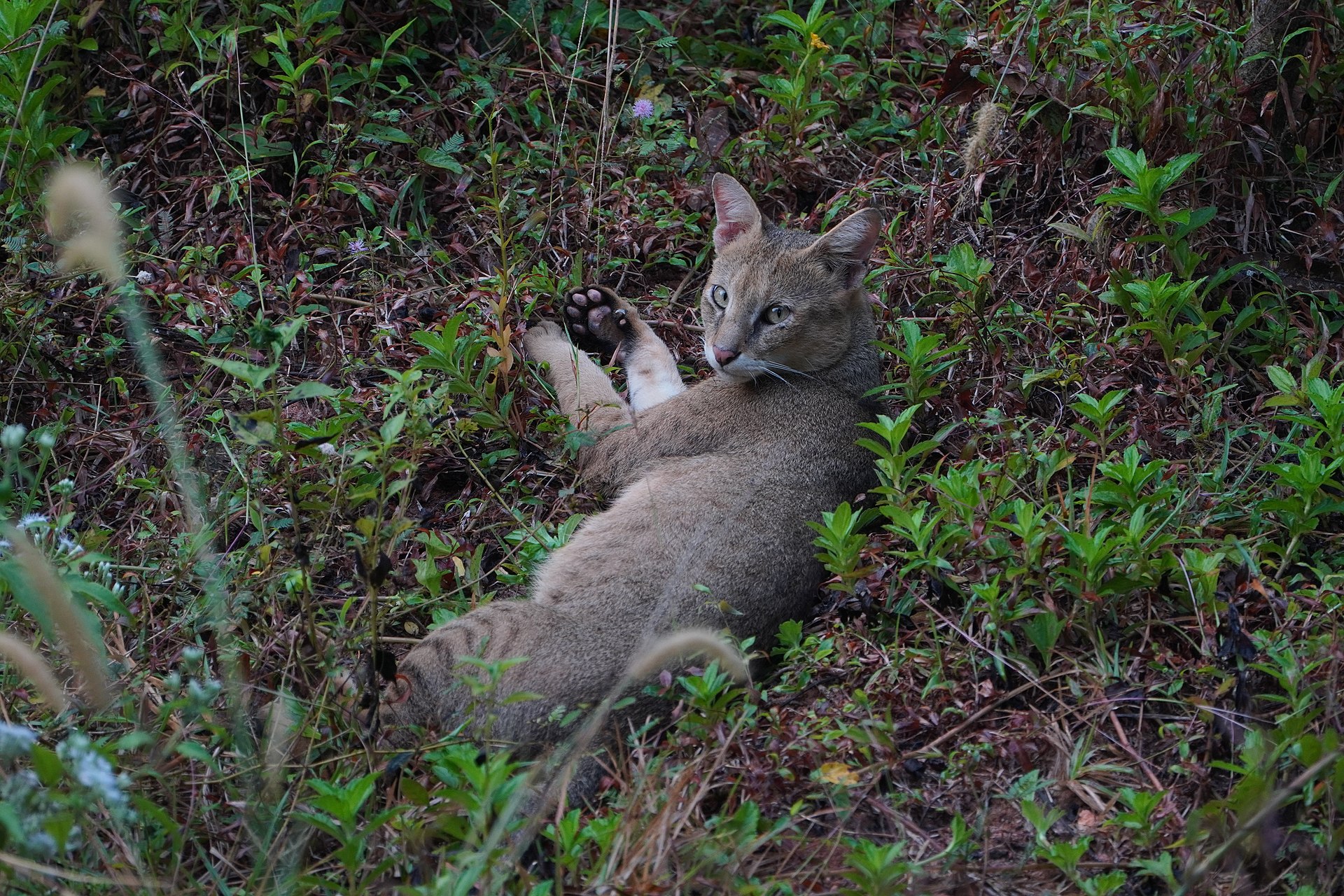
Jungle Cat
Felis chaus
Characteristics
Temperament
A solitary, territorial wild feline, agile and versatile, of a shy disposition towards humans but — unlike many cats — often active by day too. An energetic, tireless hunter, it is a good swimmer able to fish and a skilful jumper. It frequents the edges of human areas (rice paddies, fields, villages), drawn by prey. It is NOT a pet: it is a medium-sized wild cat, to be observed and safeguarded in its wetland environments. Although it is behind the rare hybrid breed Chausie, it remains in itself a fully wild predator.
Diet
An agile, opportunistic predatory carnivore. It feeds above all on rodents (the basis of its diet, of which it catches large quantities), as well as birds (caught even with leaps into the air), fish and frogs (caught near or in the water), reptiles, hares and other prey. It hunts by ambush in the reedbeds, swims and can even dive to fish, and jumps high with agility to grab birds. Although tied to wetlands, it is above all a great devourer of rodents, and in agricultural areas it plays a useful mouse-control role.
The Jungle Cat (Felis chaus), also called the reed cat or swamp cat, is a fascinating wild feline with a misleading name. Famous for:
- The misleading name: despite being called "jungle cat", it does NOT live in the jungle, but in marshes, reedbeds and open wetland environments
- Being the largest of the "Felis": it is the largest species of the genus Felis, the same as the domestic cat
- The rangy look: a lean body, long legs and a tawny-greyish, almost unmarked coat
- The tufted ears: often adorned with small dark tufts on the tips, recalling a miniature lynx
- Aquatic skills: it is a good swimmer and hunter near water, where it can fish
- The link with ancient Egypt: it was known and sometimes mummified along the Nile
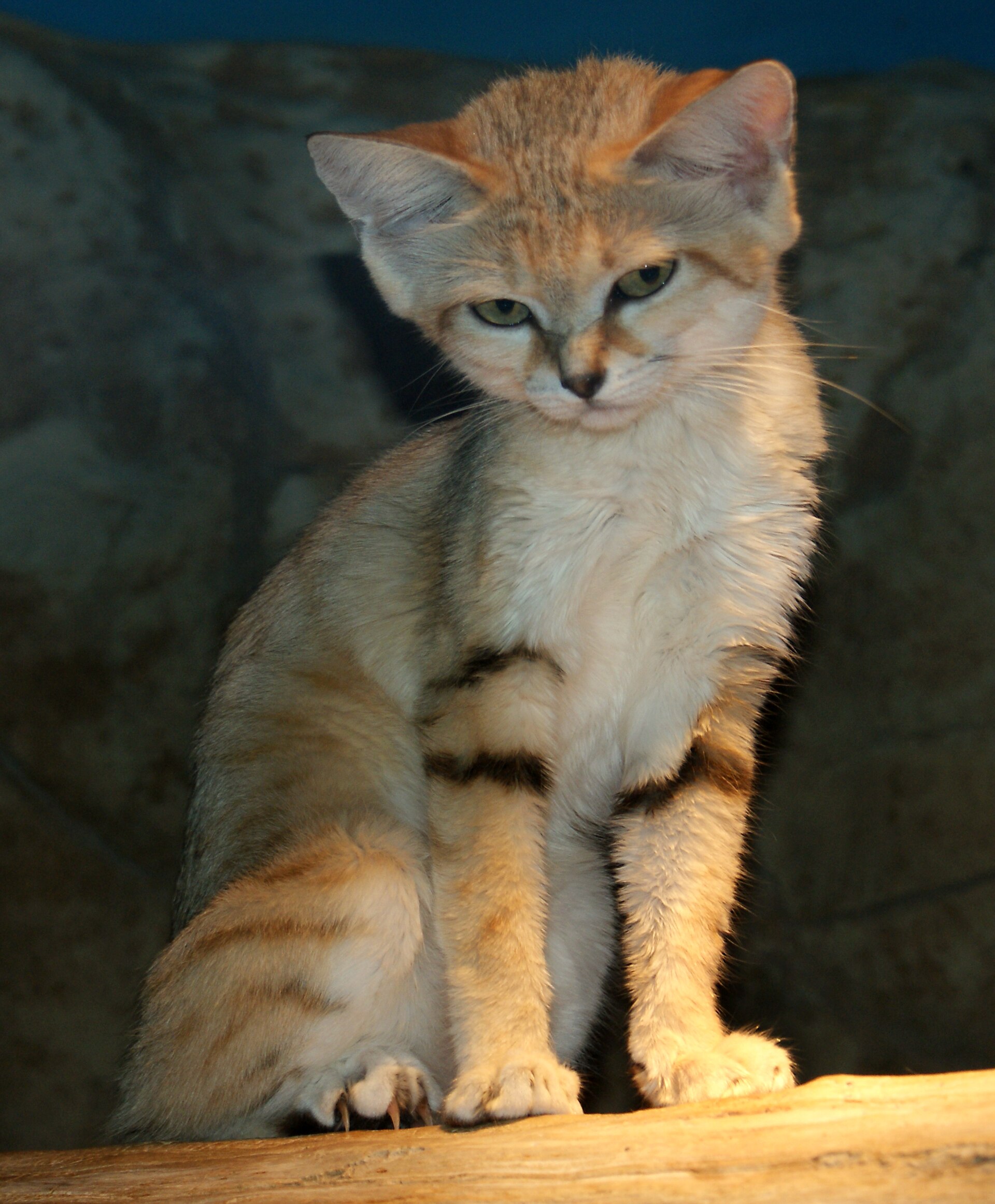
IUCN status: Least Concern (LC), but in decline in many areas. It joins the many wild felines of the portal, alongside the European Wildcat and the Sand Cat (also of the genus Felis): among these "close cousins" of the house cat, the Jungle Cat is the largest and the one tied to wetlands.
Classification and category
Order Carnivora, family Felidae (the felines), genus Felis — the same as the domestic cat (Felis catus), the European wildcat (Felis silvestris) and the sand cat (Felis margarita), all present or represented in the portal. Among the species of the genus Felis, it is the largest. In the portal it is placed among the Wild felines. Some comparisons help to place it: it is much larger than the domestic cat and the sand cat, with longer legs and a more "rangy" look; the small tufted ears may suggest a lynx or a caracal, but the Jungle Cat is smaller and belongs to another genus; unlike many small cats, it has an almost uniform coat, without conspicuous spots or stripes. Etymology: the scientific name "chaus" comes from a Greek/Latin word for this cat; the common name "jungle cat" is actually misleading: the alternative names "reed cat" or "swamp cat" describe its true environments much better. Parameters: Head-body length about 50-75 cm, plus a relatively short tail. Weight about 5-12 kg (decidedly larger than a domestic cat). Appearance tall on the legs, rangy and muscular. Longevity: not fully known in the wild, but in captivity it can reach and exceed 15 years. Reproduction: the female usually gives birth to 2-5 kittens, raised in a shelter hidden among the vegetation.
Habitat and distribution
The Jungle Cat is the wild feline with the widest distribution of the genus Felis: from Egypt and the Middle East through the Caucasus, central and southern Asia to Southeast Asia. Preferred habitats — contrary to what the name suggests, wet and open environments: marshes, reedbeds, wetlands and the banks of rivers, lakes and ponds; grasslands, scrub and brush near water; and farmland, including rice paddies and cane fields, where it hunts rodents. It is an animal tied to water and to dense, low vegetation (reeds, rushes), much more than to forest. It is mainly diurnal and crepuscular, unlike many nocturnal cats, and is an excellent swimmer. Its adaptability leads it to frequent human-modified environments such as cultivated fields and rice paddies. However, the destruction of wetlands, persecution and hybridization with domestic cats threaten many populations. IUCN: Least Concern globally, but in decline in numerous regions, mainly due to the loss of wetland habitats and conflicts with humans.
Diet
The Jungle Cat is an agile, versatile predatory carnivore. It eats: rodents (the basis of its diet, of which it catches large quantities — it is a useful controller of mice and rats); birds, caught even with leaps into the air; fish and frogs, taken near or in the water; and reptiles, hares and other prey of suitable size. Hunting strategies: ambush in the reedbeds (it uses the dense marsh vegetation to approach prey); hunting in water (it swims and can even dive to catch fish, a rare skill among cats); and the aerial leap (it jumps high with great agility to grab low-flying birds). Crucially, although tied to wetlands, the Jungle Cat is above all a great devourer of rodents, and for this reason in agricultural areas it plays a useful pest-control role. Its versatility — hunting on land, in water and in the air — makes it one of the most adaptable small cats.
Physical features
A feline of rangy, long-legged, sober-coloured appearance. Coat and colouring: relatively short fur, tawny-sandy, greyish or reddish-brown in colour, fairly uniform; markings almost absent on the body, but often dark rings on the legs and tail, and a dark tail tip; in some areas there are also melanistic (black) individuals. The head and ears: a relatively small head compared with the body; large, tall, close-set ears, often adorned with small dark tufts on the tips (like a miniature lynx). The body: a lean, muscular body with long legs; a relatively short tail compared with that of other cats. Performance: an excellent swimmer, able even to dive; great agility in leaping, useful for catching birds; and speed and stamina in running, as a hunter of open environments.
Behaviour and curiosities
The Jungle Cat is a solitary, territorial animal, but, unlike many felines, it is often active by day too. It is an energetic, tireless hunter, of a shy disposition towards humans. It habitually frequents the edges of human areas (rice paddies, fields, villages), where it can come into conflict with people but where it also finds abundant prey.
The wrong name: the "jungle cat" is one of the most misleadingly named felines; despite the appellation, this cat is NOT an inhabitant of dense rainforests, but prefers entirely different environments: marshes, reedbeds, banks and wet grasslands; this is why the alternative names "reed cat" and "swamp cat" are much more apt and faithfully describe its habitats. The giant among the Felis: although a "small cat", the Jungle Cat is actually the largest representative of the genus Felis, the one that includes our domestic cat, the European wildcat and the sand cat; with its 5-12 kg and long legs, it clearly exceeds its better-known cousins in size, while remaining much smaller than big cats like lions and tigers. The cat that fishes: contrary to the reputation of cats as animals that hate water, the Jungle Cat is a skilled swimmer and does not hesitate to enter water to hunt; it can catch fish and, according to some observations, even dive to chase them; this aquatic aptitude is tied to its life in wetlands and links it to other "fishing" felines. The fake-lynx ears: the small dark tufts on the tips of the Jungle Cat's ears can be deceptive, making it resemble a small lynx or a caracal; in reality it is not closely related to these tufted-eared felines: it is a superficial resemblance; the tufts, however, add to its elegant, "wild" look. The pharaohs' cat: the Jungle Cat is one of the felines that lived along the Nile in ancient Egypt; it was known to the Egyptians and, like other cats, was sometimes mummified; according to some hypotheses it may have been partly tamed or used for fowling in the reedbeds; although not the main ancestor of the domestic cat (which descends mainly from the African wildcat), it was part of the rich feline world of the Nile valley. The "parent" of the Chausie: the Jungle Cat is behind a rare domestic cat breed, the Chausie, obtained by crossing it with the house cat to create a domestic feline with a "wild", long-legged, athletic look; it is a case analogous to that of the leopard cat for the Bengal or the serval for the Savannah; the Jungle Cat itself, however, remains a fully wild animal.
Pros
- Affascinante e poco noto: il più grande gatto selvatico del genere Felis
- Versatile e adattabile: caccia a terra, in acqua (sa pescare) e in aria
- Utile predatore di roditori nelle zone umide e agricole
- Legato all'antico Egitto; IUCN Least Concern (ancora relativamente diffuso)
Cons
- NON è un animale domestico: è un gatto selvatico di taglia media
- In declino per la distruzione delle zone umide e i conflitti con l'uomo
- Minacciato dall'ibridazione con i gatti domestici (perdita di purezza genetica)
- Nome fuorviante: spesso frainteso come animale "da giungla" o esotico da tenere