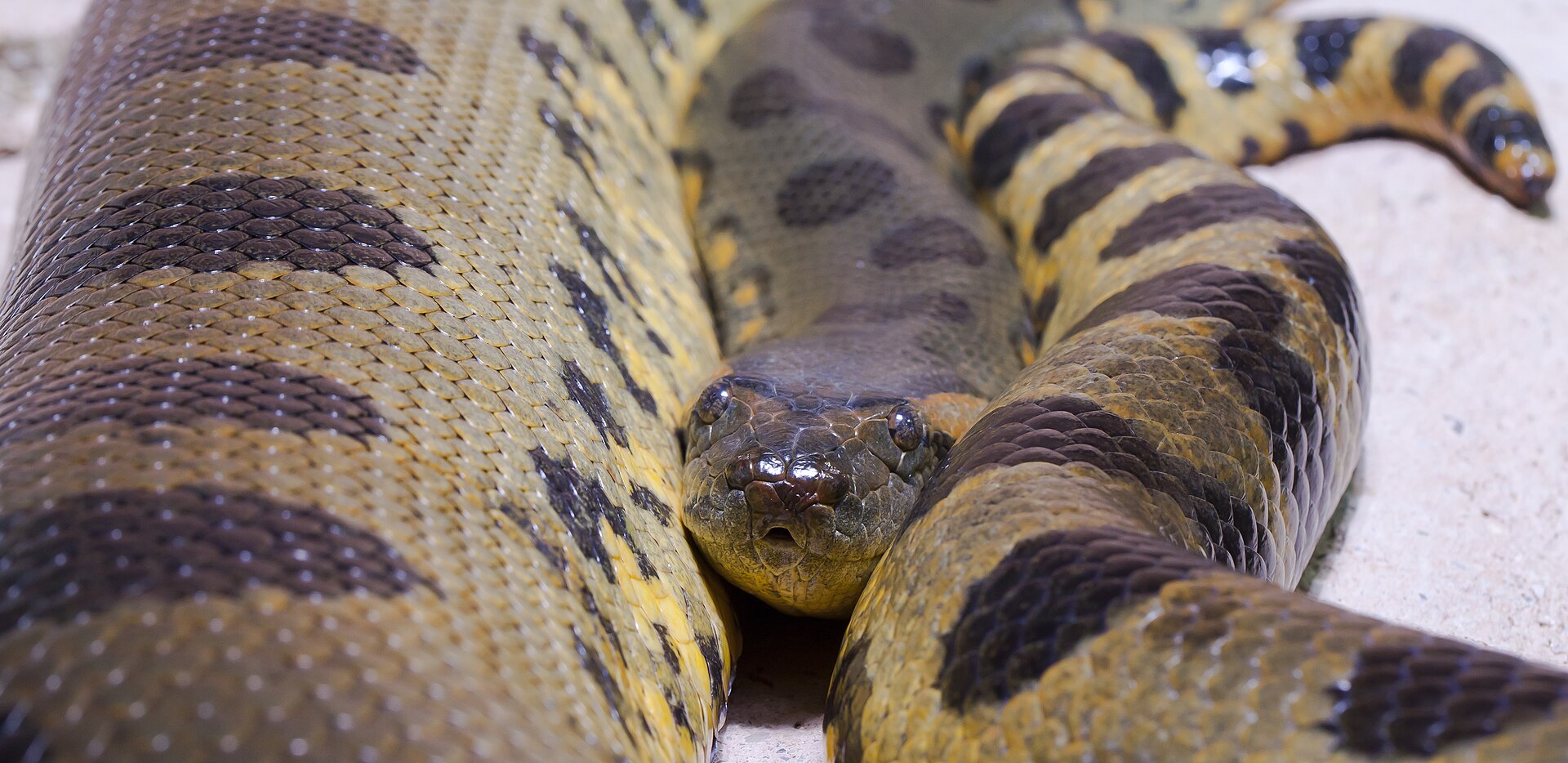
Green Anaconda
Eunectes murinus
Characteristics
Temperament
Solitary, semi-aquatic, crepuscular-nocturnal. Non-venomous constrictor. Extreme dimorphism: females 5x heavier than males. Ovoviviparous, gives birth to 20-40 live young. "Breeding ball" mating ritual.
Diet
Apex predator carnivore: fish, caimans, capybaras, tapirs, deer, birds, occasionally small jaguars. Kills by constriction and swallows whole. A large prey satiates for one year.
The Green Anaconda (Eunectes murinus) is the heaviest snake in the world and one of the longest, second only to the Reticulated Python. A non-venomous constrictor, it is a semi-aquatic predator of the swamps and tropical rivers of South America. Sexual dimorphism is extraordinary: females weigh on average five times more than males and can exceed 200 kg in record specimens. The stuff of films and Amazonian legends, it is in reality a shy animal, rarely observed, and of fundamental ecological interest as the apex predator of Neotropical aquatic ecosystems.
Classification and category
The Green Anaconda belongs to the order Squamata, suborder Serpentes, family Boidae (boas). The genus Eunectes comprises four living anaconda species: the Green Anaconda, the Yellow Anaconda (E. notaeus), the Dark-Spotted Anaconda (E. deschauenseei) and the recent E. akayima, described in 2024. The Green is by far the largest: average length of adult females is 4-6 m, with documented specimens up to 9 m. Weight ranges from 30 to 70 kg in females, up to over 200 kg in record specimens; males are much smaller (3 m and 30 kg on average). It is not a venomous snake: it kills prey by constriction, suffocating them with the coils of its body before swallowing them whole.
Habitat and distribution
The Green Anaconda's natural habitat consists of swamps, lagoons, slow-flowing rivers, river basins and flooded forests of tropical South America. It is a strictly semi-aquatic species: it spends most of its time submerged, with only eyes and nostrils above water, in ambush to hunt. On land it moves with difficulty due to its body mass, but in water it is agile and powerful, capable of swimming for kilometres.
The range covers the Orinoco and Amazon basins: Venezuela, Colombia, Ecuador, Peru, Bolivia, Brazil, Guyana, Suriname, French Guiana and Trinidad. Conservation status is listed as Least Concern (LC) by the IUCN, with stable populations in remote areas but in decline where poaching for skin, illegal trade of juveniles and destruction of wetlands are intense. The species is included in CITES Appendix II.
Diet
The Green Anaconda is a generalist carnivore and apex predator. The diet varies enormously based on size: juveniles feed on fish, amphibians, small birds and rodents, while adults can catch large prey — caimans, capybaras, young tapirs, deer, turtles, waterbirds and occasionally even small jaguars. Its hunting technique is typical of boas: ambush in water followed by a lightning-fast attack, immobilisation with the coils and whole ingestion.
A large prey item (50-70 kg) can satiate an anaconda for up to one year: the metabolism is extraordinarily efficient and the animal can survive long fasting periods between meals. Digestion of a large prey takes 2-3 weeks, during which the snake remains inactive in quiet, sun-warmed areas. The jaws do not "unhinge" as commonly believed: the quadrate bones are mobile joints that allow extreme mouth opening without dislocation.
Physical features
The Green Anaconda has a cylindrical, massive body, disproportionate compared to its relatively small head. The colouration is olive green on the back, with dark black-brown oval spots arranged in two alternating rows; the belly is yellowish with darker spots. This pattern is perfect for camouflage in murky water and among swamp vegetation. The eyes and nostrils are positioned on the upper part of the head, a typical adaptation to semi-aquatic life that allows it to remain almost completely submerged while still breathing and observing the surroundings.
The skin is covered with small, smooth scales, waterproof and suited for gliding in water. The tongue is forked and is flicked outside the mouth to "smell" the environment through the Jacobson's organ. It has heat-sensing pits on the upper jaw, although less developed than those of pythons. Among the lesser-known features, it retains remnants of a pelvic girdle and vestigial femurs (the "anal spurs" visible near the cloaca), a legacy of the evolution of snakes from legged ancestors.
Behaviour and curiosities
The Green Anaconda is a solitary, crepuscular-nocturnal and shy species. Females live in areas with territories not strictly defended; encounters between adults are rare except in the breeding season. Between April and May, coinciding with the end of the dry season, the famous phenomenon of the "breeding ball" occurs: up to 12 males wrap around a single female in an intricate clump that can last 2-4 weeks, during which the males compete for fertilisation.
The Green Anaconda is ovoviviparous: embryos develop inside eggs retained in the maternal body and are born fully formed. The female generally gives birth to 20-40 young (documented record 82), each 70-80 cm long. Newborns are completely self-sufficient and independent immediately. The phenomenon of facultative parthenogenesis has also been documented in captivity: some females have produced viable young without mating. Lifespan is 10 years in the wild, up to 30-40 in captivity. Despite the legends, attacks on humans are extremely rare and almost always linked to capture attempts: the Green Anaconda does not consider humans natural prey.
Pros
- Specie iconica della fauna amazzonica
- Predatore apicale dei sistemi acquatici neotropicali
- Longeva (fino a 40 anni in cattività)
- Fenomeni biologici unici (breeding ball, partenogenesi)
Cons
- Specie selvatica, NON è un animale da compagnia per non esperti
- Richiede vasche ENORMI in cattività (200+ litri)
- Dieta a base di prede grosse (problemi etici)
- Minacciata da bracconaggio per la pelle