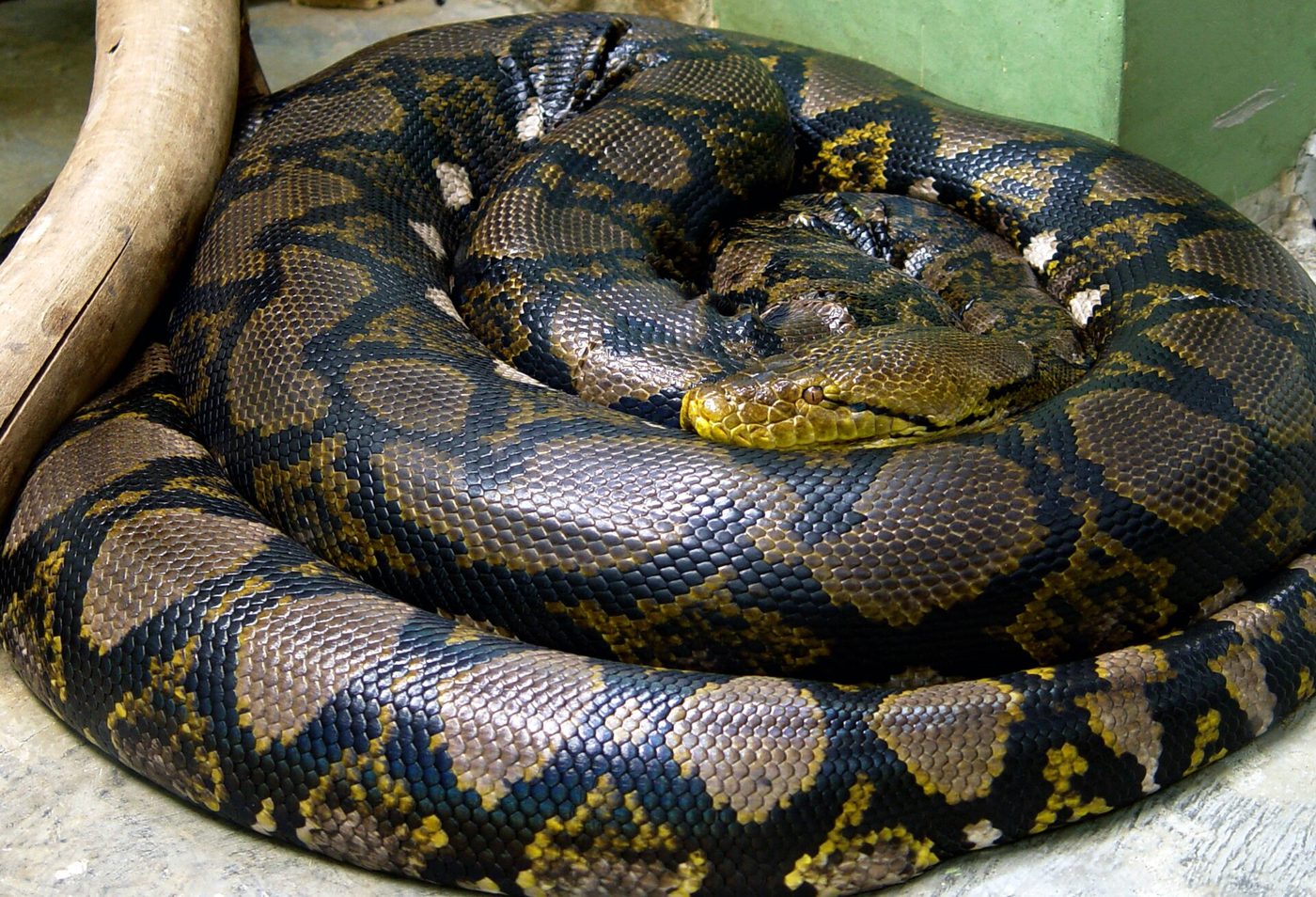
Reticulated python
Python reticulatus
The reticulated python is the world's longest snake: a giant of Southeast Asia with a net-like skin pattern, an excellent swimmer and constrictor.
Characteristics
Temperament
Nocturnal, solitary and ambush-hunting; a great swimmer; non-venomous.
Diet
Carnivorous: mammals and birds, even large ones, killed by constriction.
The world's longest snake
The reticulated python (Malayopython reticulatus, formerly Python reticulatus) is the longest snake on the planet: the largest individuals exceed 6–7 metres in length. It is also one of the heaviest, third after the green anaconda and the Burmese python. Its name comes from the distinctive skin pattern: a dense network of dark diamonds edged with pale lines, creating a geometric "reticulated" design that gives excellent camouflage among leaves and shadows. It is non-venomous, killing its prey by constriction, wrapping it in its coils.
Habitat and range
It lives in South and Southeast Asia, from humid rainforests to swamps. It is a highly adaptable species, able to colonise farmland and areas near human settlements too. It is an excellent swimmer and has reached many small islands, even venturing out to sea.
Behaviour and diet
It is a nocturnal ambush predator: it waits motionless and seizes mammals and birds, from rodents up to large prey such as deer or pigs, which it constricts and then swallows whole. Thanks to highly extensible jaws it can swallow animals wider than its own head.
Did you know?
Because of its size, in rare well-documented cases it has attacked and killed humans, especially in Indonesia. It is also one of the most economically important reptiles, hunted for its skin, for traditional medicine and for the pet trade.
Conservation
The IUCN lists it as Least Concern thanks to its wide distribution and adaptability. Intensive hunting for its skin is nonetheless a pressure to watch in some areas.
Pros
- The world's longest snake
- Striking, camouflaging reticulated pattern
- Adaptable, an excellent swimmer
Cons
- Very large and powerful: dangerous to handle
- Intensively hunted for its skin
- Not suited to keeping without great experience