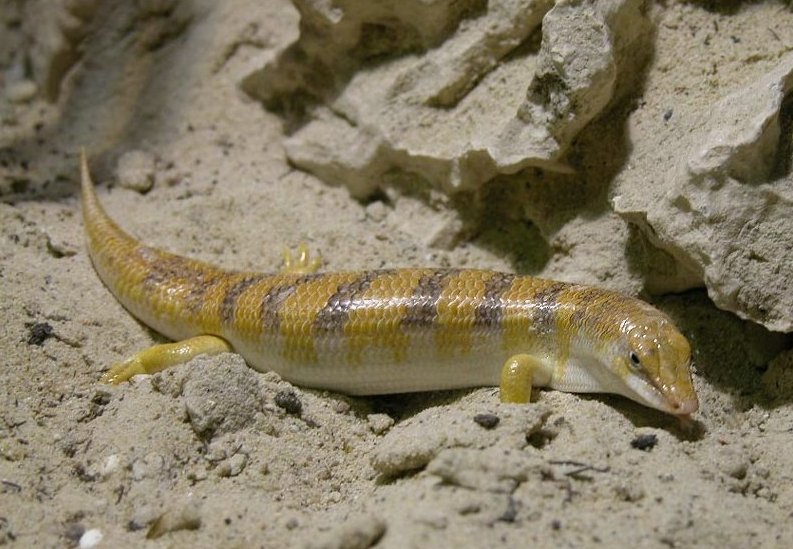
Sandfish Skink
Scincus scincus
Characteristics
Temperament
Diurnal, solitary, fossorial. Desert lizard (Sahara, Arabia) sharing the range of Jerboa, Sandgrouse and Sand Cat. "SWIMS" IN THE SAND: moves below the surface with a fish-like lateral undulation (hence "sandfish"). Dives into sand to escape heat and predators. Detects prey by vibrations while buried. Shovel snout, countersunk jaw, fringed toes. Studied by physicists for its locomotion. Contrast with the Jerboa: it hops ON, the Sandfish swims IN.
Diet
Desert insectivore. Beetles and larvae (main), ants, termites, caterpillars, other invertebrates (spiders, arthropods), occasional plant matter. Ambush hunting below the sand: detects vibrations of a surface insect (seismic sense) and bursts out in a lightning strike. Can also hunt actively on the surface by day, diving at any danger.
The Sandfish (Scincus scincus) is a small desert lizard iconic of Old World deserts (Sahara, Arabia, Middle East). Famous for:
- "SWIMS" THROUGH THE SAND! It moves beneath the sandy surface with a lateral undulating motion identical to a fish — hence the name "sandfish". It doesn't dig: it literally swims through the sand!
- Same desert as the Jerboa, Sandgrouse and Sand Cat (all in catalogue) — Sahara and Arabia
- Locomotion contrast: the Jerboa hops ON the sand, the Sandfish swims INSIDE the sand
- Detects prey by vibrations: senses insects walking on the surface while buried below
- Dives to escape extreme heat and predators (vanishes into sand instantly)
- Wedge-shaped snout: shovel-like, to penetrate the sand
- Studied by physicists: its sand locomotion inspired robotics and X-ray research
IUCN status: Least Concern (LC). Common, widespread across North African and Arabian deserts. Popular in terrariums. CLOSES THE MILESTONE: with the Sandfish the Animalia catalogue reaches 29 species in each of the 5 categories — 145 animals in perfect symmetry.
Classification and category
Order Squamata (lizards and snakes), family Scincidae (skinks), genus Scincus. Skinks are one of the largest lizard families (1,500+ species), with cylindrical bodies, smooth overlapping scales, often reduced limbs. Genus Scincus: a few desert "sand-swimming" skinks (S. scincus this entry, S. mitranus, S. albifasciatus, etc.). Etymology: "Scincus" from Greek "skinkos" (ancient name of these lizards); doubled name because it is the type species. "Sandfish" describes its fish-like movement through sand. Parameters: Length 13-20 cm (with tail). Weight 20-40 g. Cylindrical streamlined body. Longevity 5-8 years. Oviparous (lays eggs, unlike many live-bearing skinks), eggs buried in slightly moist sub-surface sand, self-sufficient hatchlings.
Habitat and distribution
Sandy Old World deserts: North Africa (Sahara — Morocco to Egypt), Arabian Peninsula (Saudi Arabia, Kuwait, UAE, Yemen, Oman), Middle East (Jordan, Iraq, SW Iran). Habitats: sand dunes (essential — can only "swim" in loose sand), ergs (Sahara sand seas), sandy deserts with sparse vegetation. Avoids rocky/compact ground, wet/hard sand, wetlands. Spends much of its time buried below the surface (stable temperature, predator protection); emerges to bask and hunt, dives instantly at any danger or excess heat. Sand serves as refuge, hideout and thermostat. IUCN: Least Concern, stable.
Diet
Mainly insectivore. Diet: beetles and larvae (main), ants/termites, caterpillars/larvae, other invertebrates (spiders, small arthropods), occasional plant matter (minor). Hunting technique: lies in ambush just below the sand, detects vibrations of an insect walking on the surface (a "seismic" sense), bursts out to catch prey; can also hunt actively running on the surface by day, diving at any danger. Detecting prey by vibration while buried is a remarkable sensory adaptation — the Sandfish "listens" to the desert through the sand.
Physical features
A body perfectly engineered for sand life. Body and scales: cylindrical, streamlined ("sand-dynamic"); smooth glossy overlapping scales (engineered-grade smoothness to reduce friction with sand grains, studied by engineers); sandy-golden/ochre with darker cross-bands (desert camouflage), pale belly. Head (specialized to penetrate sand): wedge/shovel-shaped snout (cuts the sand like a ship's bow); COUNTERSUNK lower jaw (recesses under upper jaw, keeping sand out of the mouth while "swimming"); small eyes with protective lids; protected nostrils and ears. Legs: short but sturdy (for the initial "dive"), fringed toes (fringe edges act like little snowshoes/fins on loose sand); during "swimming" the legs fold against the body and locomotion is by undulation alone. Physiology: fish-like lateral undulation through sand, thermoregulation by submerging, seismic sense, vanishes into sand in a fraction of a second.
Behaviour and curiosities
Diurnal, solitary, fossorial (largely lives under the sand). Buried at night and in the hottest hours, emerges to bask and hunt; shy and lightning-fast to dive at any danger. Oviparous (unlike many live-bearing skinks): female lays small eggs buried in slightly moist sub-surface sand; hatchlings self-sufficient and able to "swim" in sand.
Famous: "sand swimming" — the Sandfish's superpower. Unlike tunnel-diggers (e.g. the Jerboa, in catalogue), it builds no tunnels: it dives in and moves through loose sand with a lateral undulation identical to a fish in water, folding its legs and undulating among grains that behave almost like a fluid. "Sandfish science": studied with high-speed X-rays, revealing optimal undulation frequency; smooth-scale microstructure reduces friction; inspired robots that move through granular media (search and rescue). "Contrast with the Jerboa": same Sahara, opposite sand solutions (Jerboa hops ON, Sandfish swims IN). With Sand Cat (furry paws) and Sandgrouse (feathered legs), a quartet of convergent sand adaptations. "Seismic sense": detects surface insect vibrations while buried. "Countersunk jaw": keeps sand out of the mouth. "Vanishing dive": disappears into sand in a fraction of a second. "Fringed toes": snowshoe-like on loose sand. Thermoregulation: uses sand depth as a thermostat. Terrarium: popular pet for its sand-swimming behaviour.
Pros
- Locomozione unica al mondo — "nuota" nella sabbia
- Adattamenti desertici straordinari (muso a pala, mascella incassata)
- Fonte d'ispirazione per la robotica e la biomeccanica
- IUCN Least Concern, popolazione stabile
Cons
- Richiede sabbia fine e sciolta (habitat specifico)
- Raccolta per il commercio di animali da terrario
- Vulnerabile alla degradazione delle dune
- Difficile da osservare (vive sotto la sabbia)