Photo: User:Bäras · CC BY-SA 3.0
Thorny devil
Moloch horridus
Entirely covered in spines and able to collect water with its skin, the thorny devil is a small and extraordinary lizard of the Australian deserts.
Characteristics
Temperament
Slow, camouflaged, entirely harmless
Diet
Specialised insectivore: almost only ants
A lizard all spines
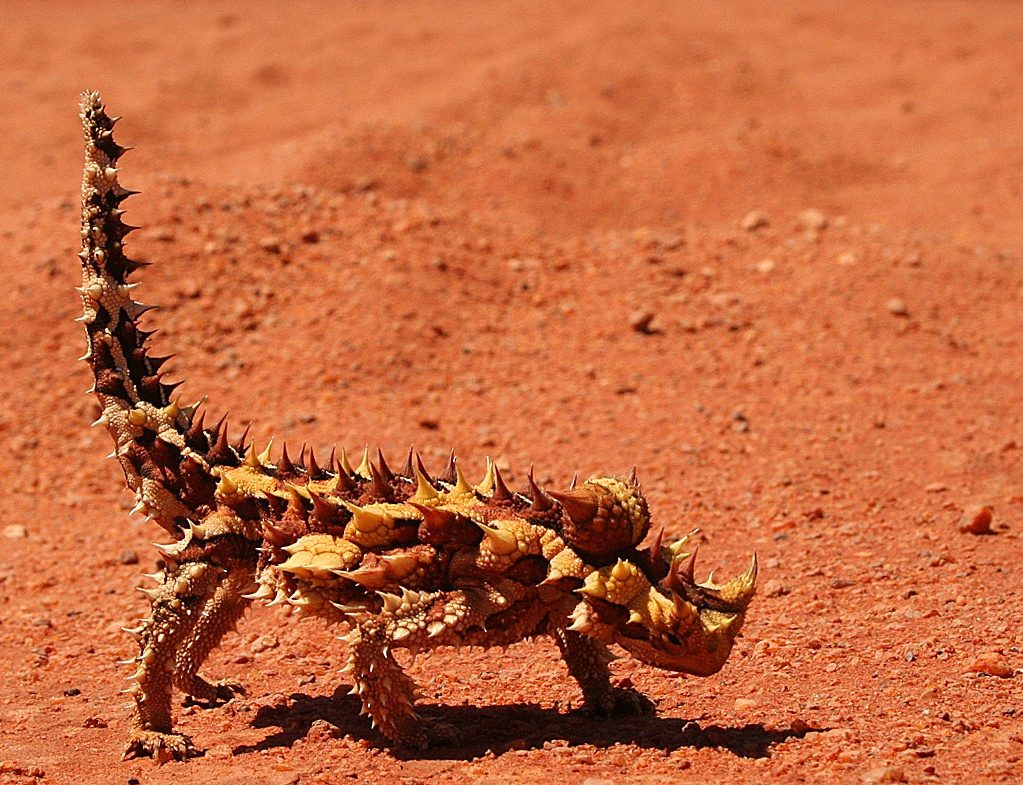
The thorny devil is a small and bizarre lizard of almost mythological appearance, covered from head to tail with numerous conical, pointed spines. Its body, of a colour ranging from brown to orange and yellow with tones recalling the sand and rocks of the desert, is a perfect camouflage. Among its most curious features is a fleshy knob on the neck, a kind of 'false head': when threatened, the animal lowers its real head and shows this structure, deceiving predators.
Habitat and distribution
It lives in the arid and desert regions of Australia, among the sands and scattered scrublands of the continent's interior. It is perfectly adapted to an extreme, hot and water-poor environment, where it moves with a slow, swaying, almost hesitant gait, which makes it inconspicuous to predators.
An ant-eater and a water-hunter
The thorny devil has an extremely specialised diet: it feeds almost exclusively on ants, which it catches one by one with its sticky tongue, devouring thousands in a single meal. Even more extraordinary is its ability to obtain water. Its skin is crossed by tiny grooves that, by capillary action, channel every drop of dew, rain or ground moisture to the corners of the mouth. In this way the animal is literally able to 'drink with its skin', making use of every faint trace of water in the desert.
Defences
The spines that cover the body have a defensive function: they make the thorny devil an awkward and dangerous mouthful for many predators to swallow. Together with its camouflaged colouring, slow gait and false head, they form a refined protection system for a small and otherwise defenceless animal.
Conservation
The thorny devil is classified as a species of least concern, with populations spread across the vast Australian desert areas. Like all inhabitants of arid environments, it depends on the health of its delicate ecosystem and on the availability of the ants it feeds on. It is a fascinating symbol of wildlife adapted to the extremes of the desert.
Pros
- Unique appearance, entirely covered in spines
- Extraordinary ability to collect water with its skin
- Refined defence system with a false head
- Entirely harmless to humans
Cons
- Extremely specialised diet (only ants)
- Tied to specific desert environments
- Small and slow, depends on camouflage