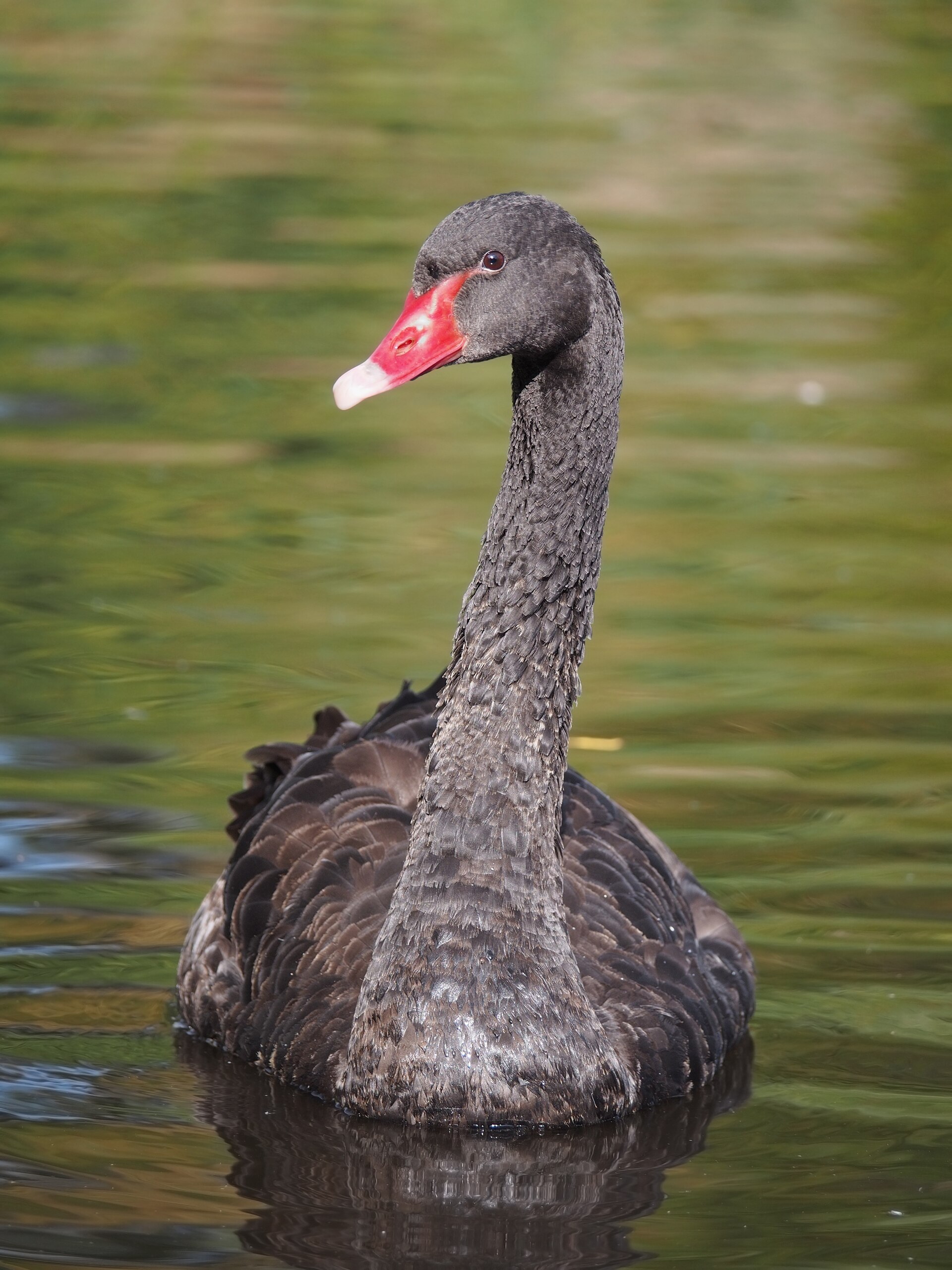
Black Swan
Cygnus atratus
Characteristics
Temperament
Lifelong monogamous, social in flocks, territorial during nesting. Neck with 32 cervical vertebrae (record). 25% of pairs are "stable homosexual" (two adoptive males). "Divorce" possible (6%). Endemic to Australia, Western Australia symbol.
Diet
Strict herbivore: algae, submerged aquatic vegetation (Myriophyllum, Vallisneria), aquatic seeds, shore grasses. 1-1.5 kg/day (20% weight). "Dabbling" technique with extra-long neck. Survives 1 month without food.
The Black Swan (Cygnus atratus), endemic to Australia, is one of the most fascinating and symbolic birds in the world. Its uniform jet-black plumage, in stark contrast to the bright red of the beak, makes it one of the most recognisable birds on the planet. For centuries, Europeans considered "impossible" the existence of a non-white swan — phrase used as metaphor for the non-existent — until in 1697 the Dutch explorer Willem de Vlamingh spotted the first specimen in the Swan River (Western Australia). This discovery gave rise to the famous concept of the "Black Swan event" by Nassim Nicholas Taleb (2007): an improbable, unpredictable event, but with enormous consequences, which was thought impossible before it happened. The Black Swan is today the national symbol of Western Australia, depicted on the state flag.
Classification and category
The Black Swan belongs to the order Anseriformes (swans, ducks, geese), family Anatidae, subfamily Anserinae, genus Cygnus. The genus comprises 6 species of swans: C. olor (Mute Swan), C. atratus (Black Swan), C. melancoryphus (Black-necked Swan from South America), C. cygnus (Whooper Swan), C. buccinator (Trumpeter Swan), C. columbianus (Tundra Swan). The Black Swan is a medium-large sized species: length 1.1-1.4 m, wingspan 1.6-2 m, weight 3.5-9 kg (males slightly larger than females). The species was scientifically described by John Latham in 1790. There are two geographic subspecies: C. a. atratus (continental Australia and Tasmania) and C. a. sumnerensis (New Zealand, now extinct — the modern New Zealand population derives from reintroductions). The neck is particularly long (32 cervical vertebrae, the highest number among all birds), which allows feeding in depth.
Habitat and distribution
The habitat of the Black Swan consists of lakes, rivers, swamps, coastal bays, estuaries and artificial wetlands. It prefers fresh or slightly brackish waters with abundant aquatic vegetation. It is nomadic: it moves based on water availability, often making migrations of hundreds of kilometres in response to drought or floods (Australia is characterised by great climatic variability). It lives in flocks that can reach thousands of individuals in areas particularly rich in food, but for nesting the pairs retreat to solitary areas.
The natural distribution covers all of Australia (except the most arid interior areas) and Tasmania. It has been introduced to New Zealand (1864, after the extinction of the native subspecies in the 15th century), England, Holland, Belgium ("feral" populations from escapes from parks and zoos). The global population is estimated at 500,000-1,000,000 individuals; conservation status is listed as Least Concern (LC) by the IUCN. The main threats are: loss of aquatic habitats in Australia (swamp drainage), collisions with aircraft (particularly in Perth, capital of Western Australia where the species is abundant), hunting (limited and regulated). The species is protected in Australia. The Black Swan is the state bird of Western Australia: it appears on the state flag and coat of arms. The capital Perth is crossed by the Swan River ("River of Swans"), so named for the large population of Black Swans. The Australian Football League (AFL) team of Sydney is called "Sydney Swans" in honour of the species.
Diet
The Black Swan is a strict herbivore with specialised aquatic diet. It feeds mainly on: filamentous algae, submerged aquatic vegetation (Myriophyllum, Vallisneria, Potamogeton), aquatic seeds, shore grasses, occasionally small aquatic insects and molluscs (1-2% of diet). The feeding technique is characteristic: it uses the long neck (the longest among all birds) to immerse the head up to 1 metre deep, keeping the body floating on the surface ("dabbling"). It can also make brief underwater dives of 30-60 seconds when food is deeper.
Daily food requirement is 1-1.5 kg of fresh aquatic vegetation (an adult consumes about 20% of its own weight every day). In urban areas it has easily adapted to human food (bread, corn), but it is not recommended: bread causes digestive and nutritional problems. The pairs divide the tasks: during incubation, the male looks for food in the vicinity and defends the territory, while the female broods. During the rearing of the chicks, both parents participate in foraging and defence. The adult male consumes 1.5-2 kg/day, the nesting female increases the requirement to 2-3 kg/day. The species is able to survive long periods without food (up to 1 month) by exploiting accumulated fat reserves.
Physical features
The Black Swan has an elegant, elongated, slender body, of similar but slightly smaller size than the European Mute Swan. The plumage is the most distinctive characteristic: uniform opaque black throughout the body, with white wing tips visible only during flight (safety characteristic used by chicks to recognise the parents' flight). The white wing tips derive from the different chemical composition of the primary feathers. The skin of the legs is grey, the webbed feet are black.
The beak is the second iconic characteristic: bright intense red (vermilion-orange colour), with white tip at the end ("bill nail") and a characteristic horizontal light band before the tip. Cubs have dark grey beak that gradually turns to adult red at 12-18 months. The eyes are red-bordeaux in adults (the only swans with red eyes), black in juveniles. The neck is exceptional: 32 cervical vertebrae, the highest number among all birds (for comparison, the Mute Swan has 25, humans 7). This extra-long neck allows immersing the head to greater depths to look for underwater food, in addition to contributing to the characteristic "S" shape of the neck at rest. The flight speed is 50-60 km/h, with wingspan of 1.6-2 m. The species can perform regional migrations of hundreds of kilometres. The swimming is elegant and powerful: 2-4 km/h sustained, up to 6 km/h in sprint. The young ducklings (cygnets) are covered in greyish-white down in the first months, and gradually acquire the black adult plumage at 6-12 months.
Behaviour and curiosities
The Black Swan is a lifelong monogamous, social, strongly territorial during nesting animal. The pair maintains the same partner for many years (couple longevity: 10-20+ years). Unlike European mute swans, Black Swan pairs can practise "divorce": 6% of pairs separate to re-associate with different partners (rare among swans). An exceptional curiosity: 25% of Black Swan pairs in some studied populations are composed of two males ("stable homosexual pairs"), who often "steal" a nest from a heterosexual pair and raise the chicks as adoptive parents. It is one of the most documented examples of stable homosexual behaviour in the animal kingdom.
Nesting takes place between Australian winter (June-September). The nest is a large floating platform of aquatic vegetation built by the pair in protected areas. The female lays 4-8 white-greenish eggs; incubation lasts 35-40 days, conducted by both parents in turn. The chicks (called "cygnets") are precocial: they leave the nest within 24 hours of hatching and follow the parents in the water. They are often transported on the parents' backs for the first weeks. Sexual maturity is reached at 2-3 years. Longevity is excellent: 10-20 years in nature, with well-cared specimens in zoos reaching 40+ years.
The cultural meaning of the Black Swan is exceptional. For centuries in Europe, the "black swan" was used as a metaphor to indicate something impossible or non-existent (Juvenal, satire: "rara avis in terris nigroque simillima cygno" — "rare as a bird on earth similar to a black swan"). When Dutch explorers discovered the Black Swan in Australia in 1697, the concept was shaken. In 2007 the Lebanese-American mathematician/philosopher Nassim Nicholas Taleb published "The Black Swan: The Impact of the Highly Improbable", which uses the metaphor to describe extremely rare events but of huge impact (e.g. 2008 financial crisis, COVID-19 pandemic, September 11 attack): "Black Swan event" has entered the world economic-financial vocabulary. The species is also the official symbol of Western Australia, depicted on the state flag. The Swan River in Perth ("River of Swans") owes its name to the large population. Sport curiosities: the AFL team of Sydney "Sydney Swans", the football team of Adelaide "Adelaide Swans", and numerous other Australian teams use the Black Swan as a mascot. The famous ballet "Swan Lake" by Tchaikovsky (1877) features the Black Swan character "Odile" — the dark and deceitful version of the white protagonist Odette.
Pros
- Simbolo nazionale Australia Occidentale
- Ispirò la teoria 'Black Swan event' di Taleb
- Longevità eccezionale (40+ anni in zoo)
- Monogamia stabile a vita, com paesi multipli
Cons
- Specie protetta in Australia, detenzione vietata fuori dai parchi
- Collisione frequente con aerei (Perth)
- Nel folklore europeo associato all'impossibile (errato!)
- Vulnerabile alla perdita di habitat acquatici