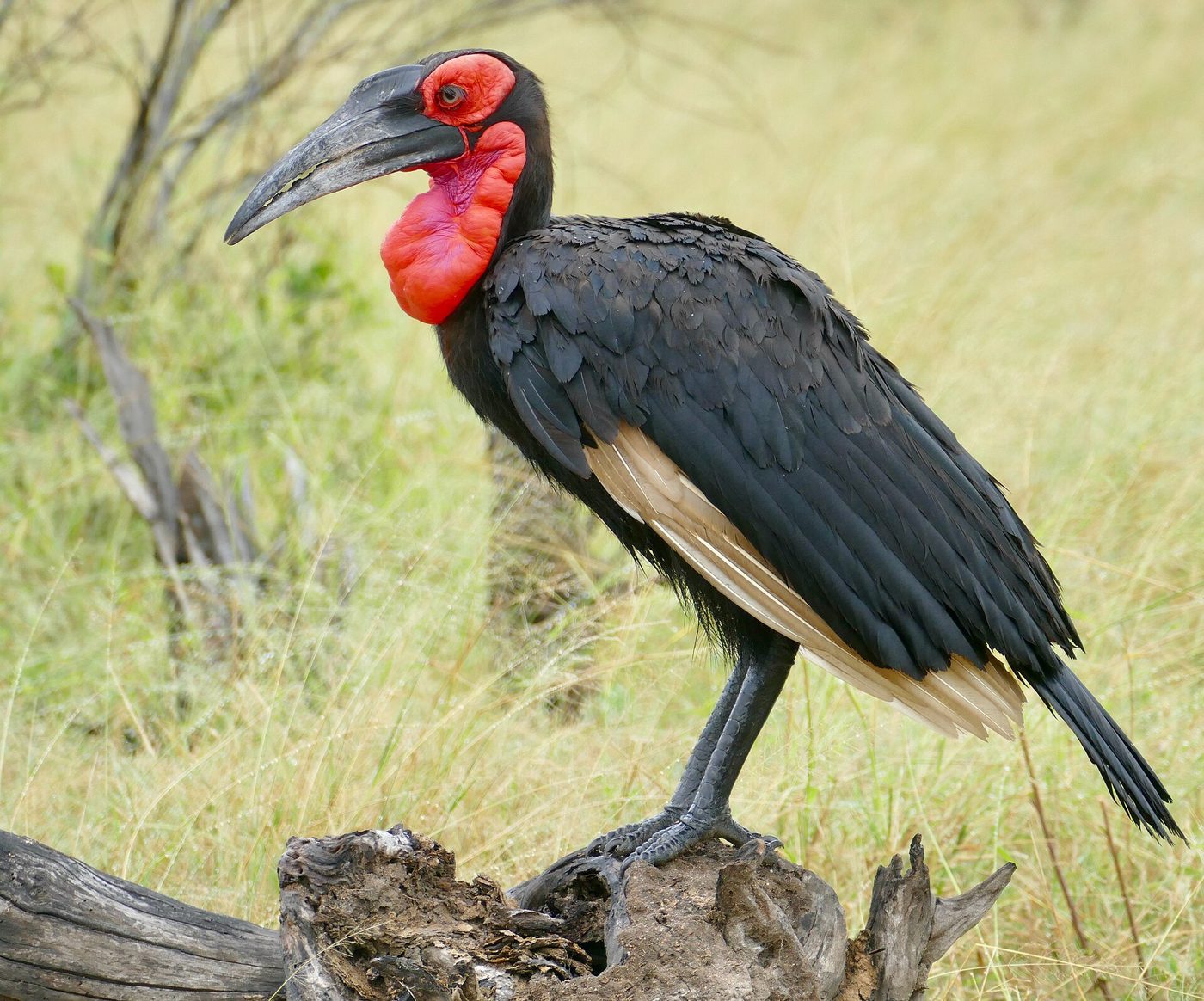
Photo: Bernard DUPONT from FRANCE · CC BY-SA 2.0
Southern ground hornbill
Bucorvus leadbeateri
The southern ground hornbill is the largest hornbill in the world: an imposing black bird of the African savannah, with a striking red throat and a heavy bill.
Characteristics
Temperament
Ground-dwelling, social and cooperative; lives in family groups.
Diet
Carnivorous: insects, frogs, snakes, lizards, small vertebrates.
The black giant of the savannah
The southern ground hornbill (Bucorvus leadbeateri) is the largest member of the hornbill order. It has entirely black plumage, a large, sturdy bill topped by a small casque, and striking patches of bare red skin around the eyes and on the throat — a deeper red in males. Males usually weigh between 3.5 and 6 kg. (Note: the body-mass value listed on Wikidata, 100.5 kg, is clearly an error — this is a bird of just a few kilograms.) In flight it shows white flight feathers, but it spends most of its time on the ground, striding about on long legs.
Habitat and range
It lives in the savannahs, grasslands and open woodlands of southern sub-Saharan Africa, from Kenya to South Africa. It favours open country where it can walk long distances in search of prey, but it needs large trees with cavities in which to nest.
Behaviour and diet
It is a ground-dwelling carnivorous predator, taking insects, frogs, snakes, lizards, small mammals and birds, which it seizes and hammers with its powerful bill. It lives in cooperative family groups led by a dominant pair; the other members help defend the territory and raise the young. Breeding is extremely slow: a pair successfully raises just one youngster every several years.
Did you know?
It has a deep, booming call, almost like a drum roll, audible for kilometres at dawn. In many African cultures it is regarded as a sacred or lucky bird, which has helped protect it locally.
Conservation
The IUCN lists it as Vulnerable. Its extremely slow breeding makes it fragile: habitat loss, poisoning, the felling of large nest trees and persecution all threaten its populations, which are declining in many areas.
Pros
- The world's largest hornbill
- Cooperative social life in family groups
- Deep call audible over long distances
Cons
- Vulnerable and declining
- Extremely slow breeding, one chick every few years
- Dependent on large nesting trees