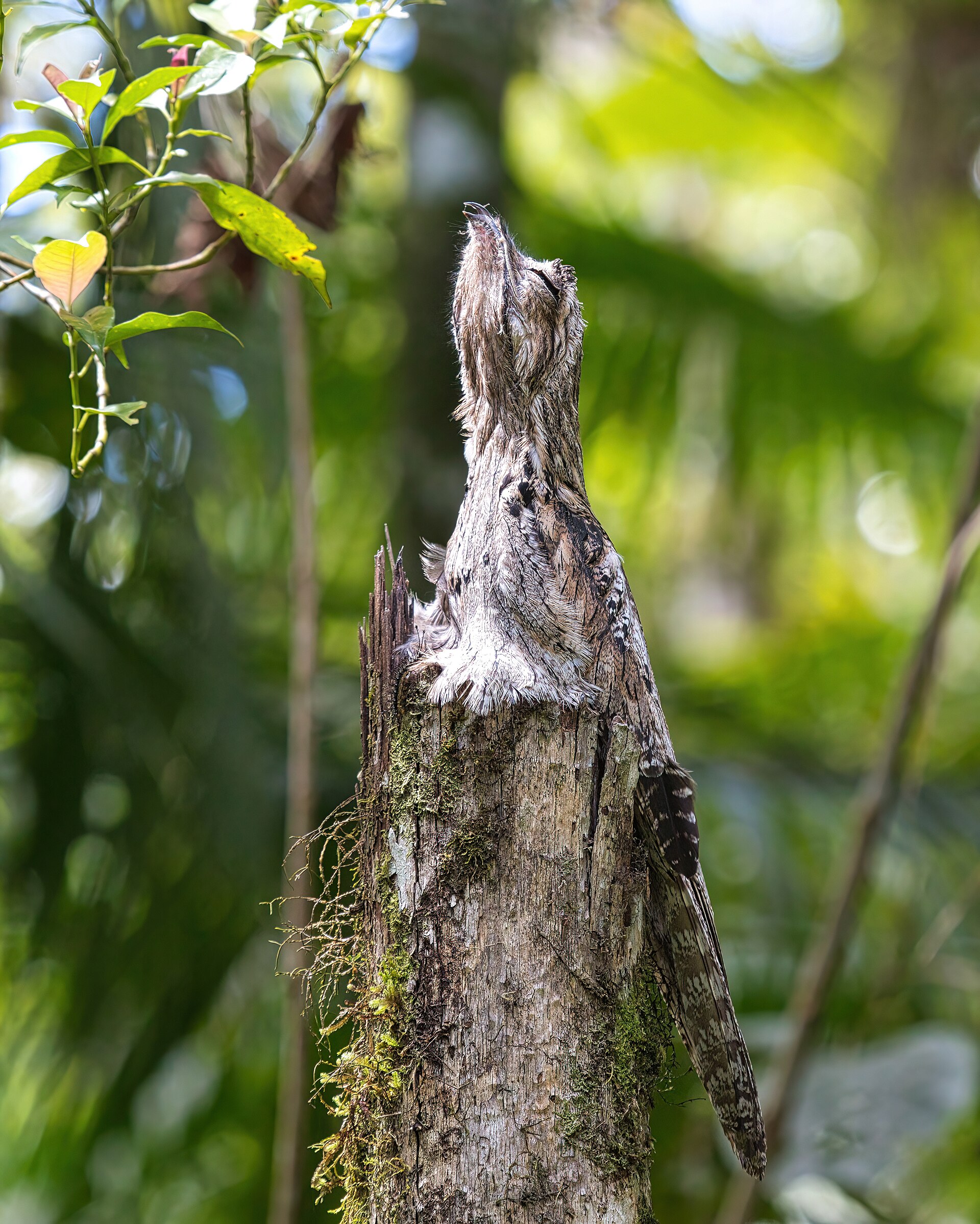
Common Potoo
Nyctibius griseus
Characteristics
Temperament
Solitary, nocturnal and shy, entirely focused on camouflage. By day it stays motionless for hours atop a broken stump, pretending to be a dead branch and relying on disguise rather than flight. By night it becomes an agile aerial hunter. Sedentary and tied to its perches. Quiet and silent except for its mournful nocturnal song. Not a pet: a wild bird hyper-specialized to vanish from sight.
Diet
A nocturnal insectivore that hunts by aerial sallying like a giant flycatcher. It eats moths, beetles and other large flying insects, grasshoppers and winged termites. It sits motionless on a conspicuous perch scanning the dark with its large eyes, then launches out to catch prey in mid-air by opening its huge mouth, returning to the same branch. The bill is small but the very wide gape works like a net for insects.
The Common Potoo (Nyctibius griseus) is a nocturnal bird of Neotropical forests and one of the animal kingdom's most extraordinary masters of camouflage. Famous for:
- Perfect camouflage: by day it perches motionless atop a post or broken stump, stretching its body upward, becoming indistinguishable from a dead branch stub
- Enormous eyes: huge for night vision, with a unique trick — tiny slits in the eyelids that let it "peek" even with its eyes shut
- An outsized gape: a small bill but a huge mouth, opened wide to catch insects in flight
- The "ghost bird" song: a mournful, melancholy nocturnal call at the heart of many Amazonian legends
- The non-existent nest: it lays a single egg in a small hollow atop a broken stump, building no nest at all
- The "bark-fluff" chick: white and downy, it soon learns to camouflage like its parent
IUCN status: Least Concern (LC), with a wide, widespread population. Nocturnal and arboreal, it shares the Neotropical forest night with other canopy dwellers active in the dark — like the Margay and the Coendou — but unlike them its weapon is neither strength nor quills, but the art of vanishing from sight.
Classification and category
Order Caprimulgiformes (nocturnal birds such as nightjars and frogmouths), family Nyctibiidae — the potoos, exclusive to the tropical Americas. It is a relative of the nightjars and of the Australasian frogmouths, sharing their nocturnal life and cryptic looks but distinguished by its upright posture and bearing. The genus Nyctibius holds several potoo species, from the small Common Potoo to the large Great Potoo (Nyctibius grandis), known for an even more sinister call. Similar animals to tell it from: owls (also nocturnal with large eyes, but with powerful talons, a round head and a hooked raptor's bill — the potoo has weak feet and a small bill with a huge mouth); and nightjars (close relatives, but the potoo perches upright and in the open, pretending to be a branch, rather than crouching on the ground). Etymology: "Nyctibius" is from Greek for roughly "living by night"; "griseus" is Latin for "grey", for the plumage; the international name "potoo" is onomatopoeic, imitating the bird's call. Parameters: Length 34-38 cm. Weight 145-285 g. Gape disproportionately wide for the small bill. Longevity estimated around 12-14 years. Monogamous; it builds no nest but lays a single egg in a natural hollow atop a broken trunk or branch, incubated in turns by both parents.
Habitat and distribution
The Common Potoo ranges across much of Central and South America: from southern Mexico and Central America, through much of South America to northern Argentina and Uruguay; it also occurs on some Caribbean islands. Preferred habitats: tropical and subtropical forests and their edges; open woodland, treed savanna and semi-open areas (it favours edges and clearings, where conspicuous perches abound); and treed human landscapes (plantations, orchards, parks and even the outskirts of towns, as long as suitable posts and branches exist). It is a solitary, nocturnal, sedentary bird. Its whole lifestyle revolves around the perch: it chooses a few favourites, conspicuous yet resembling its body, from which it hides by day and hunts by night. Unlike many forest birds it does not hide in the thick: it sits in the open, relying entirely on disguise. IUCN: Least Concern. A common, adaptable species that tolerates human-modified landscapes well as long as trees and perches remain; its camouflage makes it hard to census, but it is considered widespread and unthreatened.
Diet
A nocturnal insectivore that hunts by "aerial sallying", much like a giant flycatcher: moths (an important part of the diet); beetles and other large flying insects; and grasshoppers, winged termites and assorted insects. Hunting strategies: waiting on the perch (sitting motionless on a conspicuous branch, scanning the dark with its huge eyes); the flight sally (when it spots prey it launches out, catches it in mid-air by opening its huge mouth, and returns to the same perch, just like a giant flycatcher of the night); and the net-mouth (the bill is small but the gape is very wide, ideal for "bagging" insects in flight). Crucially, the potoo combines two opposite talents — absolute stillness by day, to avoid being seen, and aerial agility by night, to hunt; the same perch serves it as both hideout and hunting post.
Physical features
A cryptic-looking bird built to vanish from sight. Plumage: mottled grey-brown, with streaks, spots and veining that perfectly reproduce bark and dead wood; no bright colour — everything serves the disguise; the livery works only when paired with the right posture and stillness. The extraordinary eyes — its most surprising feature: enormous, to gather the scant night light; and fitted with "magic slits" — small notches in the rim of the upper eyelids that let the bird sense movement and light even with its eyes closed, so it can stay perfectly still and camouflaged while still watching for danger. Head and body: a small bill but a huge mouth (a disproportionate, net-like gape for insects); short, weak legs (only for gripping the perch, not for walking or seizing); and a slender body that, stretched upward, extends the line of the branch it sits on. Performance: prolonged stillness (it can stay motionless for hours, its main defence); excellent night vision; agile, silent flight when hunting; and a powerful voice (the mournful song carries far through the night).
Behaviour and curiosities
A solitary, nocturnal animal deeply tied to its disguise. By day it is almost impossible to spot; by night it betrays its presence only by its song and by the glow of its eyes caught in a torch beam. Its entire biology, from hunting to nesting, is built around the art of not being seen.
The "breathing branch": the potoo's camouflage is among the most perfect in the bird world. By day it perches atop a broken stump, stretches its neck and body upward, raises its bill and shuts its eyes: its outline becomes the natural continuation of the wood, and the bark-like plumage completes the illusion. It can stay this way, motionless, for hours, and many predators (and human observers) pass right by without noticing. The "magic eyes": how does it keep watch while staying still with its eyes closed? The potoo has two small slits in the rim of its upper eyelids; when it "shuts" its eyes to avoid betraying itself with their shine, it can still sense light and movement through these notches, keeping an eye on a potential threat without ever breaking the pose that makes it invisible — a very rare adaptation. The "ghost bird": the potoo's nocturnal song is one of the most evocative sounds of the tropical American night — a series of mournful, descending notes, melancholy and almost human; in many Central and South American cultures this call is linked to legends of grieving souls, lost loves and longing, earning it a reputation as a "ghost bird" or "bird of lament"; its larger relative, the Great Potoo, gives an even darker, more sinister cry. The non-existent nest: the potoo builds no nest at all; the female lays a single egg directly in a small natural hollow atop a broken trunk or branch — a knot, a fork, a shallow cavity — and the egg, then the chick, is protected solely by camouflage, the incubating parent perching over it pretending, as ever, to be a snag of wood: a total bet on invisibility. The camouflaged chick: the potoo chick hatches as a white, downy puff but grows fast, learning the family art; even when young, perched on the stump-nest, it adopts the parent's upright, motionless pose, blending its down into the bark, and the adult often perches right in front of the chick to hide it completely, merging the two outlines into one believable "branch".
Pros
- Maestro del mimetismo: uno degli uccelli più straordinari del Neotropico
- IUCN Least Concern: popolazione ampia e diffusa
- Controlla naturalmente falene e insetti notturni
- Grande valore educativo e di curiosità (occhi 'magici', canto fantasma)
Cons
- Non è un animale domestico (uccello selvatico iperspecializzato)
- Notturno e mimetico: quasi impossibile da osservare
- Dipende da posatoi e alberi: sensibile alla rimozione totale degli alberi
- Un solo uovo per covata: ripresa lenta delle popolazioni locali