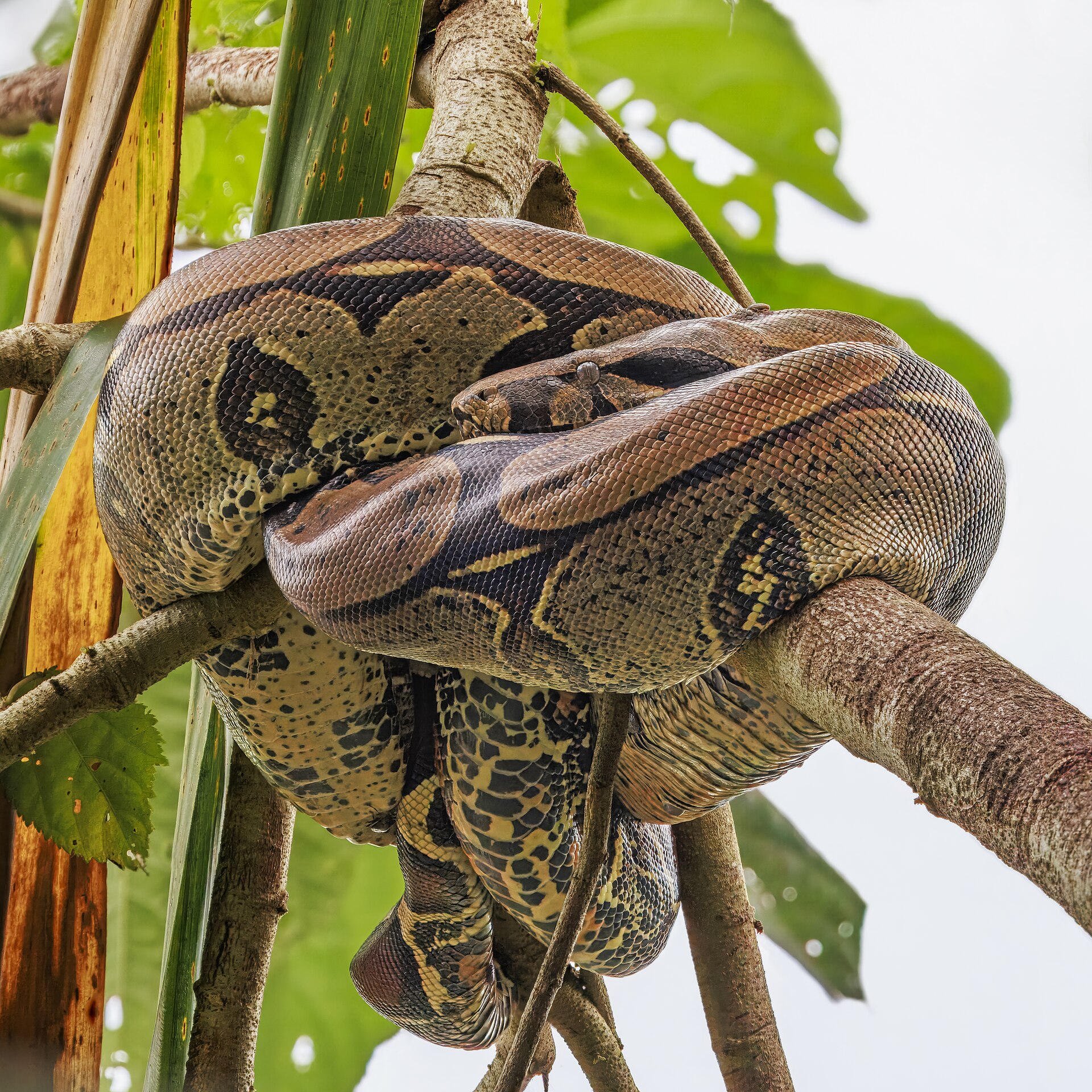
Boa Constrictor
Boa constrictor
Characteristics
Temperament
Solitary, nocturnal-crepuscular, ectothermic. Non-venomous constrictor. Hunts by ambush. Kills by suffocating with coils (circulatory collapse in 90-120 sec). Viviparous: gives birth to 10-65 live young. Docile in captivity (popular in terrariums).
Diet
Strict carnivore. Hunts mammals (rats, opossums, small monkeys, young capybaras), birds, reptiles. Technique: ambush + wrapping (coils) + suffocation (circulatory collapse). 1 prey/month. Survives 12-18 months without eating.
The Boa Constrictor (Boa constrictor), also known as Imperial Boa or simply "Boa", is one of the most famous snakes in the world, the symbol par excellence of non-venomous constrictor snakes. It is widespread in a vast range that goes from northern Mexico to northern Argentina, through all of Central and South America, where it lives in tropical forests, savannas, semi-deserts and agricultural areas. Although large, it reaches more modest dimensions compared to anacondas and pythons: 2-4 m in length (verified record 4.3 m), 10-30 kg in weight (maximum documented 45 kg). Its scientific name (constrictor) describes its fundamental characteristic: it kills by suffocating prey by wrapping them in its coils and squeezing until stopping their blood circulation (not, as once thought, by breaking bones). It is non-venomous: its teeth are curved backward to hold prey during coiling. The global IUCN conservation status is Least Concern (LC), but the species is subject to strong pressure from the illegal trade in terrarium animals (it is one of the most popular snakes in terrariums).
Classification and category
The Boa Constrictor belongs to the order Squamata, suborder Serpentes, family Boidae (boas), subfamily Boinae, genus Boa. The Boidae family comprises about 60 species of boas distributed throughout the world (Americas, Madagascar, Indonesia, Pacific); the genus Boa contains only 4 American species. The species Boa constrictor was scientifically described by Linnaeus in 1758 with its current name. "Boa" derives from Latin and means "large water snake"; the term was used by Pliny the Elder in his "Naturalis Historia" to describe Italian water snakes.
Modern systematics recognises 9 subspecies of Boa constrictor:
- B. c. constrictor — "Common" Boa, Brazil, Suriname, Guyana
- B. c. imperator — Imperial Boa, Mexico-Colombia (most common in captivity, today often considered own species Boa imperator)
- B. c. amarali — Amaral's Boa, Bolivia, Paraguay
- B. c. longicauda — Long-tailed Boa, Peru
- B. c. nebulosa — Clouded Boa, Dominica Island (Caribbean)
- B. c. orophias — Saint Lucia Boa (Caribbean)
- B. c. melanogaster — Black-bellied Boa, Ecuador
- B. c. occidentalis — Argentine Boa
- B. c. ortonii — Orton's Boa, Peru
Adult dimensions are: length 2-3 m (females), 1.5-2.5 m (males), verified record 4.3 m in Trinidad. Weight 10-30 kg, record 45 kg. Sexual dimorphism is marked (females 20-30% larger than males). Longevity is 20-30 years in nature, 30-40 years in captivity (record 40 years and 4 months for a specimen at Philadelphia Zoo in 1977).
Habitat and distribution
The Boa Constrictor's habitat is extraordinarily variable: from Amazonian and Central American rainforests, to dry savannas (cerrado, chaco), to gallery forests (along rivers), to dry deciduous forests, to semi-deserts, up to agricultural areas and urban outskirts. It adapts extraordinarily well: the subspecies B. c. constrictor is semi-arboreal (lives in rainforests), while B. c. imperator is predominantly terrestrial (savannas and arid areas). It is found up to 1,000-1,500 m of altitude (rarely up to 2,000 m).
The geographical distribution covers the entire Latin America: from northern Mexico (Sonora, Sinaloa, Chihuahua), through Central America (Belize, Guatemala, Honduras, Nicaragua, Costa Rica, Panama), Caribbean (Dominica, Saint Lucia, Trinidad and Tobago), South America (Colombia, Venezuela, Guyana, Suriname, French Guiana, Brazil, Bolivia, Paraguay, northern Argentina, Peru, Ecuador). The global IUCN conservation status is Least Concern (LC). The global population is estimated at millions of specimens. However, some subspecies are in danger: B. c. nebulosa (Dominica) and B. c. orophias (Saint Lucia) are both assessed as Vulnerable by IUCN due to their restricted range. The species is included in CITES Appendix II: international trade is permitted but regulated. The main threats are: pet animal trade (one of the most requested snakes in the world's terrariums — 200,000+ specimens caught and sold per year globally, of which 60% for the USA), hunting for skin (boa leather boots are widespread in South America), direct killings (fear, venomous myth), habitat loss (Amazonian deforestation). Captive breeding programmes: since 1980 boas have been bred in over 200 commercial facilities worldwide, reducing pressure on wild populations.
Diet
The Boa Constrictor is a strict carnivore, opportunistic predator. The diet is composed mainly of mammals: rats, mice, opossums, squirrels, small marsupials, young coatis, small monkeys; birds: poultry, chicks, forest birds (caught on branches with lateral lunge); reptiles: lizards, geckos, occasionally other small snakes. Young specimens (under 1 m) hunt mainly lizards and small rodents; large adults can catch prey such as young capybaras (10 kg), capuchin monkeys and occasionally dogs or domestic cats in agricultural areas.
The hunting technique is iconic: silent ambush. The boa hides on branches (arboreal varieties) or among vegetation (terrestrial varieties), camouflaged by the mimetic coat. When a prey passes within range (50-100 cm), the boa attacks with a lightning lunge: the jaw opens and the head projects forward at 4-5 m/s. Curved teeth (4 rows, 80-100 total teeth) grab the prey by the neck or torso. Immediately the body wraps around the prey in coils: 2-3 coils for small prey, 4-5 coils for large ones. The tight coils exert constant pressure of 6-15 kPa. For a long time it was thought that the cause of death was suffocation (interruption of breathing); recent 2015 studies (Dickinson University, Boback et al.) have instead shown that the cause of death is circulatory collapse: pressure interrupts blood flow to the brain in 6-12 seconds, causing loss of consciousness in 15-30 seconds and death in 90-120 seconds — much faster than suffocation. The boa "feels" the prey's heartbeat with mechanical receptors under the ventral scales, and releases the grip only when the heart stops definitively. After the prey's death, the boa swallows it whole: large meals require 5-30 minutes of swallowing. Digestion is very slow: a 5 kg prey is completely digested in 14-30 days. The adult boa consumes one prey per month; can survive over 12-18 months without eating (in extreme stress situations). Bone and hair metabolites are excreted as cylindrical pellets unique to the genus.
Physical features
The Boa Constrictor has a massive, cylindrical, muscular body, with circular cross-section. The length in adults varies from 1.5 to 4 m (record 4.3 m, Trinidad 1973); the weight from 10 to 30 kg (record 45 kg). Females are larger than males (sexual dimorphism +20-30%). The head is triangular, distinct from the neck, wedge-shaped. The muzzle is broad, robust, with two thermo-sensitive pits (called "labial pits") on the upper lip scales: these infrared receptors allow the boa to perceive warm-blooded prey in the dark, sensing thermal variations of 0.005°C — particularly useful during nocturnal hunting.
The teeth are aglyphic (without venom channels): 80-100 total teeth in 4 rows, curved backwards, 1-2 cm long. They are painful for the bite (serious lacerations) but not venomous. The eyes have elliptical vertical pupils (typical of nocturnal predators); sight is moderate at short distances; but smell (through forked tongue and Jacobson's organ) and thermal receptors are the main senses. The colour is the most variable characteristic of the boa: each subspecies and each region has different patterns and colourings. The base pattern is composed of dorsal "saddles" (oval spots) dark brown, reddish or black, on grey-beige background, alternating with smaller lateral spots. The terminal tail is intense brick-red (diagnostic characteristic of the genus Boa). Numerous colour variants exist selected in captivity ("morphs"): albino (pink-white), anery (black-white), hypo (lighter), salmon (pink), motley (altered pattern), pied (piebald). "Fancy" variants can cost €1,000-10,000 per specimen in the terrarium market.
The scales are smooth (not keeled), small, in 70-90 dorsal rows. The ventral scales are broad and single (characteristic of snakes), and contribute to locomotion (5-8 km/h maximum speed). Boas also have "anal spurs" (near the cloaca): small horny protrusions, vestiges of hind legs — testimony of the fact that snakes evolved from lizards 100 million years ago. In male specimens the spurs are larger (4-6 mm), used to stimulate the female during courtship; in females they are reduced (2-3 mm). Boas have asymmetric lungs: the right lung is functional (60-80% of body length), the left is reduced or absent (snake characteristic, due to the elongated body).
Behaviour and curiosities
The Boa Constrictor is a solitary, nocturnal-crepuscular, ectothermic animal. During the day it hides in dens (tree cavities, rock crevices, under fallen branches) or climbs on branches in the sun for thermoregulation. It goes out to hunt at dusk and at night. It is an excellent swimmer: it easily crosses rivers and lakes. It is also a good climber: young are semi-arboreal, adults less so (they are too heavy). Territorial behaviour absent or weak: boas tolerate the presence of other boas, sometimes gathering in common dens ("hibernacula") during the cold season (species of the South, Argentina).
Reproduction has a unique biological detail: boas are viviparous (they do not lay eggs!). Fertilisation occurs in spring (May-June). Gestation lasts 5-8 months; the female carries the embryos internally, where they are nourished through a primitive placenta (very rare in reptiles). Parturition occurs in autumn-winter: the female gives birth to 10-65 live young (record 64, exceptional 100+), already fully developed. Dimensions at birth: 35-60 cm, weight 30-100 g. The young are completely autonomous from birth (the mother provides no parental care). Male boas have a unique characteristic: "parthenogenetic reproduction" — some females in captivity have been documented giving birth to young without ever meeting a male (in 2010 the Lyon Zoo, France, documented spontaneous parthenogenesis with young genetically identical to the mother). Parthenogenesis is rare but documented also in other snakes.
Famous curiosities: the Boa Constrictor is one of the most popular snakes in terrariums. The ratio compared to the royal python: the boa is more docile and quiet to handle (it is the first choice for beginners among large snakes). Adults rarely attack humans, and bites are rare and brief. However, there have been fatal accidents: in 1994, a reptile trainer in the USA was strangled by his 4 m boa. In 2018 an Indian family was attacked by a wild boa (South American subspecies). Historical curiosity: in 1936 the Boa Constrictor "Pegasus" from Lincoln Park Zoo (Chicago) won a Guinness for 23 years of zoo residence — one of the longest-lived documented snakes. Ethological curiosity: boas have an "individual recognition": studies show they recognise their owner through smell (hand pheromones), and "calm down" when touched by familiar people. The calm can be measured by tongue vibrations: the tongue moves slowly with calm, quickly in stress. Linguistic curiosity: the term "boa" in modern design indicates a feather scarf, first used by 19th-20th century ladies, and then popularised by burlesque — because it resembles the snake for the elongated shape that wraps around the neck. Mythological curiosity: the Mayas considered the boa a sacred creature associated with the underground (Xibalbá); many Mayan tombs contain carved boas as spiritual guardians. Pop culture curiosity: the "Kaa" of "The Jungle Book" (Rudyard Kipling, 1894) is inspired by a python, but the Disney film of 1967 represents it more as a boa (although geographically India has pythons, not boas).
Pros
- Costrittore iconico delle Americhe (Messico-Argentina)
- Docile e tranquillo: il serpente grande più adatto ai principianti
- Longevità eccellente (20-40 anni)
- Numerose 'morphs' colorate disponibili in cattività
Cons
- CITES Appendice II: commercio regolato, permessi necessari
- Cresce grande: terrario adulto 200×60×60 cm minimo
- Costosi a mantenere: termo-regolazione, riscaldamento, UV
- Incidenti mortali rari ma documentati con esemplari adulti