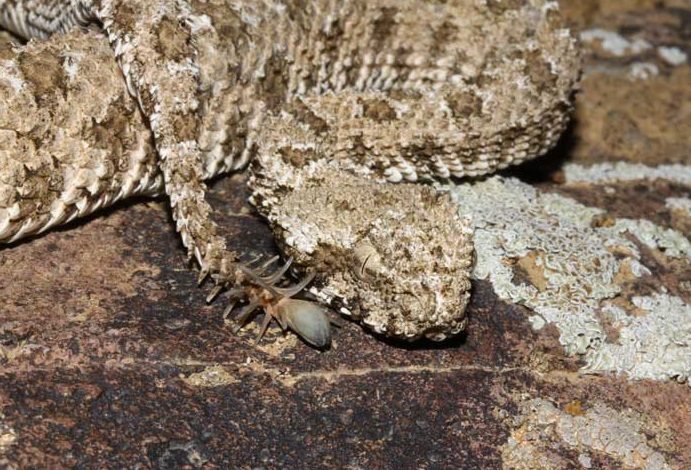
Photo: Omid Mozaffari · CC0
Spider-tailed horned viper
Pseudocerastes urarachnoides
A venomous snake of western Iran, the spider-tailed horned viper has a tail tip shaped like a spider, which it waves to lure birds within striking range.
Characteristics
Temperament
Sedentary, camouflaged, ambush predator
Diet
Carnivore: mainly birds, lured by the tail
A snake with a lure on its tail
The spider-tailed horned viper is one of the most extraordinary reptiles in the world for a single, astonishing feature: the tip of its tail is modified to resemble a spider or solifuge with uncanny accuracy. A bulbous swelling mimics the body, while a series of elongated scales simulate the legs. The rest of the body, stout and covered in rough scales, blends perfectly with the rock thanks to a greyish-brown livery.
Habitat and distribution
It is endemic to a restricted area of western Iran and the border region with Iraq, in arid, rocky hill country. It lives among gypsum outcrops and scree, where it merges with its surroundings.
A deceptive hunt
When an insect-eating bird passes nearby, the viper stays motionless and moves its tail, making the "lure" undulate: the fake spider appears to move and crawl realistically. The bird, deceived, approaches to seize what it thinks is prey and ends up within reach of the snake's jaws, which strike with a lightning-fast venomous bite. It is one of the most refined examples of aggressive mimicry (Peckhamian mimicry) in the animal kingdom.
Curiosities
The tail's resemblance to a spider is so precise that it was only discovered and studied by scientists recently, after the species was described in 2006. Its prey is mostly migratory birds, less used to recognising the deception than local birds.
Conservation
The IUCN lists the species as Near Threatened: it has a very limited range and is potentially vulnerable to illegal collection for the exotic pet trade and to habitat loss.
Pros
- Spider-shaped tail unique in the world
- Extraordinary example of aggressive mimicry
- Perfect camouflage with the rocky environment
Cons
- Venomous: potentially dangerous
- Tiny range, Near Threatened
- Vulnerable to illegal collection