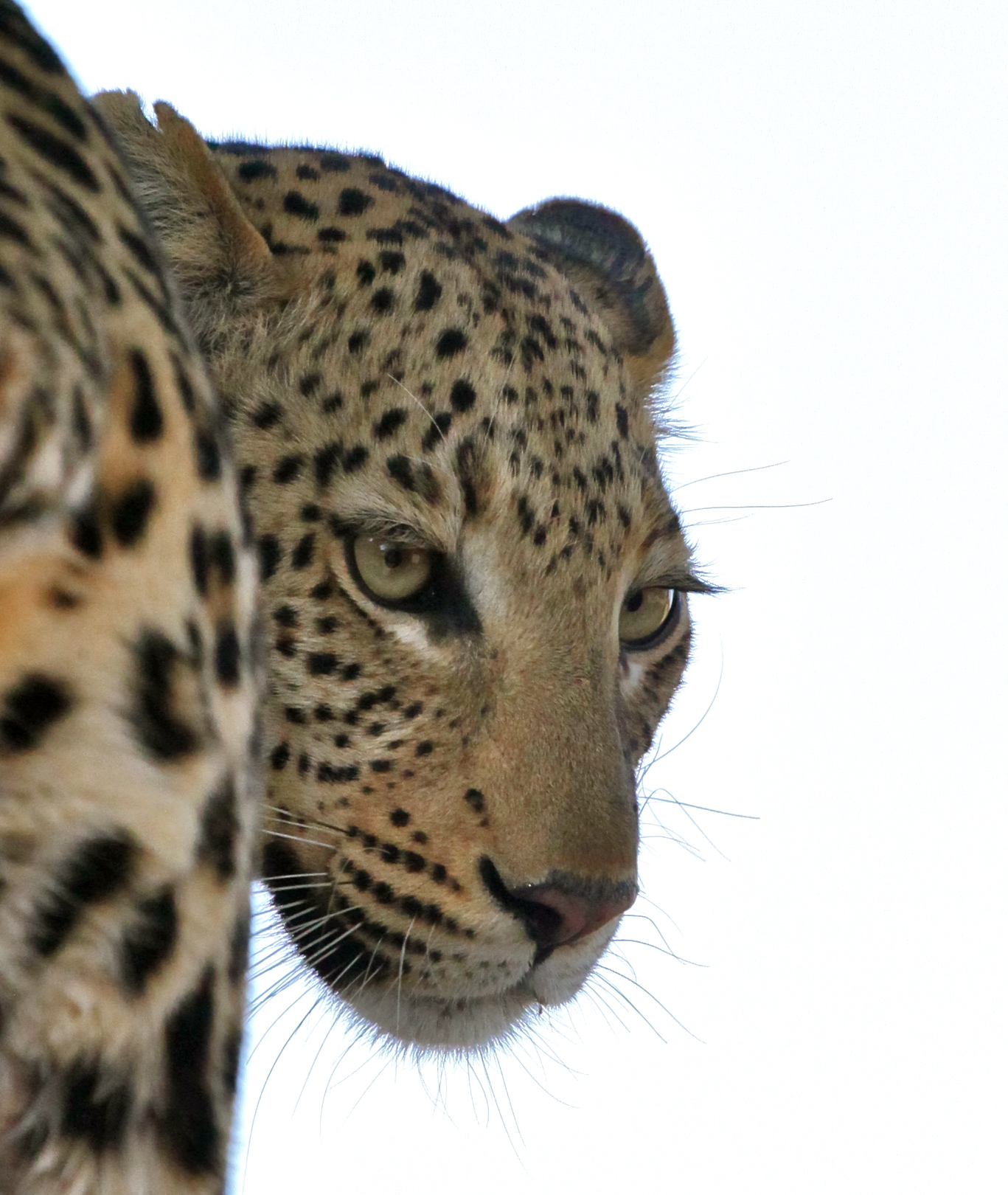
Leopard
Panthera pardus
Characteristics
Temperament
Solitary, territorial, nocturnal-crepuscular. Cat with widest distribution in the world (62 countries). Characteristic "tree-larder": carries prey 3× its own weight up trees. 8 subspecies, rarest (Amur) has only 120 specimens. Melanistic variant = black panther.
Diet
Strict carnivore, generalist (92+ prey species). Deer, antelope, monkeys, pigs, birds, rodents, reptiles. Hunting by silent stalking, sprint 50-60 km/h. Drags prey 3× its weight up trees. 5-10 kg meat/day. Hunt success 30-40%.
The Leopard (Panthera pardus) is one of the five great cats of the genus Panthera, known for its extraordinary adaptability: it lives in habitats ranging from African rainforests to Siberian tundras, from savannas to Indian urban areas. It is smaller than lion and tiger (weight 30-90 kg), but it is the cat most powerful per muscle mass: capable of carrying prey of 3 times its own weight to the top of trees to hide them from lions and hyenas. Its iconic rosette-spotted coat hides the true number of subspecies: "black leopards" (black panthers) are melanic variants of the same species. The leopard is the cat with the widest distribution in the world, present in over 62 countries across Africa, Asia and the Middle East. It is classified as Vulnerable (VU) by IUCN since 2016: the global population is estimated at 200,000-300,000 specimens, declining by 30-40% in the last 22 years. Some subspecies are critically endangered: the Amur Leopard has only ~120 specimens left in the wild.
Classification and category
The Leopard belongs to the order Carnivora, family Felidae, subfamily Pantherinae, genus Panthera. The genus comprises 5 species of "great roaring cats": P. leo (lion), P. tigris (tiger), P. onca (jaguar), P. pardus (leopard), P. uncia (snow leopard). The species was scientifically described by Linnaeus in 1758 with its current name. There are 8 recognised subspecies of P. pardus:
- P. p. pardus — African (most widespread, ~80,000 specimens)
- P. p. fusca — Indian (~12,000-14,000)
- P. p. saxicolor — Persian (~800)
- P. p. melas — Javan (~200-300, Critically Endangered)
- P. p. nimr — Arabian (~200, Critically Endangered)
- P. p. delacouri — Indochinese (~400-700)
- P. p. japonensis — North Chinese (~500-1,500)
- P. p. orientalis — Amur/Russian Far East (~120, the rarest, Critically Endangered)
Dimensions vary by subspecies: males 30-90 kg (Africa: 31-72 kg, Asia: 40-90 kg, record 96 kg), females 23-45 kg. The head-body length is 90-190 cm; the tail 60-110 cm. Sexual dimorphism is marked (males 30-50% larger than females). Longevity is 12-17 years in the wild, 20-23 years in captivity (record 27 years).
Habitat and distribution
The Leopard is the cat with the widest geographical distribution in the world, present in over 62 countries across Africa, Asia and the Middle East. Its ecological adaptability is extraordinary: it lives from tropical rainforests (Congo, Borneo), to savannas (Serengeti, Masai Mara), to steppes (Iran, Mongolia), to deciduous forests (China), to semi-boreal tundras (Russian Far East, where it withstands -40°C), to rocky deserts (Namib, Negev), to high-mountain forests (Himalaya, up to 5,200 m). It has also adapted to urban areas: in Mumbai (India), the Sanjay Gandhi National Park hosts 30-50 leopards that live on the edges of a metropolis of 22 million people, hunting stray dogs and pigs (unique case in the world).
The current distribution includes: Sub-Saharan Africa (largest population, but declining), India (~12,000-14,000, most numerous Asian population), Pakistan, Nepal, Bhutan, Bangladesh, Myanmar, China, Russia (Primorsky Krai), Iran, Saudi Arabia, Yemen, Oman, Sri Lanka, Indonesia (Java). Historically the species covered a much wider range, from South Africa to the Caspian Sea to Korea. Today it is extinct or critically endangered in Egypt, Tunisia, Morocco, Algeria, Libya, Singapore, Hong Kong, Kuwait, Israel. The global IUCN conservation status is Vulnerable (VU) since 2016 (previously Near Threatened). The total population is estimated at 200,000-300,000 specimens, declining by 30-40% in the last 22 years. Threats include: habitat loss (agriculture, construction), conflict with herders (killings for attacks on livestock), poaching (fur, bones for Chinese traditional medicine, teeth, whiskers), decline in prey, sport hunting (legal in some countries). The Amur Leopard is one of the rarest species in the world: only ~120 specimens in the wild, distributed between Russia (Primorsky Krai, Land of Leopard NP) and northeastern China.
Diet
The Leopard is a strict carnivore, opportunistic and generalist predator: its diet comprises over 92 species of prey documented throughout its range (more than any other cat). The most frequent prey are: medium-sized ungulates (deer, antelopes, gazelles, impala, kob, sitatunga, tragelaphus), monkeys (baboons, macaques, langurs), wild pigs, birds (gallinaceous, young ostriches), large rodents (porcupines, squirrels, mole rats), small hyenas, jackals, foxes, reptiles (snakes, lizards, monitors). It also eats insects in periods of scarcity of other prey. In South Africa, over 50% of the diet is composed of damaschi (African ground squirrel) and rock rats. The hunting technique is silent stalking: the leopard approaches silently to 1-5 m of the prey, exploiting vegetation and darkness, and attacks with a lightning sprint (50-60 km/h). The lethal bite is given to the throat (asphyxia) or to the nape (spinal cord breakage).
The unique characteristic of the leopard is the "tree-larder": after killing even a heavy prey (60 kg impala, 35 kg goat, sometimes young giraffes of 100+ kg), the leopard drags it up trees up to 10-15 metres high, where it hides it on strong branches. This allows it to: (1) consume the prey over several days without having to compete with lions and hyenas on the ground, (2) protect the remains from kleptoparasites, (3) eat in safety. The leopard is able to drag prey of 3 times its own weight to the top of trees (e.g. a 60 kg male carrying an 80 kg goat to 10 m height), a unique ability in the animal kingdom for strength/weight ratio. The sprint speed is 50-60 km/h for short distances. The leopard is an excellent climber: it can descend from trees head-first thanks to hyper-flexible wrists and ankles. It is also a good swimmer. Leopards consume 5-10 kg of meat per day; they can fast 1-2 weeks between prey. Hunting success rate: 30-40% (higher than lion 20-25%).
Physical features
The Leopard has a compact, muscular, long, low body, perfectly balanced between strength and agility. Dimensions vary by subspecies and geography: males 30-90 kg, head-body length 90-190 cm, tail 60-110 cm, withers height 60-70 cm; females 23-45 kg, 23-30% smaller. The record of a specimen in the wild is 96 kg (South Africa, 2018). The coat is the most iconic feature: short, dense hair, of golden tawny-yellow colour (variable from almost white in cold areas to intense yellow in African savannas), covered by 200-300 characteristic "rosettes" — groups of black spots arranged in the shape of a ring or rosette. African rosettes are empty in the centre (with the background colour of the coat), Indian ones more compact. On the muzzle, on the legs and on the tail the spots are solid dots; on the belly they are absent (cream-white belly).
The melanic variant, the "black panther", is a panther (= leopard, jaguar or puma with dark coat) that originates from a mutation of the ASIP gene (control of melanin production). Black leopards (more frequent in Asia, up to 50% of Java's population) still have rosettes, visible only up close or under particular lights. The skull is massive, with powerful masticatory muscles; the bite force is 328 psi, sufficient to break the skull of a prey. The teeth include 4 canines 4-6 cm long. The eyes are green-yellow, equipped with tapetum lucidum for excellent night vision. The ears are small and rounded. The legs are powerful, with retractable claws (8 cm); the leopard has 5 front toes and 4 hind toes. The tail is long (60-110 cm), used as a balance during climbing; white at the end (visible to lactating females to orient cubs).
Behaviour and curiosities
The Leopard is a solitary, territorial, predominantly nocturnal-crepuscular animal. Adult males defend territories of 30-80 km² in Africa, up to 1,000+ km² in Asia (Amur, Persia). A male's territory overlaps with 2-5 territories of females, but not with other males. Markings occur through: urine (on branches and bushes), scratch marks (scratches on trunks), vocalisations. The leopard is famously silent compared to other great cats: it produces a characteristic "sawing call" — a hoarse and repeated call that resembles the cutting of a saw on wood, audible at 1-2 km and used for territorial and sexual communication.
Reproduction is not seasonal (except subtropical subspecies): it can occur throughout the year. The gestation lasts 90-105 days; the female gives birth to 1-4 cubs (average 2-3) in an isolated den (cave, under rocks, tree hollows). The cubs are born blind, weighing 400-700 g, covered with greyish hair with dark rosettes (camouflage). They open their eyes at 10 days, begin to walk at 2 weeks, are weaned at 3 months. They remain with the mother for 18-24 months, learning to hunt. Cub survival rate: 41-50% in the first year (predation by hyenas, lions, baboons, and infanticide by territoryless adult males).
Famous curiosities: the "Black Panther" is a commercial and non-scientific term: in the world there are only 3 types of "black panthers": melanic leopard (P. pardus black var., Asia), melanic jaguar (P. onca black var., America), and — very rarely — the melanic puma (never scientifically documented with certainty). Ethological curiosity: leopards are among the most intelligent cats: studies in sanctuaries indicate problem-solving abilities, short-term planning, and rudimentary "theory of mind" (they understand whether another animal can see them or not). Historical curiosity: in ancient Egypt, leopards were sacred to Mafdet (protective goddess) and sacred mascots of the pharaohs; priests wore leopard skin as a status symbol. In Rome, leopards were used in Colosseum battles: Senator Pompey in 55 BC had 410 leopards killed in a single event. Sports curiosity: the "leopard print" is one of the most iconic and lasting fashion patterns in the history of the 20th century. Mythological curiosity: in many African cultures the leopard is a symbol of power, cunning and royalty (in the Ashanti tradition of Ghana the leopard is the "king of jungle animals" — opposed to the lion "king of the savanna"). The Marvel Black Panther (Afrofuturist hero) takes its name from the black panther (melanic leopard). Health curiosity: the "Aktarus" — the Persian leopard of the Tehran zoo, was the first great cat cloned in History (2009, partially-failed). Conservation curiosity: the Amur Leopard (P. p. orientalis) is one of the 5 rarest cat subspecies in the world: only ~120 specimens in the wild, distributed between Russia and China. The Russian "Land of the Leopard National Park" (2012, 262,000 ha) was established specifically for its protection. The population had dropped to 30 specimens in 1990; today it has tripled thanks to protection. "Man-eater" behaviour curiosity: as for the tiger, there are leopards known for chronic attacks on humans. The most famous is the "Leopard of Panar" (Uttarakhand, India): between 1900-1910 he killed 400+ people before being shot by Jim Corbett. The cause: after a cholera epidemic in the region (1900-05), human corpses buried in shallow pits were dug up and eaten by leopards, who developed a "taste" for human flesh. Similar cases: the "Leopard of Rudraprayag" (125 deaths, 1918-1926), and several in the Nepal Terai.
Pros
- Felino più adattabile al mondo (62 paesi, foreste-tundre-deserti-città)
- Forza eccezionale per dimensioni: trascina prede 3× il proprio peso
- Dieta più variata tra i felini (92+ specie di prede)
- Variante 'pantera nera' (melanica) iconica nel mito e cinema
Cons
- Specie Vulnerabile IUCN (-30-40% in 22 anni)
- Leopardo dell'Amur: 120 esemplari al mondo (uno dei felini più rari)
- CITES Appendice I (sottospecie asiatiche), detenzione vietata
- Casi storici di 'mangiatori di uomini' (Leopardo di Panar: 400+ vittime)