Bombay
Felis catus
Characteristics
Temperament
Exceptionally affectionate, social, playful. "Dog-cat": follows the owner, greets guests at the door, learns tricks (sit, give paw, fetch). Moderate vocal. Suffers greatly from loneliness, ideal in pairs.
Diet
Obligate carnivore, medium-high metabolism. 280-320 kcal/day in 2-3 meals. High-quality kibble (35-40% protein) or wet/BARF. Tendency to overweight. Omega-3/6 supplements for black coat shine.
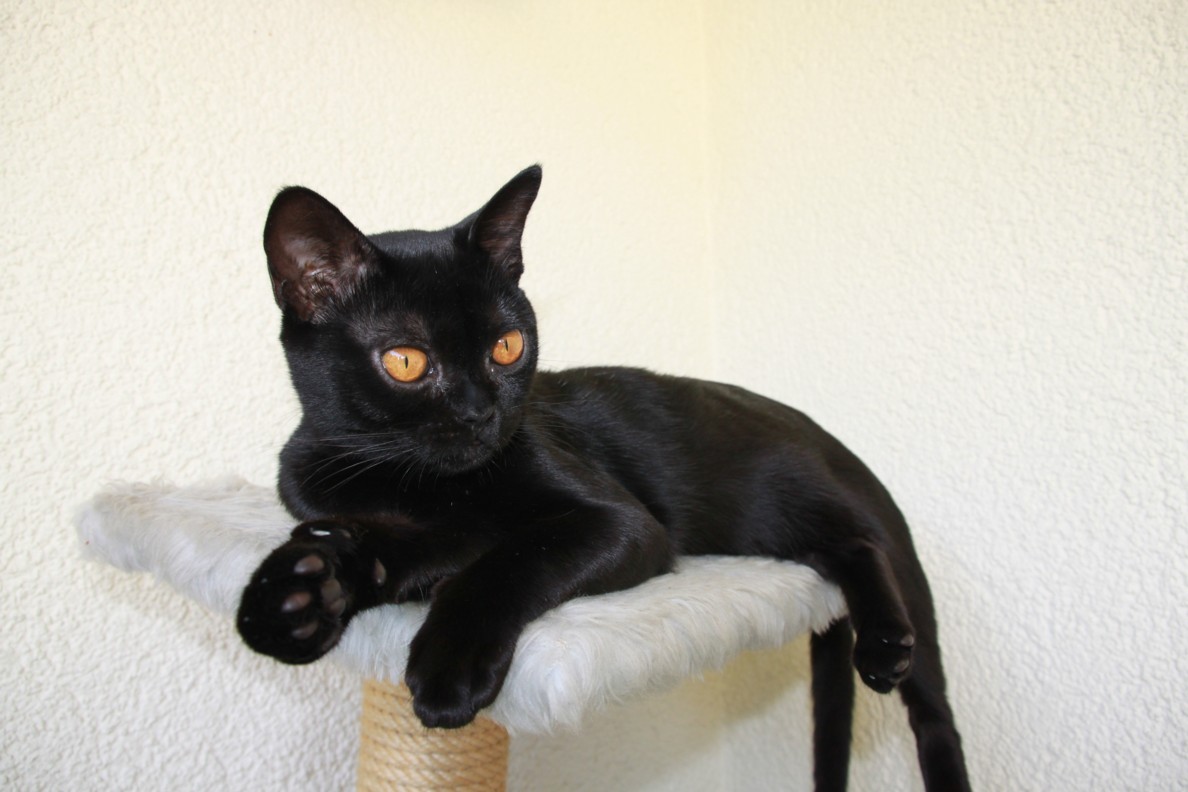
The Bombay (Felis catus) is a relatively modern cat breed, created in the United States in the 1950s by breeder Nikki Horner of Louisville (Kentucky) with the declared objective of obtaining "a small black panther for the apartment". The result is a cat with an unmistakable appearance: brilliant jet-black coat, muscular and compact physique like a small leopard, round copper-gold eyes in stark contrast. Named after the ancient Indian city of Bombay (now Mumbai) in homage to Indian leopards, the breed obtained its first official standard from the American CFA in 1976. The temperament is exceptional: extremely affectionate, social, playful, often defined a "dog-cat" for its propensity to follow the owner, play fetch, greet guests at the door. Breed still little widespread in Europe, it has more and more numerous fans for the charm of the appearance and the sweetness of the character.
Classification and category
The Bombay belongs to the species Felis catus, the domestic subspecies derived from the African wildcat (Felis silvestris lybica). It is classified by TICA as a distinct breed in Category III — Shorthair, by CFA with its own standards, but it is not officially recognised by European FIFe (which considers it a variant of black Burmese). The standard provides for a medium size: weight 3-5 kg for females, 4-6 kg for males, withers height 23-28 cm. The structure is compact, muscular, with "cobby" (gathered) body, solid but agile bone. Full physical maturity is reached at 2 years. There are two recognised variants: American Bombay (Nikki Horner's original, derived from Burmese × black American Shorthair, more compact) and British Bombay (independently developed in UK from Burmese × black British Shorthair, more robust). The breed was officially recognised by the American CFA in 1976, by TICA in 1979, by the British GCCF (for the UK variant) in 1990. The only colour variant allowed is uniform jet black: any other colour excludes the specimen from the breed standard.
Habitat and distribution
The Bombay is a completely domestic breed, perfectly adapted to apartment life. Its calm, social nature and dependence on human company makes it ideal for urban families, even small ones, with children, elderly people and other animals. It is not a breed that lives well outdoors in freedom: the black coat makes it poorly camouflaged (risk of predation and theft), and its excessive trust in strangers makes it vulnerable. It suffers greatly from prolonged solitude (over 5-6 hours) and can develop compulsive behaviours (over-grooming, excessive vocalisations, depression).
The history of the breed is documented and relatively recent. Nikki Horner (breeder of the Shawnee Cattery of Louisville, Kentucky), fascinated by the black Indian leopards she had seen at the zoo, started in 1953 a programme of selective crossbreedings between Burmese sable (Burmese sable cats, compact size) and black American Shorthair (to acquire the solid black colour). After 25 years of patient selection, she obtained the desired phenotype: a medium-small sized cat, shiny black coat like satin, large copper eyes, muscular structure similar to a miniature panther. She baptised the breed "Bombay" in 1958, before the official CFA recognition in 1976. In the last 50 years the breed has spread in North America (USA, Canada), Australia, Great Britain; in continental Europe (including Italy) it is still rare: about 50-100 kittens per year registered in the main kennel clubs. The average price of a pedigree kitten is 800-1,500 euros; show line specimens can reach 2,000-3,000 euros. Beware of prices below 500 euros: often these are common black cats sold as "Bombay" without pedigree.
Diet
The Bombay is an obligate carnivore with medium-high metabolism: the daily caloric requirement of a 4 kg adult is about 280-320 kcal, distributed in 2-3 small meals. The ideal diet consists of high-quality kibble rich in animal protein (minimum 35-40%), or wet feeding (cans) or BARF under veterinary supervision. The breed tends to be "voracious": it has good appetite and can tend to overweight if portions are not controlled, especially after sterilisation.
The breed is generally robust, with few specific genetic predispositions (being recent and derived from controlled crossbreedings). Pathologies to monitor: hypertrophic cardiomyopathy (HCM) (inherited from Burmese, DNA test available), hypokeratosis syndrome (rare, inherited from Burmese), very mild brachycephalic respiratory problems (muzzle shape less crushed than Burmese but more than common European Shorthair). Annual cardio screening from 3 years onwards is recommended. The care of the black coat requires particular attention: it needs weekly brushing to maintain shine, omega-3/6 integration to avoid hair opacity, avoid prolonged exposure to intense sun (the black hair absorbs heat and can fade or turn grey). Water must always be available, fresh.
Physical features
The Bombay has a compact, muscular, well-proportioned body, defined by the standard as "extremely elegant and powerful at the same time, like a small panther". The head has a round shape with full cheeks, strong chin, short but not crushed muzzle (intermediate between Burmese and Persian). The ears are medium, wide at the base, slightly rounded at the tip, well spaced. The eyes are the most iconic trait after the coat: large, round, well spaced, of intense copper-gold colour (the colour must be as dark as possible for a high quality standard — green or yellow disqualifies). The gaze is "feline-magnetic", very expressive.
The coat is the indisputable signature of the breed: short hair (1-2 cm), satin, very brilliant, perfectly jet black (jet black) down to the roots. The hair must have a characteristic "patent leather shine" (like varnished leather), the result of a microscopic structure of the cuticular scales. The standard is very rigorous: the coat must be completely black without any spot, band, shade, frosting, ticking. Any colour other (even a single white hair) excludes from breeding and shows. The skin must be black even under the hair (verifiable on the lips, nose, paw pads, all rigorously black). The legs are of medium length, robust, with black pads. The tail is of medium length, straight, well proportioned to the body (never a thin "whip"). The jet-black hair of high-quality specimens can appear iridescent metallic green-blue under intense sunlight, an optical phenomenon similar to that of the plumage of crows and the coat of some real black panthers.
Behaviour and curiosities
The Bombay has an exceptionally affectionate, social, playful temperament. It is often defined a "dog-cat" for its propensity to typically canine behaviours: it follows the owner around the house, greets guests at the door, easily learns tricks like "sit", "give paw", "come when called", loves to play fetch. It bonds deeply with the owner, often choosing a "favourite human" to whom it is particularly attached. It is a moderate vocal: sweet and melodious meowing, not insistent like the Siamese, never shrill. It actively seeks physical contact, loves to sleep in arms or under the covers.
It is sociable with everyone if well socialised: children, elderly, other cats, calm dogs. It is not territorial or aggressive. It gets along with other Bombays and cats of other breeds. Due to its dependent nature, it is recommended in pairs for those who work full-time: two Bombays keep each other company and suffer less from loneliness. The literary and cultural history is still limited given the recent creation of the breed, but the iconic Salem Saberhagen from the TV series "Sabrina, the Teenage Witch" (1996-2003) is a Bombay (played by several cats), which made the breed popular in the USA in the 90s. Also the Halloween black cat in many American films is usually a Bombay. Longevity is excellent: 12-16 years, with well-cared specimens reaching 18-20 years. Females are slightly longer-lived than males. Scientifically, the Bombay is an interesting example of a breed obtained by selection oriented to a specific aesthetic objective (replicating a wild phenotype in domestic format), with success in relatively short times (25 years of selection for the creator). Similar cases in the modern feline world include the Toyger (miniature tiger replica), Savannah (crossbreeding with Serval), Bengal (crossbreeding with Asian Leopard). The Bombay is considered the "father" of this philosophy of "biomimetic" selection.
Pros
- Mantello nero corvino unico, occhi rame iridescenti
- Carattere 'cane-gatto', addestrabile, affettuoso
- Salute robusta (razza recente, poche patologie ereditarie)
- Longevità eccellente (12-16 anni, fino 20)
Cons
- Predisposto a HCM (cardiomiopatia ereditata da Burmese) - test DNA consigliato
- Soffre molto la solitudine, ideale in coppia
- Raro in Europa, prezzi elevati (800-3.000 €)
- Mantello richiede cura per mantenere lucentezza