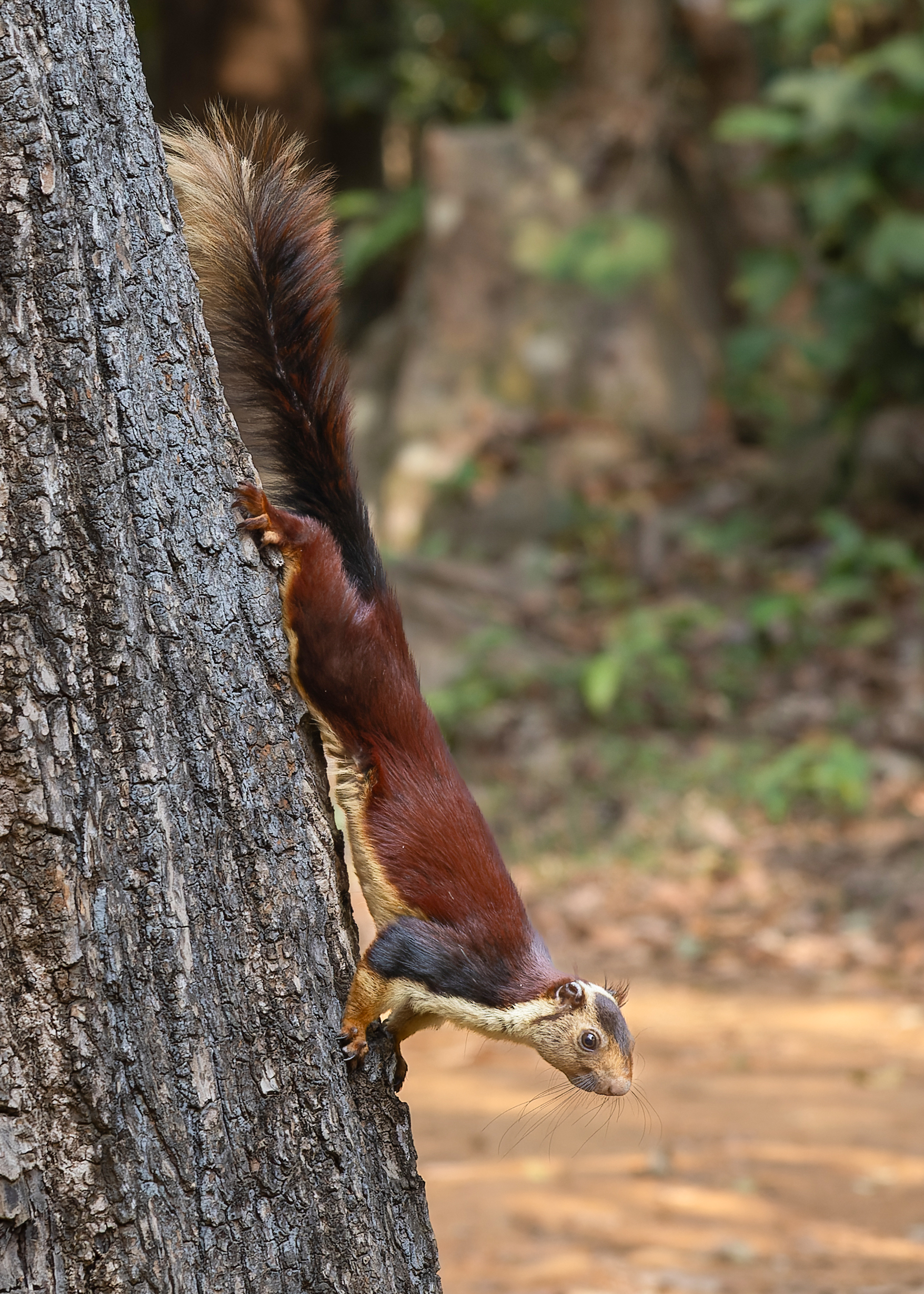
Indian Giant Squirrel
Ratufa indica
Characteristics
Temperament
Diurnal, solitary, shy, almost entirely arboreal. One of the largest and most colourful squirrels in the world ("rainbow" coat of brown, purple-maroon and cream). LEAPS UP TO 6 M between trees without descending, using its very long tail as a balance pole. FEEDS UPSIDE DOWN anchored by its hind feet. Builds several globular dreys among thin branches. Endemic to Indian forests, state animal of Maharashtra. Important seed disperser.
Diet
Arboreal herbivore/frugivore. Fruit (main, from many tree species), flowers and shoots, nuts and seeds (opened with strong incisors), bark, occasional bird eggs and insects. Feeds in the trees, often hanging upside down anchored by the hind feet, tail as balance pole. Disperses seeds while feeding on fruit, an important ecological role in forest regeneration.
The Indian Giant Squirrel (Ratufa indica), also called the Malabar giant squirrel, is one of the world's largest and most colourful rodents, endemic to India's forests. Famous for:
- A GIANT SQUIRREL: among the largest squirrels on Earth — up to about 1 metre total length (body + tail) and 1.5-2 kg!
- "RAINBOW" COAT: a spectacular two- or three-toned livery — brown, purple-maroon, rust and cream — making it one of the world's most beautiful squirrels
- LEAPS UP TO 6 METRES between trees, hardly ever coming to the ground
- Feeds hanging upside down: anchoring with its hind feet to free its forepaws for handling food
- Almost entirely arboreal: lives in the forest canopy
- Builds large globular nests (dreys) high in the trees
- State animal of Maharashtra, India
IUCN status: Least Concern (LC). Widespread in suitable Indian forests but dependent on mature forest — habitat fragmentation is the main threat.
Classification and category
Order Rodentia, family Sciuridae (squirrels), genus Ratufa — the Asian "giant squirrels", the largest of the family, in their own subfamily (Ratufinae). Genus Ratufa: 4 species — R. indica (Indian/Malabar, this entry), R. bicolor (black giant squirrel, Nepal to SE Asia), R. affinis (cream-coloured, Malay Peninsula and Borneo), R. macroura (grizzled, S India and Sri Lanka). Etymology: "Ratufa" from a local Indian name; "indica" for India, where it is endemic; "Malabar" refers to the Malabar coast (SW India) in the Western Ghats. Giant squirrels differ from common squirrels (genus Sciurus, like the red squirrel in the catalogue) by their far greater size, very long bushy tail and vividly coloured coats. Parameters: Head-body 25-45 cm. Tail ~50-60 cm. Total up to ~1 m. Weight 1.5-2 kg. Builds globular nests; usually 1-2 young per litter.
Habitat and distribution
Endemic to India: Western Ghats (the SW coastal range — the species' stronghold), Eastern Ghats, central India (Satpura range and other wooded areas). Habitats: tropical evergreen and semi-evergreen forest with tall trees and a continuous canopy (ideal), moist deciduous forest, mature mixed forest rich in fruit trees. Needs a continuous canopy to travel by leaping without descending. Avoids heavily fragmented forest and cleared land. Lives in the upper forest (canopy/emergent layer), building several globular dreys of twigs and leaves wedged among thin branches (too thin to bear larger predators); uses different nests for sleeping, refuge and rearing young. IUCN: Least Concern, stable, present in many protected areas; fragmentation/forest loss a local threat because it depends on canopy continuity.
Diet
Mainly herbivore/frugivore. Diet: fruit (main — forest fruits of many tree species), flowers and shoots, nuts and seeds (strong incisors open hard shells), bark, occasional bird eggs and insects (protein). Feeding technique: feeds in the trees (rarely descends), often HANGS UPSIDE DOWN, anchoring with its powerful hind feet so its forepaws are free to handle food even inverted; the long tail counterbalances the body during acrobatic feeding; disperses seeds while feeding on fruit (important ecological role). The ability to hang upside down anchored by the hind feet recalls the arboreal acrobatics of other canopy animals in the catalogue (like the Clouded Leopard), letting it reach fruit at the tips of thin branches unreachable by heavier animals.
Physical features
Unmistakable for size and colour. Coat: spectacular two- or three-toned livery varying by population — combinations of dark brown, purple-maroon, rust, beige and cream; typically dark (brown-maroon) upperparts and cream underparts/limbs with a pale band; the bold contrast, surprisingly showy up close, actually AIDS camouflage in the dappled canopy by breaking up the outline (disruptive coloration); thick soft fur. Body: robust elongated squirrel body of exceptional size; very long bushy tail (as long as or longer than the body, used as balance pole and rudder in leaps); rounded head with short rounded ears; large eyes. Climbing anatomy: robust limbs with strong curved claws for firm grip on bark; powerful hind feet for leaping and for anchoring upside down; balance-pole tail essential for 6 m leaps.
Behaviour and curiosities
Diurnal, solitary, shy. Most active in early morning and late afternoon; rests in the nest during the heat. Lives alone or in pairs in the breeding season. When alarmed it flattens motionless against a branch or gives alarm calls and flees by leaping through the canopy. Builds globular dreys of twigs and leaves, well hidden among thin branches; one individual may build several nests, some for sleeping, others for rearing. Small litters (1-2 young), born helpless and tended in the nest until weaning.
Famous: "6-metre leap" — an extraordinary jumper, bounding tree-to-tree up to 6 m, moving through the canopy without ever descending (where it would be vulnerable); the long bushy tail acts as balance pole and rudder. "Rainbow coat": one of the showiest rodent coats (brown, purple-maroon, rust, cream); paradoxically the bright colours aid camouflage in the dappled canopy by disrupting the outline (cryptic-by-disruption). "Feeds upside down": anchors with hind feet and dangles inverted to free the forepaws, reaching fruit on the thinnest branch tips. "Multiple nests": builds several dreys in its territory among thin branches (predator-safe), used for different purposes. "State animal" of Maharashtra ("shekru"); Bhimashankar Wildlife Sanctuary partly protects it. Seed disperser: an important role in forest regeneration. Vs the red squirrel: 6-8x heavier than the European red squirrel (in catalogue), a different lineage (Ratufinae) specialized for the tropical canopy.
Pros
- Tra gli scoiattoli più grandi e colorati del mondo
- Saltatore acrobatico straordinario (fino a 6 m)
- Importante disperdente di semi della foresta
- IUCN Least Concern, presente in molte aree protette
Cons
- Dipende dalla continuità della volta forestale
- Minacciato dalla frammentazione e perdita di foreste
- Elusivo e poco studiato in natura
- Non è un animale domestico (specie selvatica protetta)