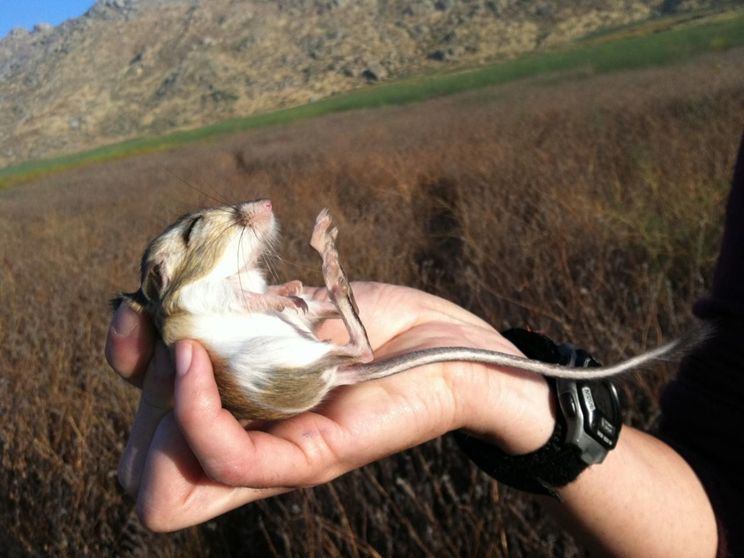
Desert Kangaroo Rat
Dipodomys deserti
Characteristics
Temperament
Solitary, territorial, strictly nocturnal. BIPEDAL (kangaroo-type locomotion): jumps up to 2.7 m, accelerates 0-9 km/h in 30 ms (7 G!). NEVER drinks water: 100% metabolic hydration from seeds. Sealed burrow during day (humid microclimate). "Foot drumming" anti-predators. Evolutionary convergence with jerboa.
Diet
Strict granivore (90-95% seeds). Carries seeds in EXTERNAL CHEEK POUCHES (5-10 g). Accumulates 2-3 kg/year in underground pantries. NEVER drinks water: metabolic hydration + hyper-concentrating kidney (urine 5× more concentrated than human). Water recovery from breath via "counter-current" nose.
The Desert Kangaroo Rat (Dipodomys deserti) is a small rodent (weight 100-180 g, head-body length 11-15 cm, tail 18-22 cm) endemic to the deserts of the South-Western United States and northern Mexico. Its name comes from its most striking feature: bipedal locomotion, similar to that of a miniaturised kangaroo. The hind legs are enormously developed compared to the front, allowing it to make spectacular jumps of up to 2.7 metres long — a distance equal to 18× its body length, the proportional equivalent of a 1.80 m man jumping 32 metres! But its most extraordinary physiological feature is that it NEVER drinks water in its entire life: it obtains all necessary hydration from the metabolism of dry seeds it eats, thanks to hyper-specialised nephrons capable of concentrating urine 5 times more than human kidneys. It is one of the most desert-adapted mammals in the world. Family Heteromyidae (heteromyids), which also includes pocket mice and jumping mice. IUCN status: Least Concern (LC), but with local populations in decline due to habitat loss (urban expansion of Las Vegas, agriculture).
Classification and category
The Desert Kangaroo Rat belongs to the order Rodentia, family Heteromyidae (heteromyids, NOT Cricetidae like most mice/rats), genus Dipodomys. The Heteromyidae family is exclusively North American and includes:
- Kangaroo rats (genus Dipodomys): 22 species, all bipedal and jumping
- Pocket mice (genera Perognathus, Chaetodipus): smaller, quadrupedal
- Mexican jumping mice (Liomys, Heteromys): rainforests
The genus Dipodomys currently comprises 22 recognised species, with a distribution area covering the south-western United States, northern Mexico and Baja California. The best-known species are:
- D. deserti — Desert Kangaroo Rat (Mojave, Sonoran, Death Valley)
- D. merriami — Merriam's Kangaroo Rat (most widespread)
- D. ordii — Ord's Kangaroo Rat (Great Plains)
- D. ingens — Giant Kangaroo Rat (California, CRITICALLY ENDANGERED)
- D. stephensi — Stephens's Kangaroo Rat (California, ENDANGERED)
The species Dipodomys deserti was scientifically described by Stephens in 1887 from Death Valley specimens. Phylogenetic kinship: Heteromyids separated from other rodents about 55-60 million years ago, during the Eocene. They are NOT related to jerboas (Dipodidae) of Africa-Asia, although they have similar appearances — it is a classic case of convergent evolution for desert life. The true kangaroo (marsupial Macropus) is even more distant (placental mammal vs marsupial): the similarities are only morphological/functional.
The morphological parameters: weight 100-180 g (M slightly larger than F); head-body length 11-15 cm; tail 18-22 cm (significantly longer than the body!); hind legs 4-5 cm; front legs 1.5-2 cm (1/3 of the hind). Longevity: 2-3 years in nature, up to 9-10 years in captivity (record 11 years). Sexual maturity: 60-90 days. Gestation: 29-32 days; litter of 2-5 cubs (record 7). Females can have up to 3 litters/year in favourable seasons.
Habitat and distribution
The Desert Kangaroo Rat is a North American desert endemic. Ideal habitat:
- Hot deserts: Mojave, Sonoran, Great Basin, Death Valley
- Sandy and gravelly terrain with sparse vegetation (creosote, mesquite, joshua tree, prickly pear)
- Sand dunes (preference for soft, diggable substrates)
- Altitude: from sea level (Death Valley -86 m) up to 1,500 m
- Temperatures: extremely wide, from -10°C to +50°C on the surface. The underground burrow has constant 25-30°C microclimate
Does NOT tolerate: forests, wetlands, meadows, compact rocky terrain (cannot dig). Geographical distribution covers:
- USA: California (Death Valley, Mojave), Nevada, Utah, Arizona, western Texas
- Mexico: Baja California, Sonora, Chihuahua
Total geographical area: ~500,000 km². Estimated population: several million individuals (density 5-50/hectare). IUCN status: Least Concern (LC) for D. deserti, but D. ingens (California) and D. stephensi are Endangered/Critically Endangered due to urban-agricultural habitat loss. Main threats are: urbanisation (Las Vegas, Phoenix, Los Angeles), intensive agriculture with irrigation (modification of substrate), invasive species (Norwegian rats compete), introduced predators (feral cats, barn owls), climate change (extreme rainfall events destroy burrows). The species is considered ecosystem engineers: digs kilometres of underground tunnels, contributes to seed dispersal (some seeds are "forgotten" in burrows and germinate), and desert soil aeration.
Diet
The Desert Kangaroo Rat is a strict granivore (eats almost exclusively seeds). Diet:
- Desert plant seeds: creosote, mesquite, ambrosia, sage, annual grasses (under rainy season). Constitutes 90-95% of diet
- Insects: occasional, especially in spring (3-5% diet)
- Fruit (cactus): rare, but can supplement in periods of seed shortage
- Green leaves: only in spring, brief period
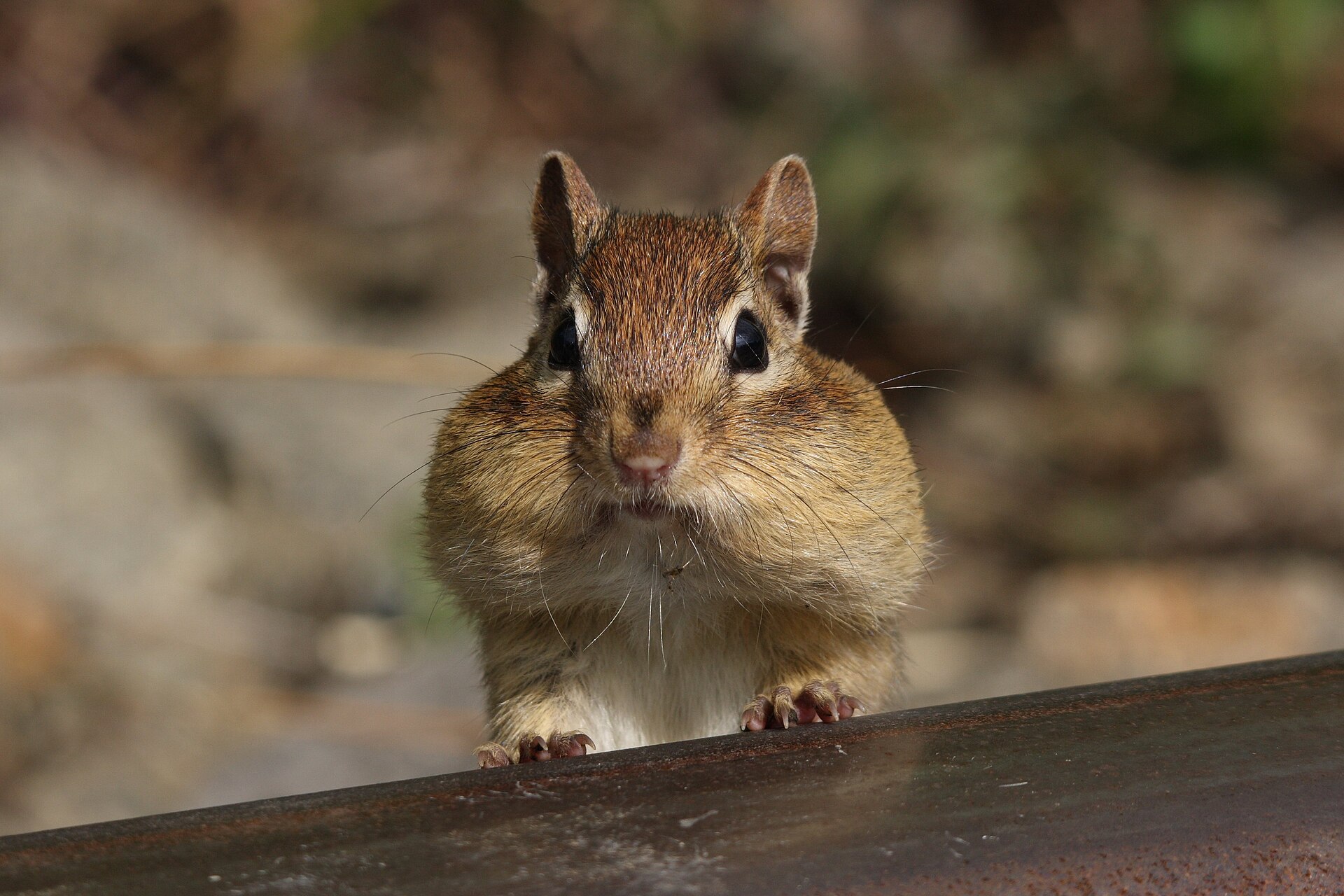
The foraging technique is remarkable: the kangaroo rat walks and jumps on the ground searching for fallen seeds. When it finds a seed, it grabs it with the front legs (short but nimble) and transfers it to the external cheek pouches — characteristic furry skin pockets that open externally (NOT inside the mouth like in friend hamsters). The cheek pouches are accessible from the outside and can hold up to 5-10 g of seeds (5% of body weight). The kangaroo rat carries the seeds to the burrow, where it hides them in underground "deposits". A single kangaroo rat can accumulate 2-3 kg of seeds/year — an enormous supply.
The most surprising physiological feature is zero water requirement. The Desert Kangaroo Rat is one of the most adapted mammals to live without free water in the world:
- NEVER drinks water in life (except rare dew drops accidentally caught)
- 100% metabolic hydration: from "combustion" of carbohydrates and fats from seeds (seeds are dry but metabolising them produces H₂O = "metabolic water")
- Hyper-specialised kidney: kangaroo rat nephrons are 5 times longer than human ones proportionally, capable of concentrating urine to 5,000 mOsm/L (vs 1,000 mOsm/L in humans); urine is 5 times more concentrated than blood
- Water recovery from respiration: the nose has a "counter-current" structure that recondenses moisture from exhaled air (water loss minimised)
- No sweating: never sweats (sweating would disperse water)
- Passive thermoregulation: during the hot day, it stays in a sealed burrow 2-3 m underground where temperature is 25-30°C and humidity 30-50% (vs 5% outside)
Experimental studies (Schmidt-Nielsen, 1964) have shown that the kangaroo rat can survive indefinitely on a single food: dried barley seeds, without access to water. By comparison: a human would die of dehydration in 3-5 days under the same conditions.
Physical features
The Desert Kangaroo Rat has a highly specialised anatomy for jumping and desert life. The body is small (11-15 cm), with distinctive proportions:
- Hind legs: enormously developed (4-5 cm), with elongated tarsi, long fingers with robust nails — pure adaptation to bipedal jumping
- Front legs: small (1.5-2 cm), 5 fingers with nails, used only for handling food and digging
- Tail: longer than the body (18-22 cm), thick at the base, thin at the top, with a characteristic white/black tuft at the tip. The tail serves as an aerodynamic counterweight during the jump (like the kangaroo's tail), and as a "rudder" to change direction in flight
The coat is the typical desert colour: tawny-sandy or light brown back, pure white belly. Characteristic "flagstaffs" — black and white stripes on the hip and tail — are visual signals for conspecifics. The ears are small, round, covered with fur (not large like those of the fennec — the kangaroo rat lives in cool underground burrows, doesn't need to dissipate heat with large ears).
The head is proportionally large, with elongated muzzle. The eyes are large (1/3 of the head), bright black, with excellent night vision (the kangaroo rat is almost exclusively nocturnal). The cheek pouches are visible as two bulges on the sides of the muzzle when full of seeds. The nose has the specialised "counter-current" nasal chambers that recover moisture.
The hairs are fine, dense, slightly shiny. The kangaroo rat takes frequent "sand baths" to clean itself: it rolls vigorously in fine sand, which absorbs oils and excess sebum from the fur. This behaviour (called "dust bathing") is essential for coat health in an environment without free water. Some kangaroo rat species have specialised skin depressions to produce more sebum, which is actively absorbed by the sand.
The burrows are complex and fundamental: a single kangaroo rat digs a system of underground tunnels of 5-30 m total, with 5-20 entrances, 1-3 nesting chambers, 2-5 seed pantries, a chamber for sand baths. The burrow is closed during the day (the kangaroo rat inserts a sand ball at the entrance to seal it) — this creates an underground microclimate with 30-50% humidity and 25-30°C temperature, essential for survival in desert heat (outside temperature can reach 50°C). The burrow also has "passive ventilation" between entrances at different heights.
Behaviour and curiosities
The Desert Kangaroo Rat is a solitary, territorial, strictly nocturnal animal. Goes out only after dusk (1-2 hours after sunset), active for 2-4 hours, then returns to the burrow. Never active during the day (the heat would kill it in minutes — it can suffer heatstroke at 38°C, while the desert surface reaches 50-60°C). Adult males have territories of 0.5-2 hectares, females of 0.2-1 hectare. Territorial marking: urine spray on the burrow entrance, olfactory plugs from anal glands.
Social behaviour: almost always solitary (one individual per burrow). Reproduction: the male seeks the female in the burrow, brief mating (2-5 min); then leaves — no paternity. The female gives birth in an isolated chamber of the burrow. The kittens are born altricial (3-5 g, blind, naked). Rapid growth: open eyes at 14-18 days, leave the burrow at 30 days, independent at 50-60 days. Mothers can be aggressive toward kittens after independence, forcing them to disperse and find their own burrow.
Defensive behaviour: the kangaroo rat is huge prey in the desert (for barn owls, rattlesnakes, coyotes, kit foxes, bobcats, feral cats). Its strategies are:
- Unpredictable movement: bipedal jumping is perfect for zigzag escape, up to 2.7 m per leap, reaches 9 km/h (relative to its weight, an incredible speed)
- Drumming: in the presence of a rattlesnake (one of its main predators), the kangaroo rat "drums" with its hind legs on the ground producing a characteristic rhythm. Function: communicate the danger to family, and sometimes confuse the snake. 2019 studies (Whitford) have shown that some kangaroo rats resist rattlesnake venom — evolutionary adaptation for predator-prey coevolution
- Sand jumping: if attacked by a snake, can jump vertically 60 cm in 50 milliseconds — faster than the snake's strike (200 ms). The vertical jump often includes a "kick" with hind legs that sprays sand into the predator's eyes
- Sealed burrow: during the day, sleeps in a chamber with blocked entrance — predators cannot access
Famous curiosities: the "no-water" physiology was the subject of pioneering studies by Knut Schmidt-Nielsen at Duke University in the 1950s-60s. Schmidt-Nielsen kept kangaroo rats in the laboratory fed only on dry seeds, without water: they survived indefinitely. Their urines were so concentrated that they crystallised releasing salt. Schmidt-Nielsen's book "Desert Animals" (1964) is still the reference on desert adaptation physiology. Name curiosity: Dipodomys derives from the Greek "dipodo-" (two-footed) + "mys" (mouse) = "two-footed mouse". "Kangaroo rat" curiosity: the English name "kangaroo rat" derives from the similarity in bipedal jumping with the kangaroo. However, kangaroo rats are NOT related to kangaroos (placentals vs marsupials). Closest relatives are North American pocket mice. Jerboa curiosity: jerboas (family Dipodidae) of Asia/Africa have similar appearance and locomotion — it is convergent evolution: two independent families have developed the same anatomical solution for desert life. Lunar flight curiosity: NASA studied the kangaroo rat as a model for "life without water" during preparations for the Apollo missions (1960s) — the first "space" study on the kangaroo rat. "Foot drumming" curiosity: the leg drumming has been recorded and analysed — each species has a distinctive "rhythm" (sound signature). Allows species identification in the dark. Speed curiosity: in bipedal jumping, the kangaroo rat accelerates from 0 to 9 km/h in 30 milliseconds — acceleration of 7 G (a NASA astronaut at launch experiences 4 G!). Forgotten seed curiosity: kangaroo rats hide thousands of seeds in their underground burrows. Forgotten seeds that germinate significantly contribute to the regeneration of desert vegetation. They are important seed dispersers: studies show that 30-50% of new mesquite/creosote in some areas comes from seeds dispersed by kangaroo rats. Burrow plug curiosity: the kangaroo rat uses a ball of sand or pellets to seal its burrow during the day. The ball is perfectly sized for the entrance; removed at dusk to exit. Without the plug, the burrow would lose moisture in hours. Petroglyphs curiosity: some indigenous populations of the US South-West (Hopi, Navajo, Apache) depicted the kangaroo rat in their rock petroglyphs. It was a symbol of "persistence in the desert" in folklore. Climate change curiosity: recent studies (2020) show that the kangaroo rat is among the most vulnerable species to global warming despite desert adaptation: increases in night temperatures (below which it goes out) and rainfall changes (altering seed production) threaten its survival. Captive hunting curiosity: the kangaroo rat is one of the most used laboratory animals to study physiological adaptations to the desert, metabolic control, and genetics of water tolerance. Sand earthquakes curiosity: kangaroo rats perceive ground vibrations much better than normal rodents, thanks to specialised inner ears. They can detect a coyote 10 metres away just from the vibrations of its steps in the sand.
Pros
- Adattamento estremo al deserto: vive senza mai bere acqua
- Locomozione bipede unica tra roditori (salto 2,7 m, 7 G accelerazione)
- Ingegnere ecosistemico: contribuisce a dispersione semi
- Sensi acuti: rileva vibrazioni del suolo a 10 m
Cons
- Vulnerabile a urbanizzazione (Las Vegas, LA, Phoenix)
- Predatori abbondanti (sonagli, civette, coyote)
- Predazione da gatti randagi (specie introdotta)
- Cambiamento climatico minaccia produzione semi