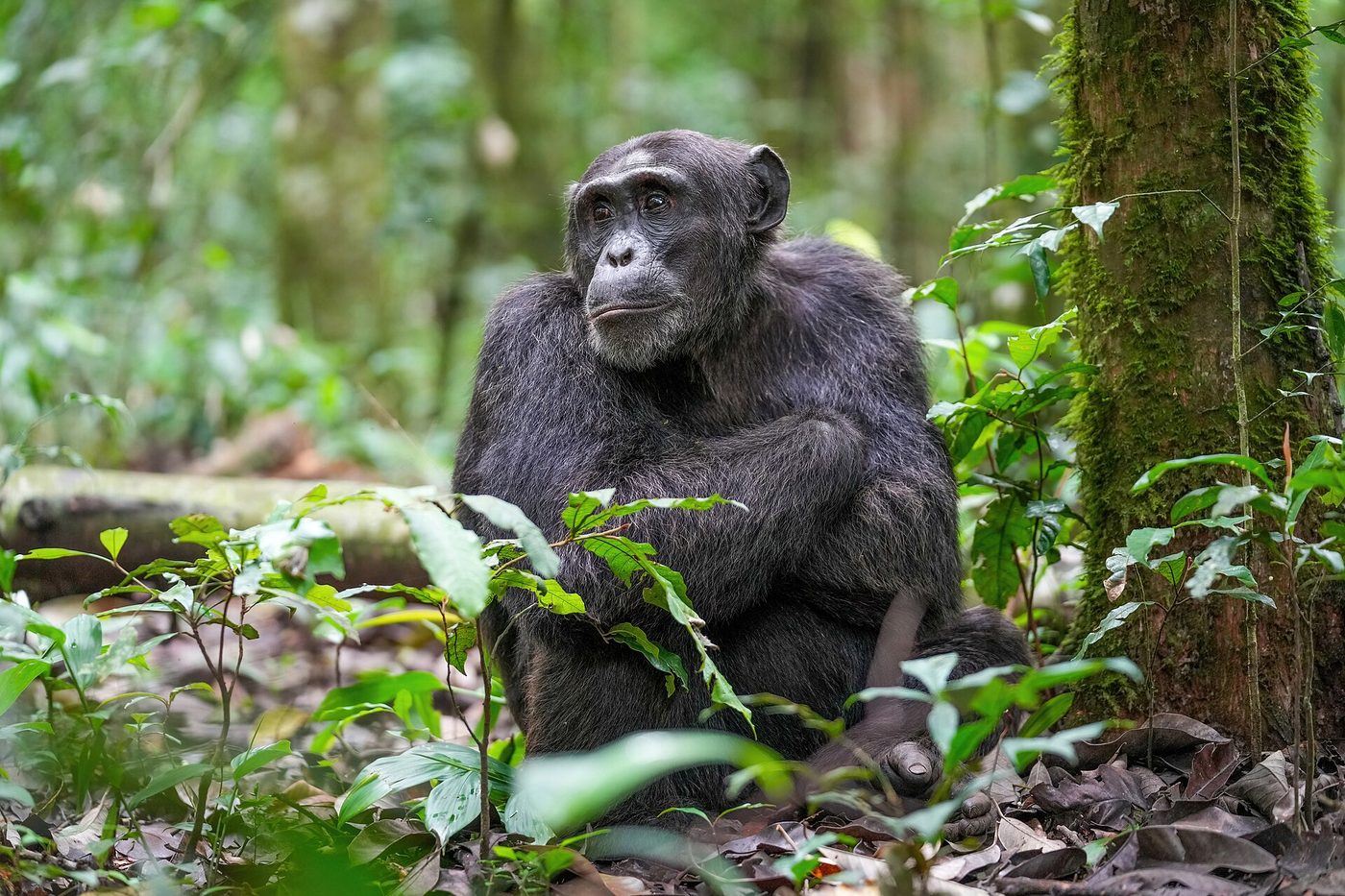
Photo: Giles Laurent · CC BY-SA 4.0
Chimpanzee
Pan troglodytes
Among humankind's closest relatives, the chimpanzee is an extraordinarily intelligent primate, able to use tools, cooperate and feel complex emotions.
Characteristics
Temperament
Extremely intelligent and social, living in communities with a complex structure. Capable of cooperation, empathy and tool use, but also of aggression and territoriality.
Diet
Omnivore: mainly fruit and vegetation, supplemented with insects, eggs and occasional cooperative hunting of small mammals.
Our closest relative
The chimpanzee is, together with the bonobo, the closest living relative of the human being: we share with it the great majority of our genetic heritage. It is a great ape with a sturdy body covered in dark hair, with long, powerful arms suited to climbing and moving among trees, but which walks on the ground leaning on its knuckles. Its hairless face, of mobile expression, reflects a surprisingly rich inner life.
An extraordinary intelligence
The chimpanzee is one of the most intelligent animals on the planet. Its most famous ability is tool use: it modifies twigs to extract termites from their nests, uses stones to crack nuts, chews leaves to make sponges for gathering water. These techniques are not instinctive but learned and passed on: different groups have different traditions, a form of culture. The chimpanzee recognises itself in a mirror, plans, remembers and shows remarkable reasoning abilities.
A complex social life
Chimpanzees live in large communities with an intricate social structure, made of alliances, hierarchies, reconciliations and conflicts. They communicate through a wide repertoire of calls, facial expressions and gestures, and form lasting bonds. They are capable of cooperation, but also of aggressive and territorial behaviour. Their emotional life includes empathy, play, consolation and even forms of grief.
Diet
The chimpanzee is omnivorous: it feeds mainly on fruit and vegetation, but supplements its diet with insects, eggs and, occasionally, the cooperative hunting of small mammals. This dietary flexibility is another sign of its adaptability and intelligence.
Conservation
The chimpanzee is classified as an endangered species. It is threatened by the destruction of African forests, poaching, illegal trade and diseases. Its closeness to humans also makes it vulnerable to our own epidemics. Protecting it means preserving not only a fascinating species, but also a unique window on the origin of our own intelligence.