Photo: en:User:Cburnett · CC BY-SA 3.0
Spectacled bear
Tremarctos ornatus
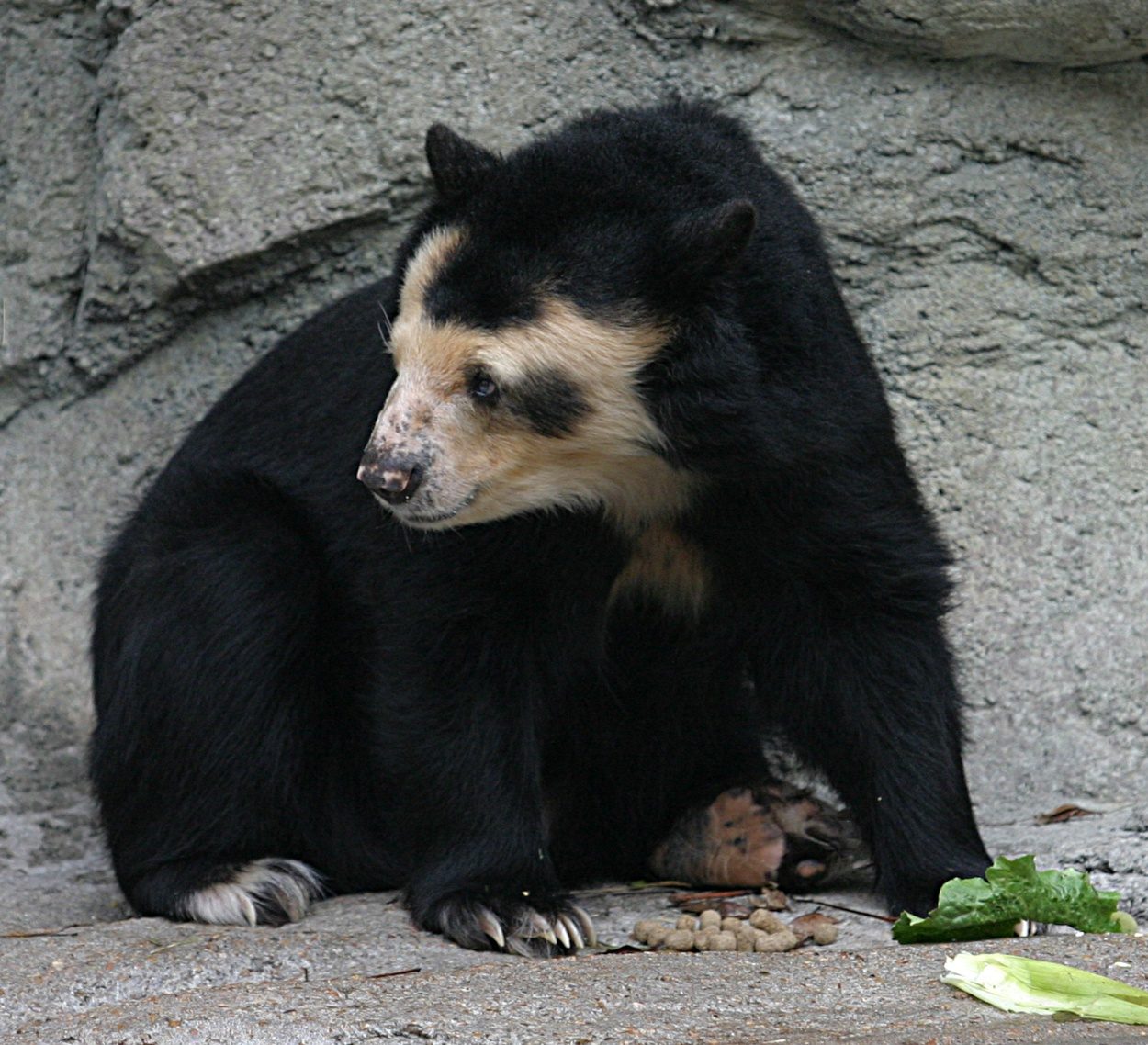
With the characteristic pale markings around its eyes that look like glasses, the spectacled bear is the only bear in South America and one of the most elusive in the world.
Characteristics
Temperament
Shy, solitary, excellent climber
Diet
Mainly herbivore: fruit, shoots, bulbs and bromeliads
The bear with glasses
The spectacled bear, also called the Andean bear, is a medium-sized bear with thick, dark, almost black fur. Its most distinctive feature is the markings of pale, cream or yellowish fur that surround its eyes and often extend over the muzzle, neck and chest: these patterns recall a pair of glasses and are unique to each individual, like a fingerprint. It is the only living bear native to South America and the last representative of the group of short-faced bears. Males are markedly larger than females.
Habitat and distribution
It lives along the Andes mountain range, in northern and western South America, in a great variety of environments: from mountain cloud forests to high-altitude grasslands, right up to the edges of arid zones. It is a typical inhabitant of the mountains, where it skilfully climbs trees in search of food, sometimes building genuine platforms among the branches.
Behaviour and feeding
Unlike most bears, the spectacled bear has a largely vegetarian diet: it feeds above all on fruit, shoots, bulbs and the fleshy bases of bromeliads, only rarely supplementing this with small animals. It is a shy, solitary animal, active mainly at dawn and dusk, and generally avoids humans.
Conservation
The spectacled bear is classified as a vulnerable species. The main threat is the loss of its habitat, due to deforestation and agricultural expansion in the Andes, along with conflicts with humans. It is an animal deeply tied to Andean culture, and the protection of the mountain forests where it lives is essential for its survival.
Pros
- The only bear in South America
- 'Spectacle' markings unique to each individual
- Excellent climber
- Largely vegetarian diet
Cons
- Vulnerable species
- Threatened by deforestation and conflicts with humans
- Elusive and hard to study