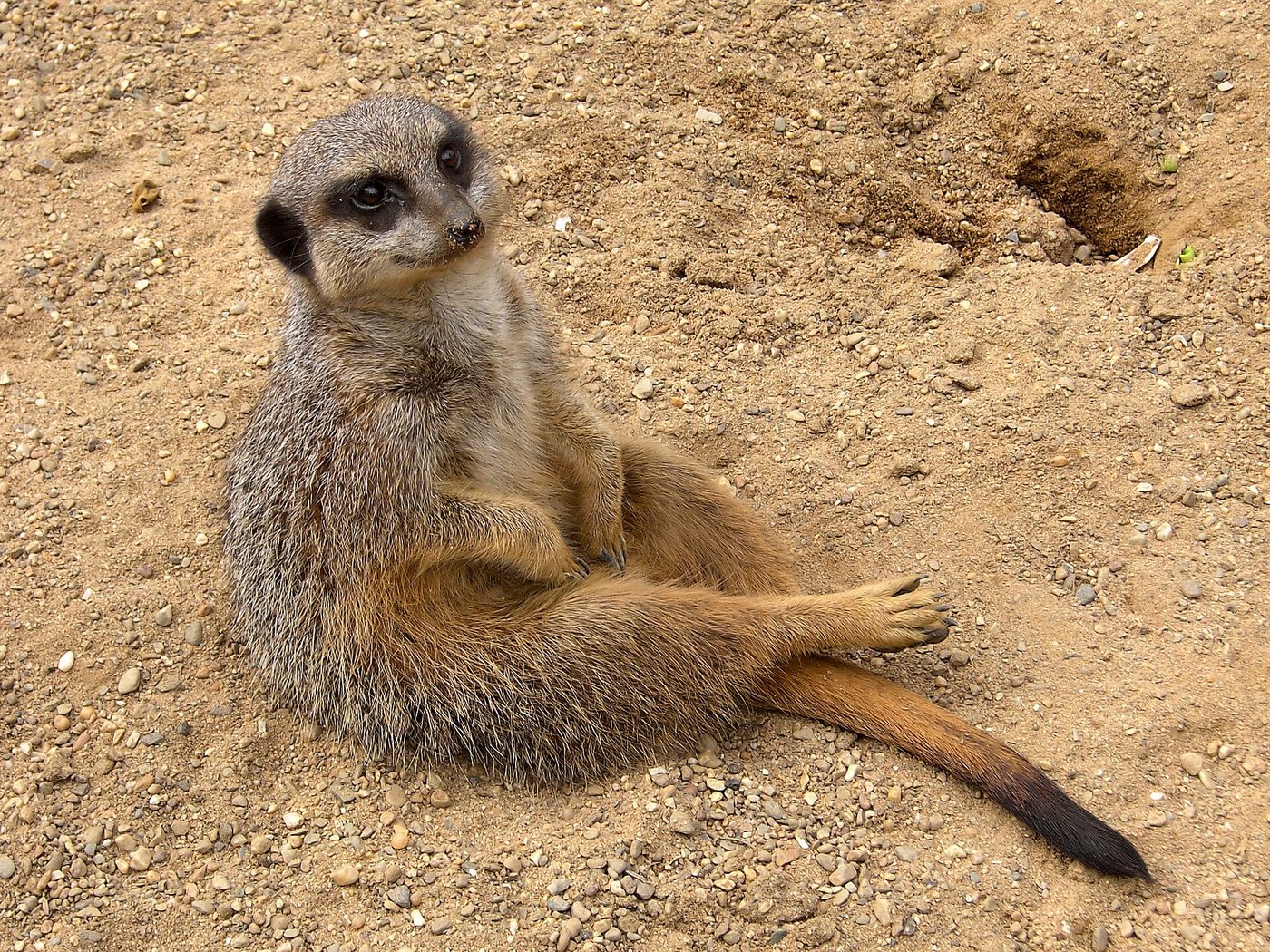
Photo: Hans Hillewaert · CC BY-SA 4.0
Meerkat
Suricata suricatta
A little sentinel of the African desert, the meerkat lives in close-knit colonies where each individual has a role, among standing guards, diggers and babysitters.
Characteristics
Temperament
Extremely social and cooperative, living in organised colonies with guards, diggers and babysitters. Watchful and active by day; it communicates with specific alarm calls.
Diet
Insectivore: mainly insects and invertebrates uncovered by digging, with small reptiles, eggs and occasionally scorpions.
A small social mongoose
The meerkat is a small mammal belonging to the mongoose family, found in the arid regions of southern Africa. It has a slender build, a pointed muzzle, a long thin tail and pale fur with faint dark bands across the back. Its eyes are ringed with dark fur that reduces the sun's glare, like a kind of natural sunglasses. But what makes the meerkat extraordinary is not its appearance, but its extremely organised social life.
The standing sentinel
The most famous image of the meerkat is that of the animal upright on its hind legs, body erect and gaze attentive to the horizon. It is the sentinel's posture: while the rest of the colony searches for food, one or more individuals stand guard from a raised spot, ready to raise the alarm at the first sign of danger, such as an approaching bird of prey. Each type of threat has a different call, and the whole colony knows how to react.
A team life
Meerkats live in colonies that can number dozens of individuals, with a complex social structure. Tasks are shared: some stand guard, others dig and maintain the intricate system of underground burrows, others still care for the young as babysitters while the parents search for food. This cooperation is the key to their survival in a hostile environment.
Diet and habitat
The meerkat feeds mainly on insects and other invertebrates, which it uncovers by digging in the ground with the long claws of its forepaws. It supplements its diet with small reptiles, eggs and occasionally scorpions, towards whose venom it shows some resistance. It lives in savannas and deserts, where the underground burrows offer shelter from the heat of the day and the cold of the night.
Conservation
The meerkat is classified as least concern and its populations are stable. It is not a threatened species, and its extraordinary social organisation, cooperative care of the young and famous sentinel behaviour make it one of the most studied and best-loved animals of the African fauna.