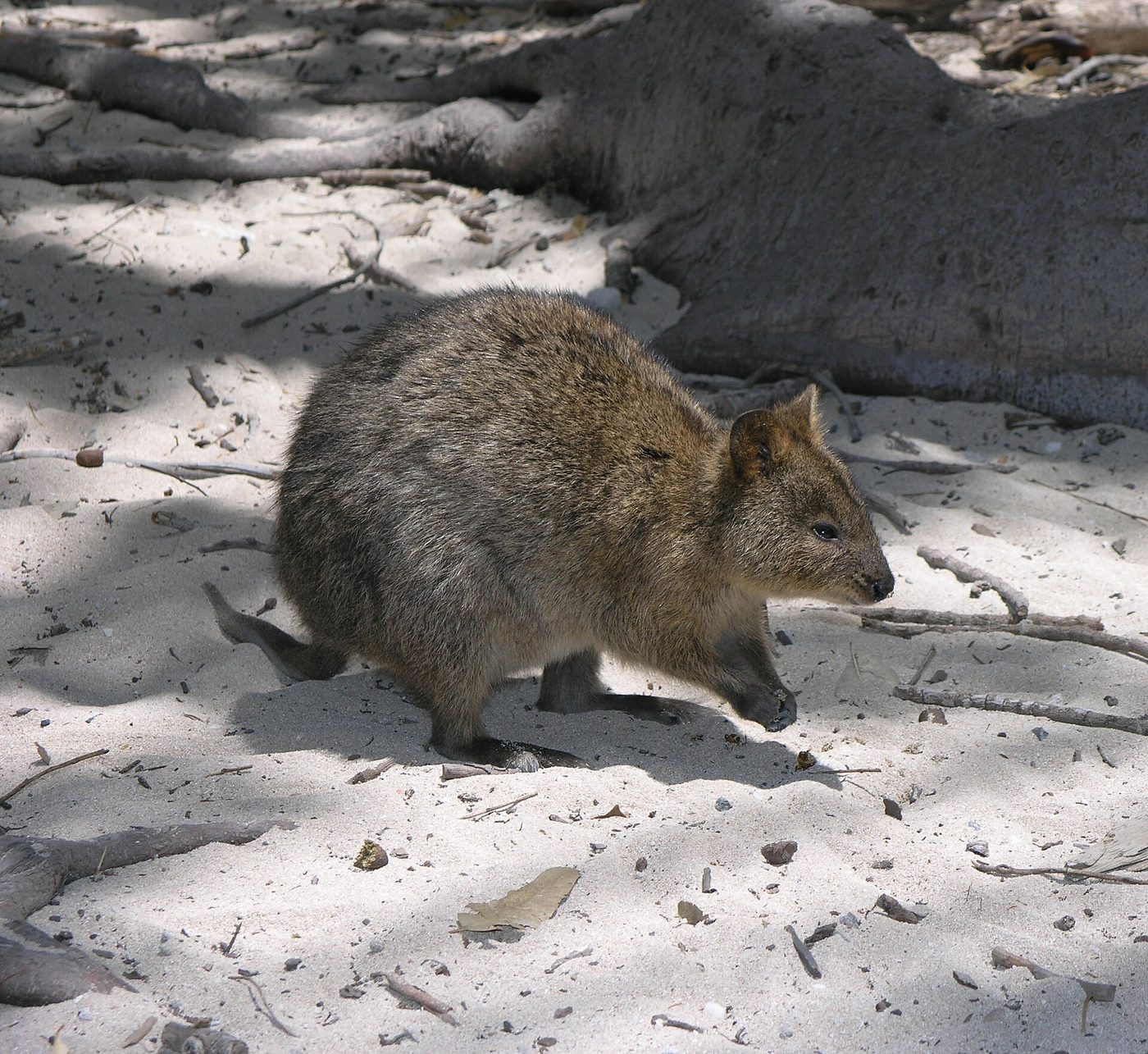
Photo: en:User:SeanMack · CC BY-SA 3.0
Quokka
Setonix brachyurus
A small marsupial with a smiling look, the quokka has become famous as 'the happiest animal in the world', a symbol of the islands of Western Australia.
Characteristics
Temperament
Seemingly sociable but wild; nocturnal
Diet
Herbivore: grasses, leaves, shoots and bark
The marsupial that seems to smile
The quokka is a small Australian marsupial, roughly the size of a domestic cat, that has become famous around the world for its expression: the shape of its mouth and cheeks gives it a constantly smiling look, which has made it a star of social media. It belongs to the same large family as kangaroos and wallabies, and like them it moves in small hops on sturdy hind legs. It has a greyish-brown coat, short rounded ears and a relatively short tail.
Habitat and distribution
The quokka lives only in a small area of Western Australia. The largest and best-known population is found on Rottnest Island, an island near Perth, where the animals, used to human presence, allow people to approach easily. Some smaller populations also survive on the mainland, in areas of dense, moist scrub. It prefers environments with low, dense vegetation, which offers it shelter from the heat and from predators.
Behaviour
It is a mainly nocturnal, herbivorous animal: it feeds on grasses, leaves, shoots and bark. During the day it rests in the shade of the vegetation, while in the cooler hours it moves about to feed. It can climb small shrubs to reach the tenderest leaves. Like all marsupials, the female carries her young in a pouch, where it completes its development after birth.
Curiosities
The name of the island where it lives, Rottnest, comes from a Dutch expression meaning 'rats' nest': the European explorers who landed there mistook the quokkas for large rats. It should be remembered that, however sociable they may appear, they are wild and protected animals: touching them or feeding them is forbidden and harmful to their health.
Conservation
The quokka is classified as a vulnerable species. The mainland populations are threatened by habitat loss, fires and predators introduced by humans, such as foxes and cats. The islands, free of these predators, remain crucial strongholds for the species. Protecting these environments is essential to ensure a future for one of the most beloved and recognisable animals in Australia.
Pros
- Unmistakable funny, 'smiling' look
- Symbol of Western Australia
- Well adapted to protected island life
Cons
- Vulnerable species
- Threatened by introduced predators on the mainland
- Must not be touched or fed: it is a protected wild animal