Photo: KeresH · CC BY-SA 3.0
Short-beaked echidna
Tachyglossus aculeatus
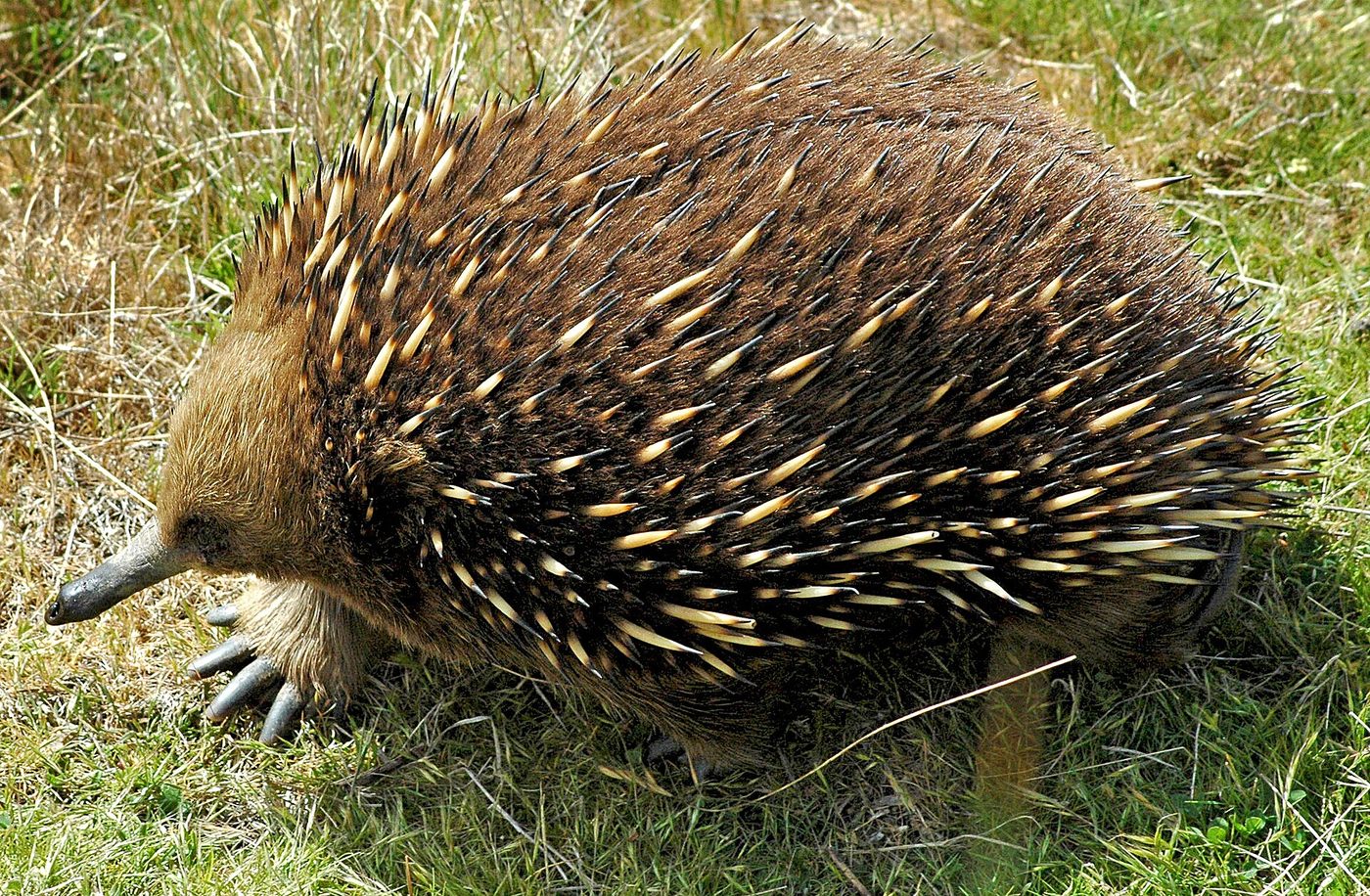
The short-beaked echidna is one of the rare mammals that lay eggs: a small Australian animal covered in spines, with a beaked snout and a lightning-fast tongue.
Characteristics
Temperament
Solitary, quiet, shy
Diet
Insectivorous: ants and termites
A mammal that lays eggs
The short-beaked echidna is one of the very few mammals in the world to lay eggs: it belongs to the monotremes, the ancient group that also includes the platypus. It has a stocky body covered in coarse fur and stout spines, an elongated beak-like snout and a thin, sticky tongue it can extend at great speed. Its legs are short and powerful, with strong digging claws. It has no teeth: it grinds its prey between tongue and palate.
Habitat and range
It lives across almost all of Australia, including Tasmania, and in south-eastern New Guinea. It is the native mammal with the widest range on the Australian continent, able to adapt to forests, grasslands, arid zones and even snowy mountain areas.
Behaviour and diet
It feeds mainly on ants and termites, which it gathers with its tongue after tearing open nests with its claws. It is a solitary, quiet animal. When threatened, it rolls into a ball of spines or digs itself quickly into the ground, leaving only its spiny armour exposed.
Reproduction
The female lays a single egg, which she incubates in a temporary belly pouch. After hatching, the young — called a puggle — stays in the pouch feeding on milk until its growing spines force it out. It is a reproductive cycle unique among mammals.
Conservation
The species is listed as Least Concern by the IUCN and remains widespread. Its adaptability and specialised diet make it resilient, though locally it suffers from road traffic and predation by introduced species.
Pros
- One of the rare egg-laying mammals
- Extraordinarily long-lived
- Very adaptable to different habitats
Cons
- Vulnerable to road traffic
- Preyed on by introduced species such as foxes