Andean cock-of-the-rock
Rupicola peruvianus
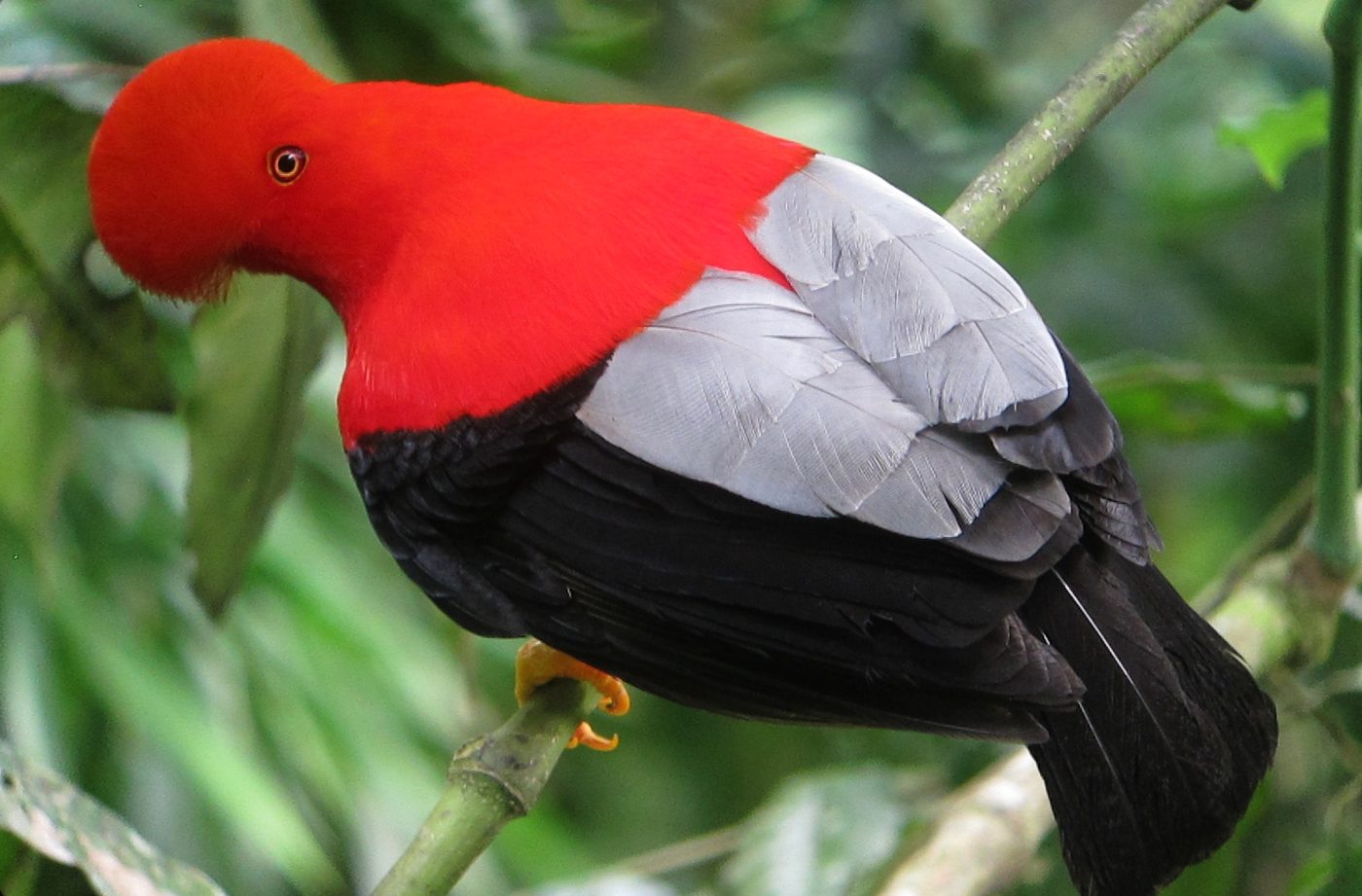
With its flaming orange plumage and showy fan-shaped crest, the Andean cock-of-the-rock is the national bird of Peru and one of the wonders of the Andean cloud forests.
Characteristics
Temperament
Lively, gregarious at courtship leks
Diet
Frugivore: fruit, with insects and small animals
A bird of flaming colours
The Andean cock-of-the-rock is one of the most spectacular birds in South America. The male is impossible to mistake: its body is clad in a brilliant, intense and luminous orange or red, contrasting with black wings and tail and some grey feathers. Its most distinctive feature is the large disc- or half-moon-shaped crest that covers much of its head, almost hiding the beak. The female, by contrast, has a far more subdued and camouflaged reddish-brown plumage, suited to remaining unnoticed while nesting.
Habitat and distribution
It lives in the cloud forests of the Andes, along the humid slopes facing the Amazon, from Venezuela to Bolivia, passing through Colombia, Ecuador and Peru. It prefers areas with rock walls, gorges and watercourses, where it finds the sheltered crevices in which it builds its nest. It is a typical inhabitant of the mid-altitudes of the cordillera, in an environment perpetually wrapped in mist.
Courtship at the lek
The most fascinating behaviour of this species is its collective courtship. The males gather in traditional areas called leks, where they display through dances, leaps, bows and sonorous calls to attract the females. It is a true competition of beauty and vitality: the female watches and chooses her partner, then takes care alone of building the nest and raising the young, cementing mud against the rock walls.
Feeding
It feeds mainly on fruit, which it gathers among the forest vegetation, supplementing its diet with insects and small animals. By feeding on fruit, it helps to disperse seeds and thus to regenerate the cloud forest in which it lives.
Curiosities and conservation
The Andean cock-of-the-rock is the national bird of Peru, where it is known by the Quechua name tunki. It is classified as a species of least concern, with populations still widespread, although the destruction of cloud forests represents a local threat to its habitat.
Pros
- One of the most spectacular orange plumages
- National bird of Peru
- Fascinating collective courtship at leks
- Disperses seeds, regenerating the forest
Cons
- Tied to the Andean cloud forests
- Locally threatened by deforestation
- Very conspicuous, and so exposed, males