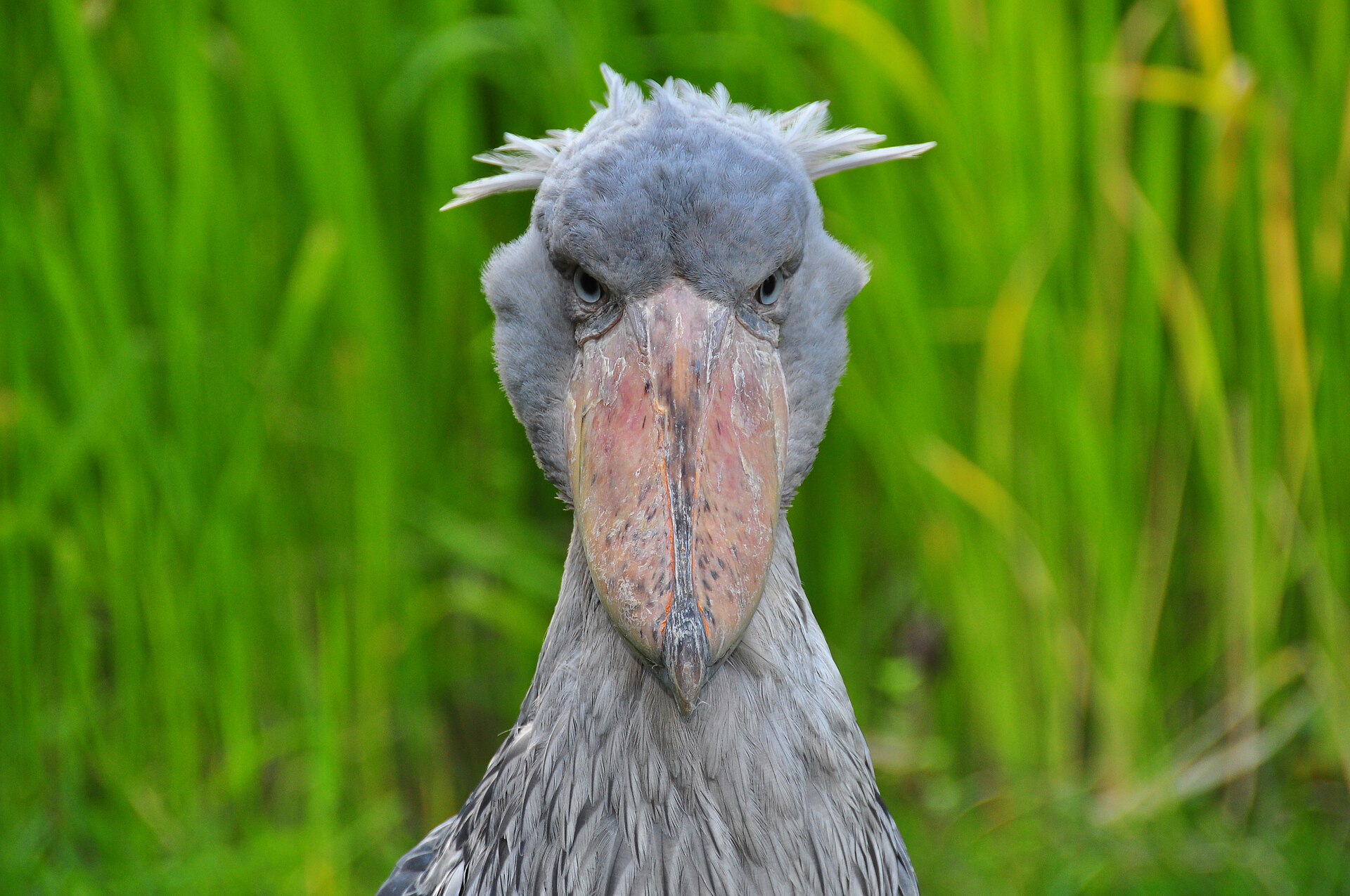
Shoebill
Balaeniceps rex
Characteristics
Temperament
Solitary, silent, infinitely patient. "Prehistoric" bird of African swamps, up to 1.5 m tall, with a huge shoe-shaped bill (hook and sharp edges). Ambush predator: stands MOTIONLESS for hours, then strikes with a lightning lunge ("the collapse"). Eats lungfish, water snakes and even baby crocodiles. Communicates by bill-clattering (machine-gun-like). Fixed, statue-like stare. Internet star. Binocular vision, very slow wing-beat.
Diet
Carnivorous swamp predator, specialized in fishing. Lungfish (Protopterus, main air-breathing prey that surfaces), other fish (catfish, tilapia, eels), reptiles (water snakes, monitor lizards, baby crocodiles, turtles), frogs, small waterfowl, rodents. "Collapse" hunting: stands motionless for hours, then throws its whole body onto prey; sharp edges and hook hold it, often decapitating before swallowing.
The Shoebill (Balaeniceps rex), also called Whalehead or shoe-billed stork, is one of the world's most extraordinary, large and "prehistoric" birds, living in the swamps of central and eastern Africa. Famous for:
- THE HUGE "SHOE" BILL: a gigantic clog/shoe-shaped bill (up to 24 cm long, 20 cm wide), with a sharp hook at the tip and sharp edges — a deadly weapon for catching large prey!
- PREHISTORIC LOOK: up to 1.5 m tall, statue-still, with a fixed penetrating stare — like a surviving dinosaur
- "COLLAPSE" HUNTING: stands motionless for hours, then strikes prey with a lightning lunge, throwing its whole body forward — one of the most spectacular strikes in birds
- Even eats baby crocodiles: its favourite prey is lungfish, but it also catches water snakes and baby crocs
- Bill "machine gun": mostly silent, it communicates with a distinctive bill-clattering
- Internet star: its charismatic look and "death stare" made it famous online
IUCN status: Vulnerable (VU). Threatened by wetland destruction, disturbance and illegal capture (much sought by collectors and zoos). Only a few thousand remain in the wild.
Classification and category
Order Pelecaniformes (pelicans and allies), family Balaenicipitidae, genus Balaeniceps. It is a species UNIQUE in its genus and family (monotypic): no other bird is like it, and it is the only living member of its lineage. Long debated: traditionally linked by appearance to storks (Ciconiiformes — hence "shoe-billed stork"), but modern genetics place it in Pelecaniformes, near pelicans and herons; it remains a very isolated bird with no close living relatives. Etymology: "Balaeniceps" Latin "balaena" (whale) + "caput" (head) = "whalehead" for the huge bill; "rex" = "king". "Shoebill" describes the bill's shape. Parameters: Height 110-140 cm (up to 150). Wingspan 230-260 cm. Weight 4-7 kg. Bill up to 24 cm long, 20 cm wide. Longevity ~35 years wild (up to 50 captive). Nests on floating vegetation; 1-3 eggs but usually only ONE chick survives (siblicide).
Habitat and distribution
Freshwater wetlands of tropical central and eastern Africa: South Sudan (the vast Sudd, a stronghold), Uganda (Lake Victoria and Nile swamps — key for birdwatching), DR Congo, Zambia (Bangweulu swamps), Tanzania, Rwanda, Ethiopia (limited). Habitats: papyrus swamps (main), freshwater marshes with floating vegetation, areas with low-oxygen water where lungfish surface to breathe (easier prey!), undisturbed marshes with little human presence. Avoids deep open water, urban areas, drained swamps. Closely tied to large undisturbed wetlands; prefers low-oxygen areas where its favourite lungfish prey must surface. Wetland destruction and draining are the main threats. IUCN: Vulnerable, ~5,000-8,000 individuals, declining — wetland loss (agriculture, grazing, fires), nest disturbance, illegal capture of chicks and adults for trade (highly prized by zoos and private collectors).
Diet
Carnivorous predator specialized in fishing. Diet: lungfish (Protopterus) — the main prey (large air-breathing fish that surface), other fish (catfish, tilapia, eels, bichirs), reptiles (water snakes, monitor lizards, BABY CROCODILES, turtles), amphibians (frogs), other animals (small waterfowl, rodents, snails). The legendary "collapse" hunting technique: (1) total stillness — stands perfectly motionless for minutes or hours, staring at the water like a statue; (2) the wait — until prey surfaces or approaches; (3) "the collapse" — with a lightning movement it throws its whole body (head, neck, bill) onto the prey, often ending almost prone in the water; (4) the grab — the huge bill closes on the prey, sharp edges and hook holding and wounding it; (5) preparation — shakes the bill to remove water and vegetation, often decapitates prey with the sharp edges before swallowing. An ambush predator of extreme patience — "stand and wait" taken to the extreme; its "collapse" is one of the most powerful, spectacular strikes among birds.
Physical features
An imposing, unmistakable, almost prehistoric look. The bill (the most extraordinary feature): enormous, clog/shoe-shaped, broad and rounded; up to 24 cm long, 20 cm wide; grey-horn with dark streaks; sharp hook at the tip (to grip slippery prey); sharp edges (to wound and decapitate). Plumage and body: uniform blue-grey with paler tones; huge head with a small nape crest; large pale eyes set forward for BINOCULAR vision (rare in birds, useful for judging distance when striking); robust but relatively short neck; long legs with big toes to walk on floating vegetation without sinking. Flight and behaviour: large wings (span to 2.6 m); slow flight, neck retracted (like herons), one of the SLOWEST wing-beat rates of any bird (~150/min); bill-clattering — a machine-gun-like drumming of the bill used to communicate.
Behaviour and curiosities
Solitary, silent, infinitely patient. So solitary that even members of a pair tend to forage at opposite ends of their territory. Mostly sedentary, most active at dawn and dusk. Its statue-like stillness is legendary. Builds a large platform nest on floating vegetation or islets, hidden among papyrus; lays 1-3 eggs; to protect them from African heat, parents carry water in the bill and pour it over the eggs to cool them, and wet the chicks too; usually only one chick survives (the larger firstborn often eliminates younger siblings — siblicide, common when resources are limited).
Famous: "prehistoric look" — often called the most dinosaur-like bird; its massive size, statue stillness, fixed penetrating stare and huge bill give it an ancient, almost menacing aura, making it an internet star (its "death stare" and bill sounds went viral). "Collapse" hunting: throws its whole body onto prey in an explosive lunge, often nearly prone in the water. "Crocodile eater": powerful enough to take baby crocodiles, water snakes, monitors, turtles — a true king of the swamp (hence rex). Bill-clattering: machine-gun-like drumming as greeting/display (one of its few sounds). "Slowest wing-beat": ~150/min, majestic flight, neck in an S. "Bowing": at sanctuaries it bows to trusted keepers. Egg-cooling: pours water from its bill onto eggs in the heat. Conservation: a flagship for African wetland conservation; birdwatching tourism (Uganda, Zambia) helps protect swamps, but illegal chick trade (tens of thousands of dollars each) and habitat loss remain serious threats.
Pros
- Uccello unico al mondo — specie monotipica dall'aspetto preistorico
- Predatore straordinario (caccia "al crollo", mangia coccodrilli)
- Star di internet, specie-bandiera per le zone umide
- Molto longevo (fino a 50 anni)
Cons
- IUCN Vulnerabile — poche migliaia in natura
- Minacciato da distruzione delle paludi e cattura illegale
- Riproduzione lenta (di solito un solo pulcino sopravvive)
- Non è un animale domestico (uccello selvatico protetto)