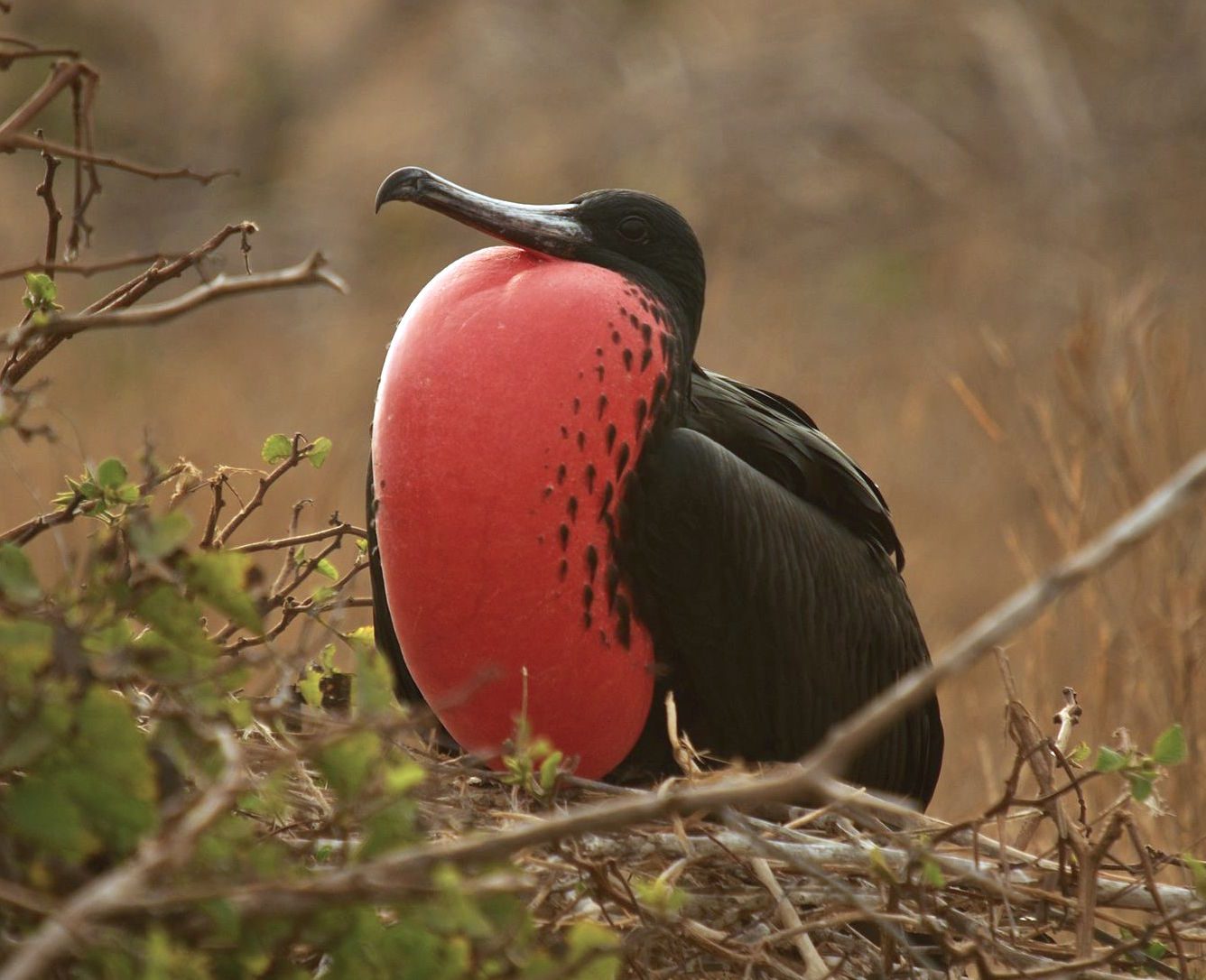
Magnificent frigatebird
Fregata magnificens
With its enormous wingspan and the males' showy red throat pouch, the magnificent frigatebird is a pirate of the tropical skies, able to fly at extraordinary speeds.
Characteristics
Temperament
Aerial, gregarious, opportunistic
Diet
Fish-eater: fish and squid, often stolen from other birds
A lord of the tropical skies
The magnificent frigatebird is the largest of the frigatebirds, seabirds of unmistakable appearance. It has a relatively light body but an enormous wingspan, which can exceed two metres, along with long, pointed, angular wings and a scissor-like forked tail. Its plumage is mainly black, with metallic sheens. The most spectacular feature belongs to the male: a pouch of bare skin under the throat which, in the breeding season, inflates until it becomes a huge balloon of bright red.
Habitat and distribution
It lives over the tropical and subtropical waters of the Americas, along the Pacific coasts from northern Mexico to Peru and along the Atlantic coasts from Florida to southern Brazil. There are also populations in the Galápagos and Cape Verde. It nests in colonies on islands and coasts, but spends much of its life in flight over the open sea.
An extraordinary flight and 'piracy'
The frigatebird is one of the queens of flight: extremely light in proportion to its wings, it can glide for hours by exploiting air currents with minimal effort, and is one of the fastest birds in the world. Curiously, however, it cannot take off from the water, because its plumage is not waterproof, and so it avoids landing on the sea. It is famous for kleptoparasitism: it chases other seabirds in flight and harasses them until they regurgitate their food, which it steals in mid-air. It also catches fish and squid directly from the surface without diving.
Courtship and conservation
During courtship the males gather and inflate their red throat pouch, displaying it to the females in flight while beating their wings and producing sound vibrations. It is classified as a species of least concern. (Note: the weight value on Wikidata, 88 kg, is clearly wrong; the real weight is around 1.1–1.6 kg.)
Pros
- Enormous wingspan, extraordinary flight
- Among the fastest birds in the world
- Spectacular red throat pouch in males
- Unthreatened populations
Cons
- Cannot take off from the water
- Depends on other birds for part of its food
- Sensitive to disturbance of breeding colonies