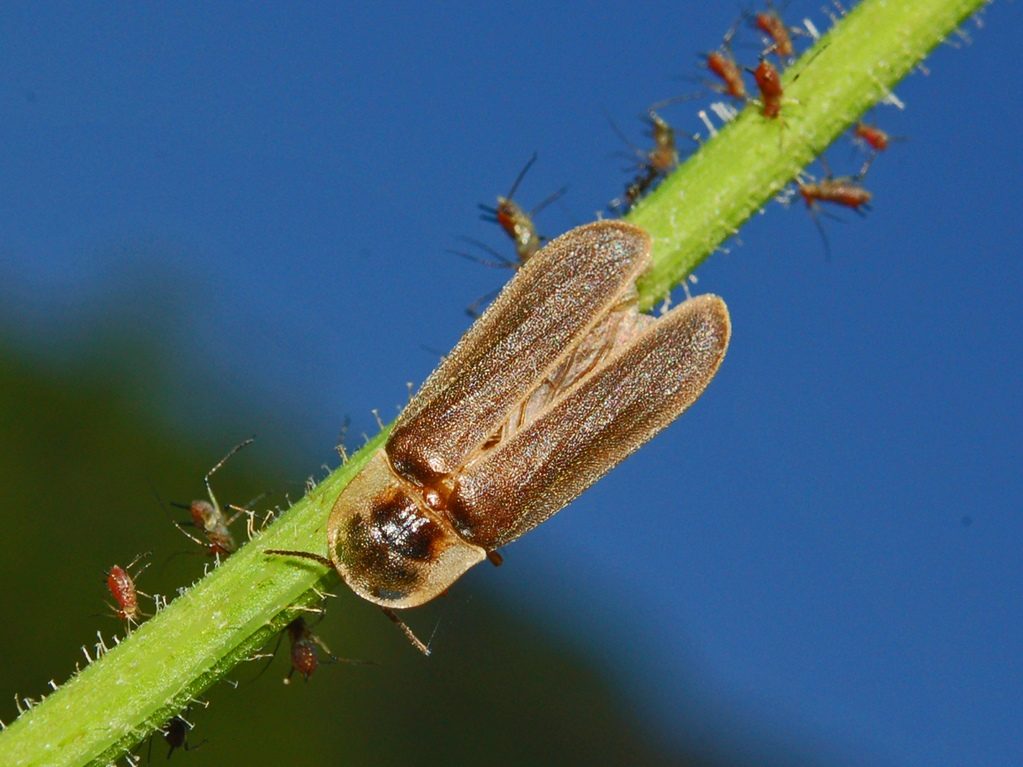
Photo: Hectonichus · CC BY-SA 3.0
Common glow-worm
Lampyris noctiluca
On summer nights the glow-worm lights its little green lantern: a signal of love made of living light, without heat or flame.
Characteristics
Temperament
Nocturnal, active on summer evenings
Diet
The larvae prey on snails and slugs
The insect that glows in the dark
The common glow-worm is a small beetle famous for an extraordinary quality: the ability to emit its own light. On warm evenings in early summer, its greenish glimmers dot meadows, hedgerows and woodland edges, creating one of the most poetic spectacles in nature. The light comes from special organs at the end of the abdomen, where a chemical reaction produces a cold luminescence, that is, without release of heat. Males and females look very different: the male is winged and resembles an ordinary beetle, while the female remains larva-like, wingless, and it is she who glows most brightly.
Habitat and distribution
The common glow-worm is widespread across much of Europe and Asia. It prefers moist, vegetation-rich environments: rough meadows, clearings, hedges, banks and untidy gardens, where the darkness of night is not disturbed by artificial lights. The presence of dark areas is essential to its life, because the light signals only work where the night sky is dark enough.
A language of light
The glow-worm's bioluminescence is not a mere ornament: it is a refined communication system for courtship. The female, perched among the grass, emits a continuous light to attract flying males, who in turn search the darkness for these living beacons. The larvae are predators and feed on small snails and slugs, thus also contributing to the balance of gardens. The whole adult life cycle is short and devoted to reproduction.
Curiosities
The light of glow-worms has fascinated people of every age, entering the poems, legends and symbols of many cultures. It is one of the few completely natural, 'cold' sources of light, so efficient that it wastes almost no energy as heat, a phenomenon that still inspires scientific study today.
Conservation
In many regions glow-worms have become rarer, and their decline is worrying. Among the main causes are light pollution, which confuses their signals of love, the loss of meadows and hedges, the use of pesticides and the disappearance of the snails on which the larvae feed. Leaving wild corners of the garden and reducing night-time lighting are simple but precious gestures to help them.
Pros
- Spectacular bioluminescence on summer nights
- Useful in the garden: larvae eat snails
- Harmless to humans
- Indicator of healthy, unpolluted environments
Cons
- Very sensitive to light pollution
- In decline in many regions
- Short adult life