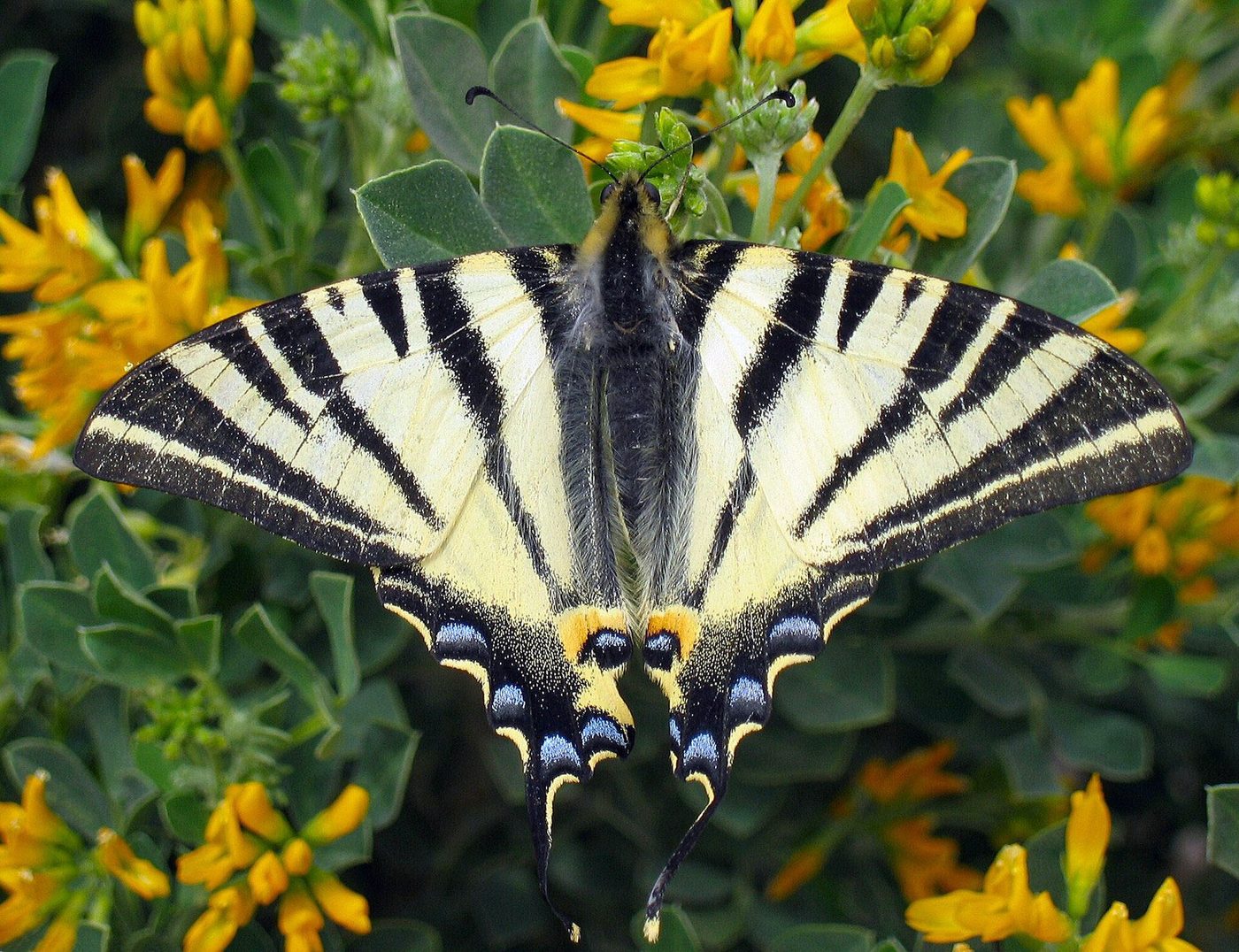
Photo: Tbc · Public domain
Scarce swallowtail
Iphiclides podalirius
The scarce swallowtail is a large, striking European butterfly with whitish wings striped in black and crowned by long tails, an elegant glider of orchards.
Characteristics
Temperament
Diurnal, high sailing flight
Diet
Caterpillars: blackthorn, hawthorn, fruit trees; adults: nectar
The tiger-striped glider
The scarce swallowtail is one of the largest and most striking butterflies of the European fauna, belonging to the family Papilionidae. Its wings are a pale cream-white, crossed by wedge-shaped black bands recalling a tiger's pattern; the hindwings end in long, elegant tails and bear blue spots and an orange eyespot. It is famous for its distinctive flight, high and sailing, with long glides.
Habitat and range
It is widespread across much of the Palearctic region, from southern and central Europe into Asia. It frequents warm, sunny habitats: dry slopes, clearings, open woodland, orchards and gardens, often where the caterpillars' host trees grow.
Life cycle and diet
The caterpillars feed on the leaves of trees and shrubs of the rose family, especially blackthorn, hawthorn and fruit trees such as pear and almond, from which some common names derive (pear-tree swallowtail). The caterpillar is green and stout, with fine pale stripes. The adults fly from spring into summer, feeding on flower nectar.
Notable facts
The scientific name podalirius recalls Podalirius, a physician of Greek mythology. The slender wing shape and long tails give the butterfly a sail-like profile, hence the German name Segelfalter (sail butterfly). In warmer regions it has two generations a year.
Conservation
The species is not considered threatened globally and is still common in many areas. Its populations depend, however, on the presence of open sunny habitats and host plants, which intensive agriculture can reduce locally.
Pros
- Large and spectacular, with long tails
- Elegant, distinctive sailing flight
- Pollinator of summer flowers
Cons
- Tied to open sunny habitats
- Caterpillars depend on specific host plants