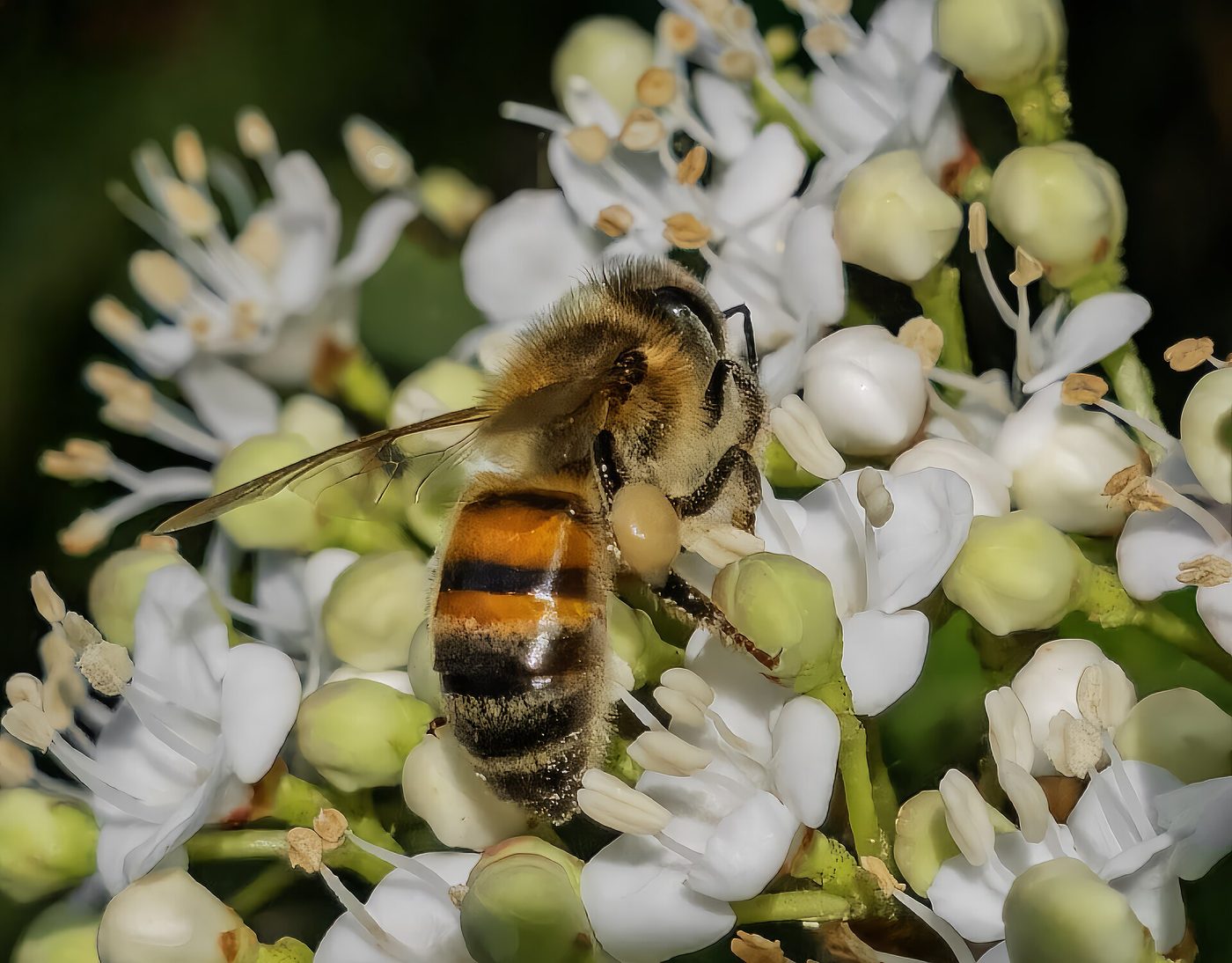
Photo: Didier Descouens · CC BY-SA 4.0
Western honey bee
Apis mellifera
A tireless pollinator and architect of wax, the honey bee is one of the most valuable insects in the world, at the heart of a perfectly organised society.
Characteristics
Temperament
A social insect organised into colonies with a queen, workers and drones. Industrious and communicative, it defends the hive but stings only when threatened.
Diet
It feeds on the nectar and pollen of flowers; from the nectar it produces honey, a store for the colony.
A social insect
The honey bee is a social insect that lives in very large colonies, able to number tens of thousands of individuals. Its body, covered in fine hair, is organised into head, thorax and abdomen, with four wings and six legs; the hind legs of the workers are fitted with special baskets to collect and carry pollen. But what makes this species extraordinary is not the single individual, but the colony, which functions like a single organism.
The society of the hive
Three castes live together in the hive. The queen is the only fertile female and her task is to lay eggs; a single queen can populate the whole colony. The workers, sterile females, carry out all the work: they clean, feed the larvae, build the combs, defend the nest and gather nectar and pollen. The drones, the males, have the sole role of mating with queens. Communication among bees also takes place through the famous dance, by which foragers show their companions the direction and distance of the flowers.
Pollination and honey
The ecological role of the honey bee is immense. Flying from flower to flower to gather nectar and pollen, it carries the pollen and fertilises the plants: much of agricultural cultivation and countless wild species depend on pollinators. With the nectar they gather, bees produce honey, a food store for winter, and work the wax with which they build the hexagonal combs, a masterpiece of geometric efficiency.
Curiosities
Bees communicate, recognise flowers, memorise routes and regulate the hive's temperature by beating their wings. The hexagonal structure of the cells is no accident: it is the shape that allows the greatest amount of honey to be stored using the least amount of wax.
Conservation and importance
Bees are threatened by pesticides, habitat loss, parasites such as varroa and diseases. Their decline is a matter of great concern, because it endangers the pollination of many crops and biodiversity. Protecting pollinators, reducing the use of harmful substances and encouraging flower-rich environments are essential actions.