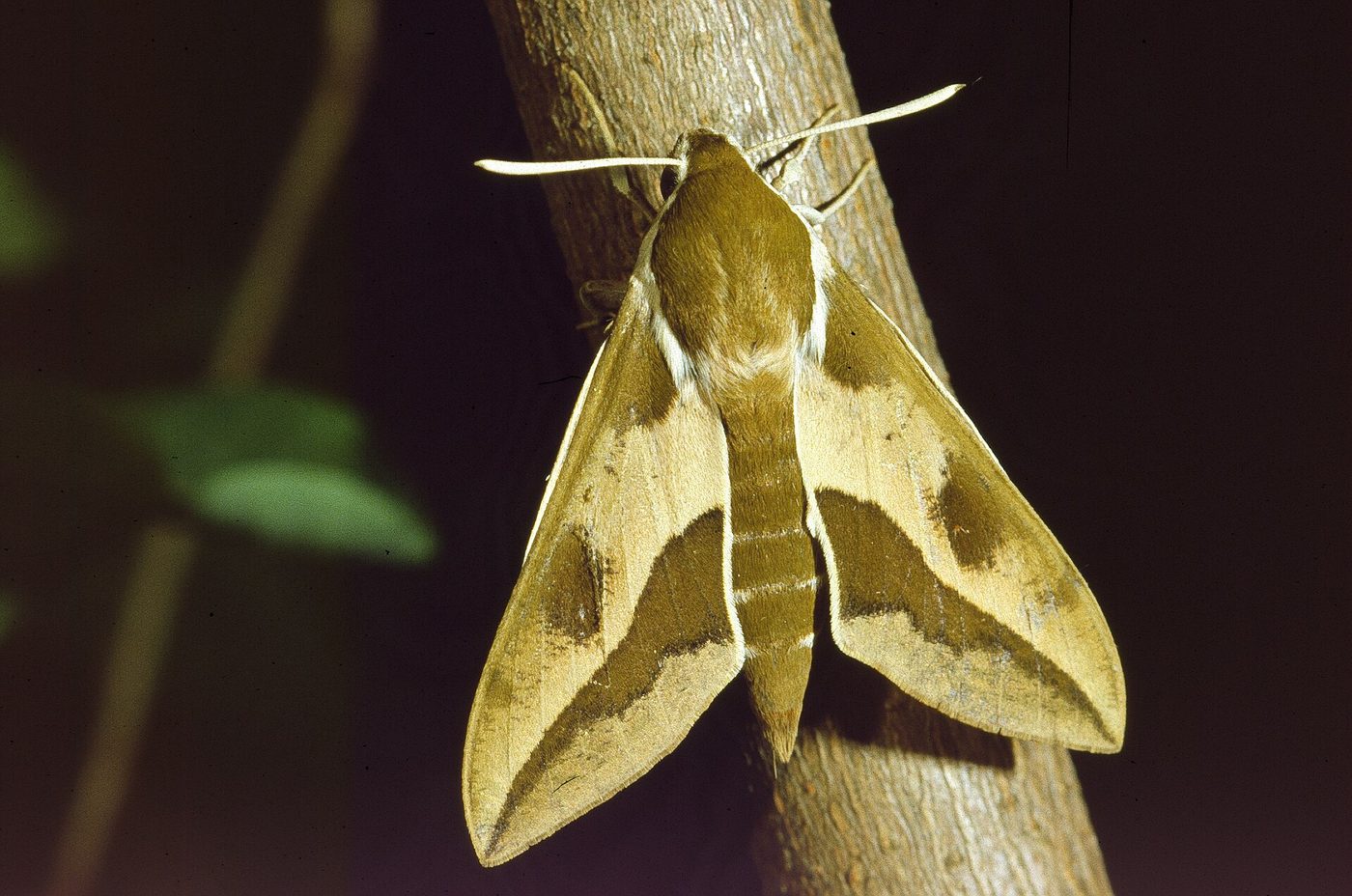
Photo: jean-pierre Hamon · CC BY-SA 3.0
Spurge hawk-moth
Hyles euphorbiae
The spurge hawk-moth is a powerful-flying moth whose brilliantly coloured caterpillars feed exclusively on toxic spurges.
Characteristics
Temperament
Crepuscular and nocturnal, strong flier
Diet
Caterpillars: spurges only; adults: nectar
A moth that flies like a hummingbird
The spurge hawk-moth is a robust moth of the family Sphingidae, the same as the hawk moths that hover like hummingbirds. The adult has tapered forewings, olive-brown with pink and cream bands, and bright pink hindwings with a black base. Its body is stout and spindle-shaped, adapted to fast, hovering flight in front of flowers, from which it sips nectar with a long proboscis.
Habitat and range
It is widespread across much of Eurasia and North Africa, in open, sunny habitats: dry meadows, slopes, dunes and waste ground, wherever its host plants grow. It has also been introduced to North America.
Life cycle and diet
The caterpillars are spectacular: black with bold yellow, red and white markings and a red rear horn typical of hawk moths. They feed exclusively on the leaves and bracts of spurges, plants that contain a toxic, irritant latex. By accumulating these substances, the caterpillars become distasteful to predators, and their bright colours serve as a warning (aposematism).
Notable facts
Precisely because of its specialised diet, the spurge hawk-moth has been used as a biological control agent against leafy spurge, an invasive weed in North America, usually in combination with other insects. The adult flies at dusk and night, but can also feed by day at flowers.
Conservation
The species is not considered threatened and remains common. Its populations depend, however, on the presence of spurges and traditional open habitats, which can decline locally.
Pros
- Powerful, hovering hummingbird-like flight
- Spectacularly coloured caterpillars
- Used in biological control of invasive spurge
Cons
- Depends closely on spurges
- Tied to traditional open habitats