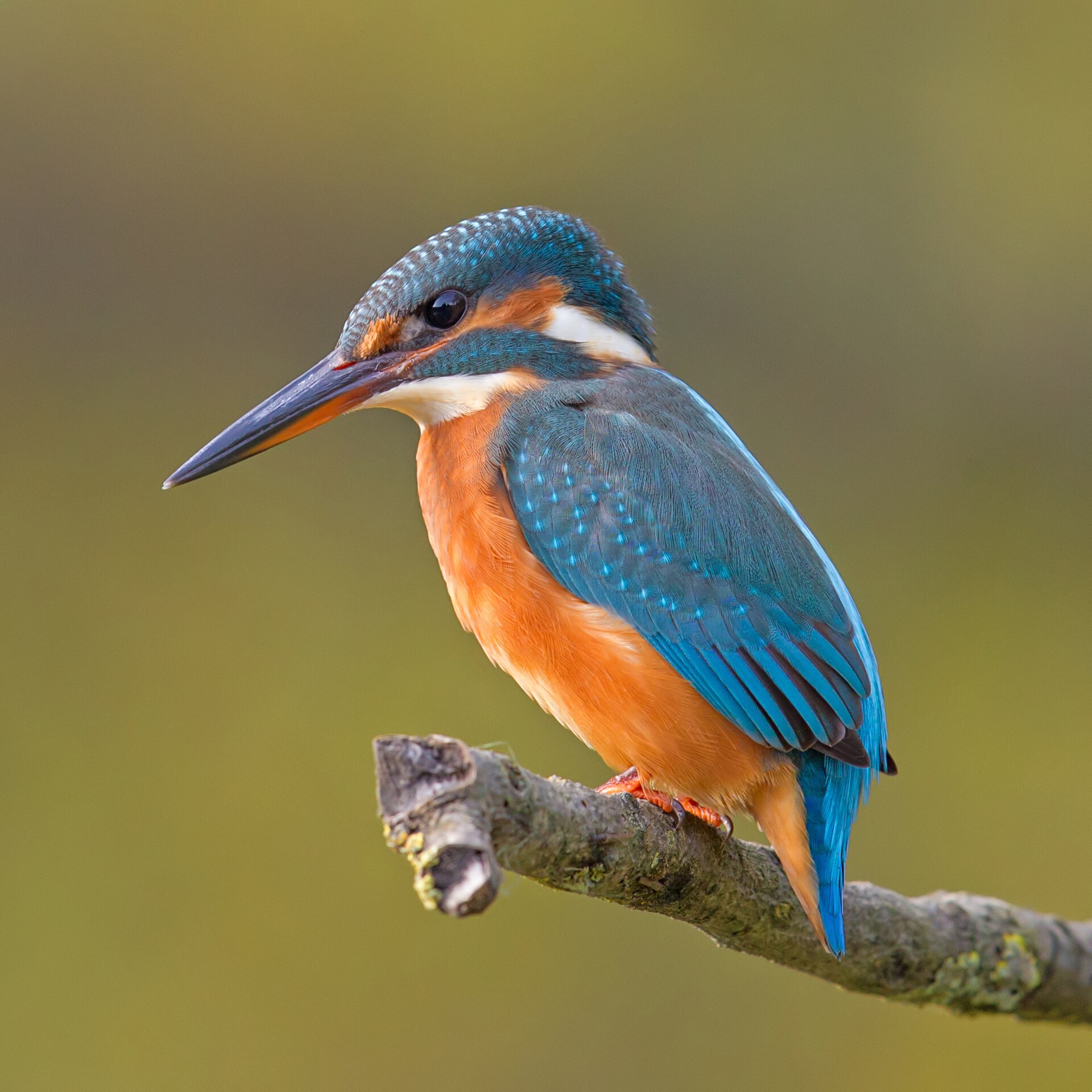
Common Kingfisher
Alcedo atthis
Characteristics
Temperament
A solitary, strongly territorial wild bird that defends its stretch of river, driving off rivals. Shy and generally silent, it betrays its presence more by the quick blue flash of its flight and a sharp, whistling call than by direct sight. A patient, highly skilled fisher, it alternates long motionless waits with lightning dives. It is NOT a cage bird: it is protected wildlife, tied to clean water, to be observed and safeguarded in nature.
Diet
A specialized fisher. It feeds mainly on small fish (fry and small river fish), as well as aquatic insects and their larvae, tadpoles, small crustaceans and other invertebrates. It hunts by ambush: motionless on an overhanging perch it stares at the water, then plunges bill-first (sometimes after a brief hover) and grabs the prey; back on the branch, it beats the fish to stun it and swallows it head-first. Its sight corrects for water refraction and is sensitive to polarized light, making its dives extraordinarily precise.
The Common Kingfisher (Alcedo atthis) is one of the most spectacular and beloved birds in Europe: a tiny "flying jewel" of dazzling colours, a true symbol of clean rivers. Famous for:
- Jewel colours: iridescent electric blue above and bright orange below, in a dazzling contrast
- The "blue arrow": often seen only as a flash of blue streaking very fast just above the water
- The precision dive: from its perch it plunges to catch fish underwater
- The dagger bill: long, straight and pointed, a perfect fishing weapon
- The tunnel nest: it digs a tunnel into earth banks to lay its eggs
- The link with clean water: it is a valuable indicator of river health
IUCN status: Least Concern (LC), but sensitive to water pollution. It enters the portal among the coraciiformes, alongside the Hoopoe: two of the most colourful and unmistakable birds of Italian and European fauna, each tied to a different environment — the Hoopoe to sunny countryside, the Kingfisher to clear watercourses.
Classification and category
Order Coraciiformes, family Alcedinidae (the kingfishers), genus Alcedo. In the portal it is placed among the coraciiformes, together with the Hoopoe: a group that brings together many brightly coloured birds, of peculiar flight and often nesting in cavities. Some clarification on the names and "relatives": there are very many kingfisher species in the world, some of which — paradoxically — do not fish at all and live far from water; the European species, Alcedo atthis, is instead a true fisher; it should not be confused with the bee-eaters and rollers, other colourful coraciiformes. Etymology: the genus name "Alcedo" is Latin for "kingfisher", in turn linked to the Greek halcyon; "atthis" recalls a figure of Greek mythology; from halcyon comes the expression "halcyon days", discussed among the curiosities. Parameters — it is little bigger than a sparrow: Length about 16-17 cm (much of it bill and head). Wingspan about 24-26 cm. Weight just 34-46 g. Longevity in the wild on average short (often around 2 years, due to high juvenile mortality and the risks of harsh winters), but it can reach several years. Reproduction: it digs a tunnel into banks and lays 5-7 white eggs, often with two or three broods a season; both parents hunt for the young.
Habitat and distribution
The Common Kingfisher is widely distributed across the Old World: much of Europe (including Italy, where it is common along watercourses), North Africa and Asia. Preferred habitats — always tied to clear, fish-rich fresh water: slow, clear, shallow rivers and streams; lakes, ponds, canals and wetlands; and environments with overhanging perches (branches, reeds) above the water and vertical earth banks in which to dig the nest. The Kingfisher's presence depends on two precise needs: clean, fish-rich water to hunt, and sandy-clay banks to nest. For this reason it is considered an excellent bioindicator: where there is a kingfisher, the water is usually in good health. It is mainly sedentary, but in colder areas it may move in winter, when frost icing over the watercourses is one of its greatest threats, able to decimate populations. IUCN: Least Concern. However, its populations suffer from water pollution, the concreting and artificialization of banks (which eliminate nest sites) and harsh winters. It is a protected species in Europe.
Diet
The Common Kingfisher is, as its name says, a specialized fisher. It eats: small fish (the basis of its diet — fry and small river fish); aquatic insects and their larvae; and tadpoles, small crustaceans and other aquatic invertebrates. The fishing technique: the watch (it stays motionless on a branch or reed overhanging the water, staring at the surface); the dive (having spotted the prey, it plunges, enters the water bill-first and grabs the fish; sometimes it also performs a brief hover before diving); and the final blow (back on the perch, it beats the fish repeatedly against the branch to stun it, then swallows it always head-first, so that fins and scales do not stick in its throat). Crucially, the Kingfisher's eyesight is extraordinary. It is able to correct for the refraction of light in water and to judge the fish's real position precisely, and it has vision sensitive even to polarized light, which reduces surface glare. This is why its dives are incredibly accurate.
Physical features
A small, stocky bird of spectacular colours. Colours and plumage: iridescent electric blue upperparts, with a back band that seems to shine with its own light; orange-reddish underparts, in dazzling contrast with the blue; white throat and side neck patches; small red-orange legs. The body and bill: a compact, stocky body with a very short tail; a head large relative to the body; a long, straight, dagger bill — all black in the male, with an orange base to the lower mandible in the female (an easy way to tell the sexes apart). Distinctive features: structural colour (the blue comes not from a pigment but from the microstructure of the feathers, which splits the light; this is why it "changes" and shines depending on the angle); fast, direct flight, skimming the water like an arrow; and keen sight adapted to fishing.
Behaviour and curiosities
The Common Kingfisher is a solitary, territorial bird. It firmly defends its stretch of river, driving off other kingfishers, and outside the breeding season leads a secluded life. It is more often noticed by the quick blue flash of its flight and the sharp, whistling call it gives as it streaks along the water than by direct sight: despite its colours, perched and motionless it can be surprisingly hard to spot.
The blue that doesn't exist: one of the most surprising things about the Kingfisher is that its splendid blue is not a "real" colour, that is, due to a pigment — it is a structural colour: the feathers have a microstructure that reflects and splits light, making the bird appear blue and iridescent; this is why, depending on how the light hits it, the kingfisher can look bluer, greener or almost turquoise: its colour "changes" with the angle. The precision diver: the Kingfisher is a formidable underwater hunter — to strike a fish seen from outside, it must solve a complex problem: light, passing from air to water, "bends" (refraction) and makes the prey appear in a different position from the real one; its brain and eyes can automatically correct this error, allowing extremely precise dives; moreover its sight is sensitive to polarized light, which helps it "see past" the surface glare. The "halcyon days": the scientific name Alcedo and the Greek halcyon recall a famous myth — Alcyone, turned into a bird with her husband Ceyx, nested on the sea in winter according to legend, and the gods granted her some days of calm sea to brood; hence the expression "halcyon days", still used today for a serene, happy period; the kingfisher is thus the mythical bird of calm and tranquillity. The tunnel nest: unlike many birds, the Kingfisher does not build a nest among the branches, but digs — with bill and feet both parents dig, in a vertical earth bank, a tunnel usually half a metre or more long, ending in a chamber where the eggs are laid; it is a safe but "uncomfortable" nest: over time it fills with fish bones and remains, and the young and parents often come out anything but clean. Male and female: the two sexes are almost identical, but one detail tells them apart easily: the bill — in the male it is all black, while in the female the lower part (the base of the mandible) is orange, as if it had a touch of "lipstick"; it is one of the rare cases where a bird's sex can be recognized at a glance by looking at the bill. The sentinel of clean rivers: because it needs clear, fish-rich water to hunt, the Kingfisher is considered an excellent bioindicator: its presence usually signals a river in good health, while its disappearance is an alarm bell of pollution or degradation; protecting the kingfisher therefore means protecting water quality and the integrity of banks, to the benefit of the whole river ecosystem.
Pros
- Uno degli uccelli più belli d'Europa: un "gioiello" iridescente nativo d'Italia
- Bioindicatore prezioso: la sua presenza segnala fiumi puliti e sani
- Affascinante cacciatore: tuffi di precisione che correggono la rifrazione dell'acqua
- Ricco di fascino culturale (il mito di Alcione e i "giorni alcionici")
Cons
- NON è un animale da compagnia: è fauna selvatica protetta
- Molto sensibile all'inquinamento delle acque e alla cementificazione delle rive
- Vulnerabile agli inverni rigidi, che ghiacciando i fiumi possono decimarlo
- Dipende da rive di terra naturali per nidificare: soffre la loro distruzione