Toco Toucan
Ramphastos toco
Characteristics
Temperament
Diurnal, social, playful. Lives in small family groups of 4-12 individuals. Harsh vocalisations "kuk-kuk-kuk". Gigantic beak functions as biological radiator (releases 60% heat). Characteristic undulating flight.
Diet
Frugivorous omnivore (60-80% fruit): palms, figs, guavas, mangoes. Supplements with insects, eggs of other birds, small reptiles. 100-150 g/day. Important disperser of tropical seeds.
The Toco Toucan (Ramphastos toco), also known as the Giant Toucan, is the largest and most iconic of the 35 existing species of toucans. Its enormous orange beak is one of the most recognisable attributes of the avian kingdom, a symbol of South American tropical forests and open environments. Made even more popular by Guinness advertising (the toucan was mascot of the Irish beer from the 1930s) and protagonist of nature documentaries, the Toco Toucan is a bird with a playful and sociable character, capable of harsh vocalisations and a characteristic undulating flight. It is also one of the most studied examples of thermoregulation in nature: its gigantic beak in fact functions as a biological radiator, regulating body temperature in a manner similar to elephant ears.
Classification and category
The Toco Toucan belongs to the order Piciformes (the same as woodpeckers), family Ramphastidae, genus Ramphastos. The genus comprises 7 species of giant toucans, all South American. R. toco is the largest species of the family: total length 55-65 cm (of which 15-23 cm is the beak), wingspan 60-80 cm, weight 500-870 g. Males are slightly larger than females, but sexual dimorphism is minimal. Two subspecies are recognised: R. t. toco (nominal population, northern part of range) and R. t. albogularis (southern population, slightly smaller and with more extended white throat). The species was scientifically described by Statius Müller in 1776 on the basis of Brazilian specimens.
Habitat and distribution
The habitat of the Toco Toucan consists of open tropical forests, wooded savannahs (cerrado), gallery forests along rivers and agricultural areas with large trees. Unlike many other toucan species, which prefer dense rainforest, the Toco is particularly attached to semi-open environments: it is often found at forest edges, in the plains of Cerrado, in the savannahs of Pantanal and in agricultural areas with food available. It lives mainly at low altitudes (below 1,000 m), occasionally up to 1,750 m.
The geographic distribution covers vast territories of central-eastern South America: eastern Bolivia, central and southern Brazil (Mato Grosso, Goiás, Minas Gerais, São Paulo), Paraguay, Guyana, Suriname, French Guiana, and north-east Argentina (Misiones and Corrientes provinces). It is absent from central Amazonia (replaced by congeneric species such as R. tucanus), the Andes and the countries of the southern Cono Sur. Conservation status is listed as Least Concern (LC) by the IUCN, with a stable or slightly increasing population thanks to the species' adaptability to anthropised environments. The main threats are the illegal trade (it is one of the most requested species in the exotic pet black market, with prices of 1,500-4,000 euros per specimen in illegal European and North American circuits), habitat fragmentation and hunting for ornamental feathers.
Diet
The Toco Toucan is a generalist omnivore with a mainly frugivorous diet. Fruit constitutes 60-80% of its diet: it prefers palm fruits (Mauritia, Acrocomia), figs, guavas, papayas, mangoes, bananas, ipê pods. It supplements with: insects (grasshoppers, beetles, larvae), eggs and chicks of other birds (important nest predator), small reptiles and occasionally small rodents. Daily requirement is about 100-150 g of food. In captivity the diet requires particular attention: it must be low in iron (toucans are predisposed to iron overload, a serious pathology called haemochromatosis) and rich in fresh tropical fruit.
The way of eating is characteristic: the toucan grasps the fruit with the tip of the beak, throws it upwards, and swallows it whole in flight. The long beak allows it to reach fruits hanging from thin branches that could not support the weight of the bird. Foraging takes place in family groups of 4-12 individuals that move through the canopy with the characteristic undulating flight. They are important seed dispersers: many tropical plants, particularly palms, depend on toucans for long-distance seed dispersal. The droppings contain intact seeds that often germinate far from the mother plant, contributing to forest regeneration.
Physical features
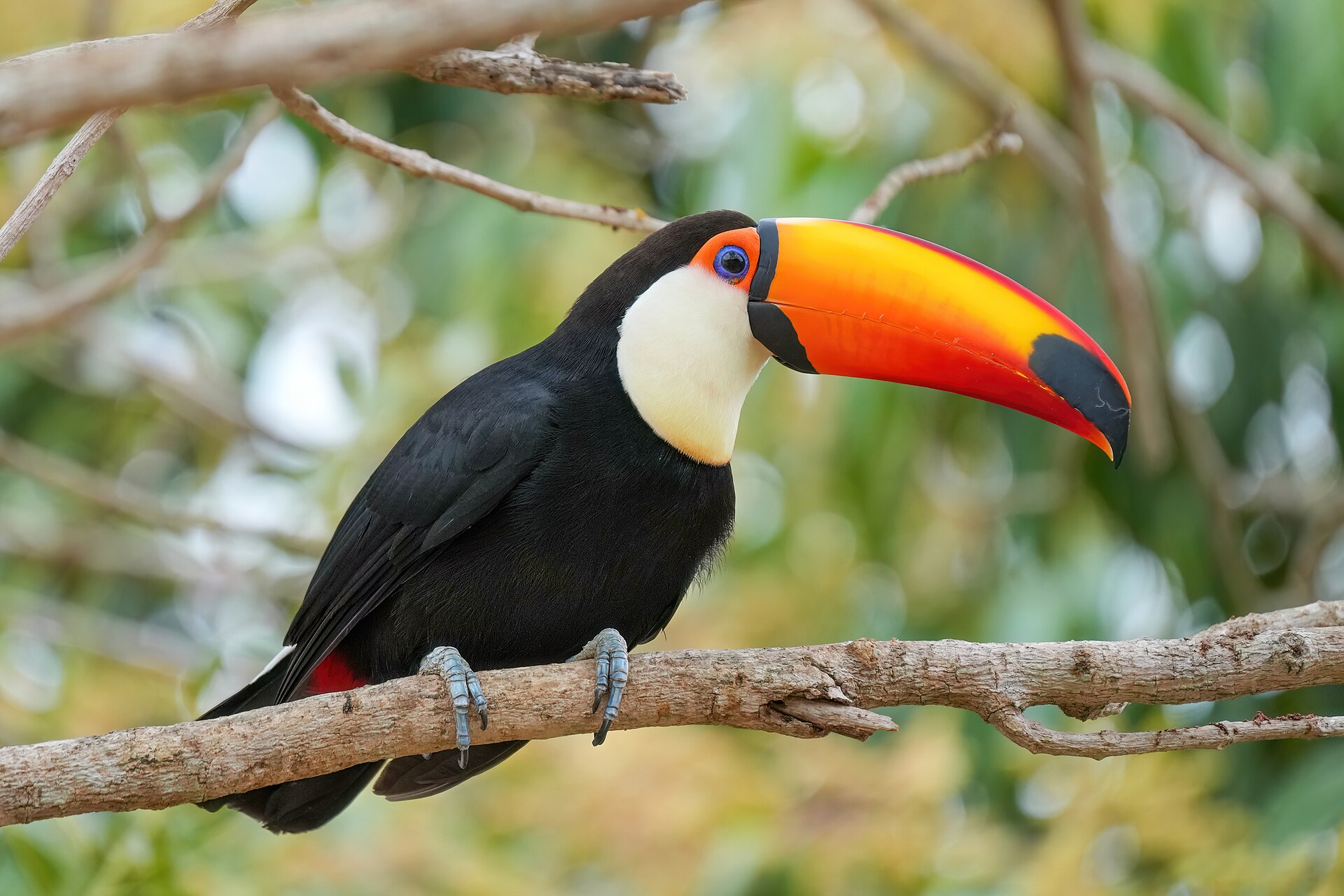
The Toco Toucan has an unmistakable appearance. The plumage is predominantly glossy black, with marked white areas: throat, upper breast, white uppertail-coverts, bright red undertail-coverts. The eyes are surrounded by bright blue skin and an orange ring, of great chromatic effect.
The beak is the most extraordinary anatomical feature: 15-23 cm long (the longest in proportion to the body among all birds), slightly curved downwards, of bright orange colour with black patch at the tip. Despite the massive appearance, it is extraordinarily light: it represents only 3-4% of total body weight. The internal structure is a network of porous bone trabeculae filled with air (like a "bone foam"), which combines mechanical strength and lightness. MIT studies have inspired the design of new composite materials from the toucan beak structure. The thermoregulatory function of the beak was demonstrated in 2009 (Tattersall et al., Science): the beak is highly vascularised and can release up to 60% of excess body heat by dilating surface capillaries. In hot environments the toucan "fans" its beak; when it sleeps, it hides it under the feathers superstitiously to conserve heat. The tongue is long (14-15 cm), thin, frayed at the edges like a feather, and functions as a sieve for fruit. The feet are zygodactyl (two anterior and two posterior fingers), typical of Piciformes, perfect for gripping branches.
Behaviour and curiosities
The Toco Toucan is a diurnal, social and playful animal. It lives in small groups of 4-12 individuals (usually breeding pairs and offspring of the year) that share territory and collaborate in foraging. Communication is complex: it includes harsh vocalisations (sound "kuk-kuk-kuk"), beak gestures (sonorous clicking), welcome greetings. The toucan's voice is audible at considerable distance (over 500 m through the forest).
Nesting takes place between August and February (South American rainy season). Pairs are seasonally monogamous (some pairs can remain united for several seasons) and nest in tree cavities, often old abandoned woodpecker nests that are enlarged. The female lays 2-4 white eggs; incubation lasts 16-20 days, conducted by both sexes. Chicks are born completely naked and blind, with short beak that grows only after the first week. They are fed by both parents for 6-8 weeks before fledging; sexual maturity is reached at 2-3 years. Longevity is 18-26 years in the wild, with captive specimens having reached 30 years. Historical curiosity: the Toco Toucan was protagonist of the famous Guinness advertising from 1935, conceived by illustrator John Gilroy, becoming one of the most recognisable animals of 20th century marketing. The original design (a toucan with two glasses of Guinness balanced on the beak) is still today an icon of classic marketing. Scientifically, the Toco Toucan is the subject of studies for the optical properties of the beak (capable of reflecting ultraviolet invisible to humans but visible to other toucans, used as a signal of individual recognition and reproductive status).
Pros
- Più grande tucano del mondo (becco fino 23 cm)
- Icona delle foreste tropicali sudamericane
- Longevità 18-26 anni
- Importante disseminatore di semi tropicali
Cons
- Detenzione vietata in UE senza permessi CITES rigorosi
- In cattività predisposto a emocromatosi (dieta low-iron)
- Commercio illegale ne minaccia popolazioni selvatiche
- Richiede voliere di almeno 4×2×2 m e clima caldo (>20°C)