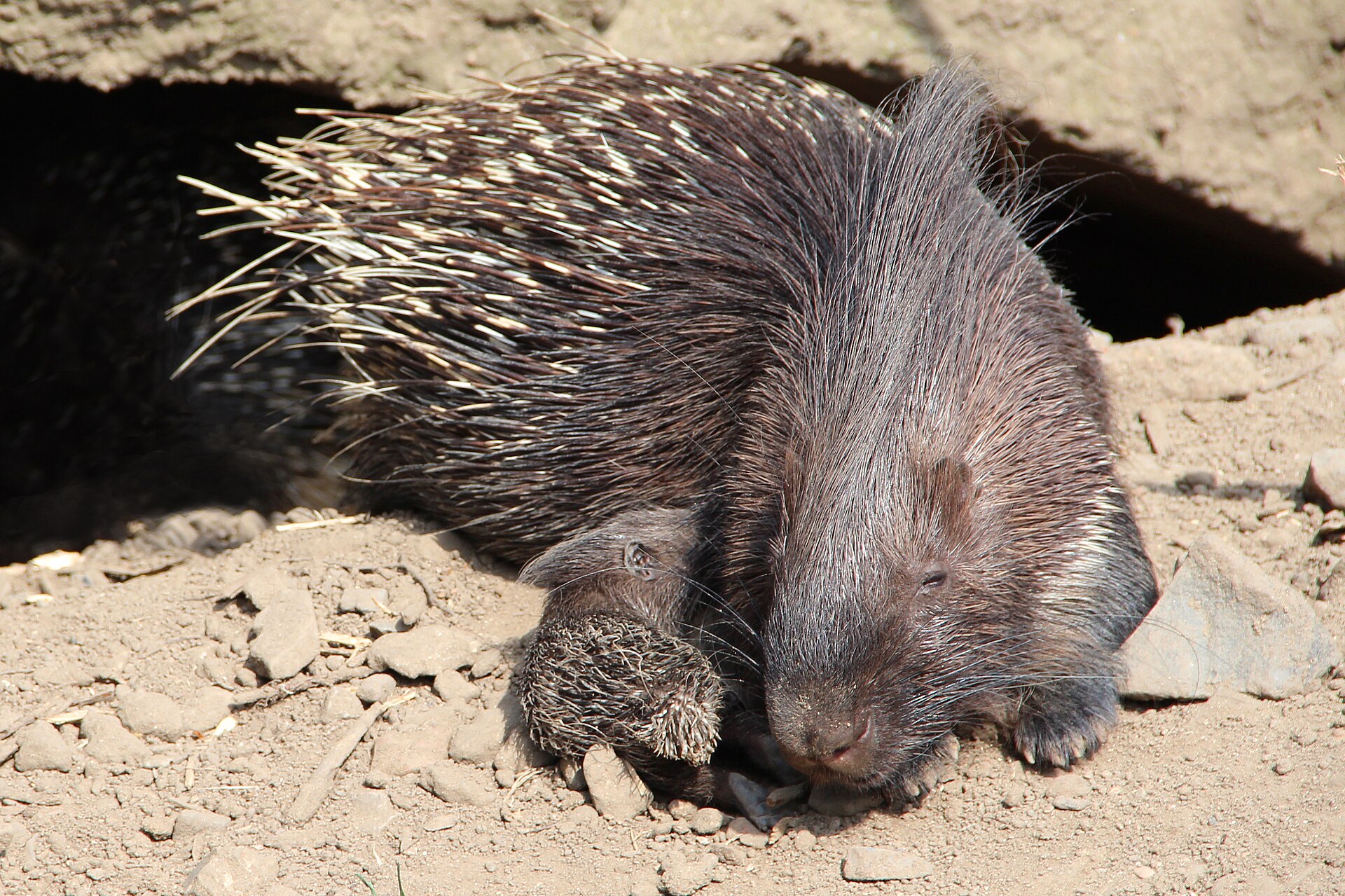
Crested Porcupine
Hystrix cristata
Characteristics
Temperament
Nocturnal, lifelong monogamous, strongly territorial. Lives in families in burrows (up to 10 m deep, 20 m long). Defends itself by raising quills and crest, shaking rattle tail, charging backwards. Protected in Italy since 1992.
Diet
Herbivore: roots, tubers, bulbs, fruit, vegetables, acorns. Practises osteophagy (gnaws bones for Ca/P) and coprophagy (vitamins B/K). Requires 500-700 g/day. Active only at night: travels up to 5 km a night searching for food.
The Crested Porcupine (Hystrix cristata) is a large rodent belonging to the Hystricidae family, known as the largest rodent in Europe and second largest in the world after the capybara. Distributed in Italy, North Africa and Sub-Saharan Africa, it is easily recognisable for its spectacular black and white quills, up to 40 cm long, covering the back and sides. Primarily nocturnal and predominantly terrestrial, it lives in burrows dug in the ground and feeds on roots, tubers, bulbs, fruit and vegetables. Despite popular beliefs, the quills are not "thrown" like darts: they detach easily on contact and remain stuck in the attacker's skin, acting as an effective deterrent against predators. In Italy it is a strictly protected species (Law 157/1992 and Berne Convention) and its population has been increasing for decades, with expansion northwards to the Po Valley.
Classification and category
The Crested Porcupine belongs to the order Rodentia, suborder Hystricomorpha, family Hystricidae (Old World porcupines), genus Hystrix. The genus comprises 8 species distributed across Africa, Asia and Europe; H. cristata is the only European species. The Hystricidae family must be distinguished from American porcupines (Erethizontidae), despite the superficial resemblance: it is a classic example of evolutionary convergence. The two families have been separated by over 30 million years of independent evolution. The species was scientifically described by Linnaeus in 1758. It is distinguished from the Indian porcupine (H. indica), its closest relative, by the presence of an erectile bristle crest on the head and neck (absent in indica). Sub-adults weigh 13-27 kg, adults reach 60-90 cm body length plus a short tail of 8-17 cm. It is an exceptional "large" rodent: the quills represent up to 15% of the total body weight.
Habitat and distribution
The habitat of the Crested Porcupine consists of Mediterranean woodlands, maquis, garrigues, olive groves, agricultural land, hilly areas up to 2,500 m elevation. It is extremely adaptable: it lives in both open environments (steppes, savannahs, rocky deserts) and forests, but prefers transition zones with shrubby vegetation and rocks for digging burrows. In Italy, the population is expanding: historically confined to the centre-south, since the 1990s it has colonised Tuscany, Emilia-Romagna, Veneto, up to Lombardy and Piedmont (confirmed presence in Val d'Aosta since 2015). The Italian population is estimated at 20,000-30,000 individuals, in constant increase thanks to legal protection, abandonment of farmland (more available niches) and milder climates due to climate change.
The global distribution includes: Italy (peninsula, Sicily; absent in Sardinia), North Africa (Morocco, Algeria, Tunisia, Libya, Egypt), Sub-Saharan Africa (from Senegal to Ethiopia, to northern Tanzania). The presence in Italy is debated: some theories maintain it is autochthonous (Italian glacial refuge), others that it was introduced by the Romans from Africa for food purposes (the meat was appreciated). Recent genetic studies support the first hypothesis: the Italian population is genetically distinct from African ones by thousands of years. The global conservation status is Least Concern (LC) according to IUCN, but in Italy it is included among particularly protected species (Law 157/1992 art. 2). The burrow of the porcupine is a complex structure: dug in the ground or under rocks/roots, it can reach 10 m in depth and 20 m in total length, with multiple chambers and entrances. Burrows are inherited for generations: some in central Italy are carbon-dated for over 100 years of continuous use.
Diet
The Crested Porcupine is strictly herbivorous, with seasonally varied diet. In spring-summer it mainly consumes green parts of plants (leaves, sprouts, flowers), fallen fruit (apples, pears, figs, blackberries), berries; in autumn-winter it moves to underground parts: roots, tubers, bulbs, rhizomes (asphodels, cyclamens, orchids), acorns, chestnuts, seeds. It prefers agricultural crops: potatoes, carrots, pumpkins, melons, corn, orchards — a factor that makes it locally unpopular among farmers. Occasionally it gnaws bones and antlers to integrate calcium and phosphorus (behaviour called "osteophagy"). Food requirements are 500-700 g of food per day for an adult. It does not drink frequently: it gets water from food.
The feeding technique is characteristic: it digs in the ground with powerful front paws to extract tubers and bulbs, leaving small typical holes (recognisable in Mediterranean woods). The large orange incisor teeth (for iron deposition that reinforces them) grow continuously and must be worn down by gnawing hard materials. The vegetable diet requires caecal fermentation: the porcupine has a large intestinal caecum where symbiotic bacteria break down cellulose. It also practises coprophagy (eats its own soft faeces) to reabsorb vitamins B and K produced by intestinal bacteria. Feeding activity is exclusively nocturnal: the porcupine leaves the burrow at dusk and travels up to 5 km a night searching for food, leaving characteristic tracks with triangular footprints (5-6 visible toes) and fallen quills along the path.
Physical features
The Crested Porcupine has a stocky, robust, oval-shaped body, 60-90 cm long with a short tail of 8-17 cm. Weight varies from 13 to 27 kg (rarely up to 30 kg in particularly large specimens). Males and females have similar dimensions (absent sexual dimorphism). The most iconic feature are the quills: modified keratinised hairs, up to 40 cm long, of alternating black and white stripes, hollow inside to be light. Each specimen has about 30,000 quills on the body. The longest and stiffest quills are on the sides and back; the shorter ones form a characteristic erectile crest on the neck and shoulders (hence the name "crested"). On the tail there are modified quills hollow and open at the end: the porcupine shakes them to produce a characteristic noise like a rattle (sonic deterrent).
The head is large, with an elongated muzzle. The incisor teeth are long, curved, orange in colour (due to iron deposition in the enamel that reinforces them) — typical of rodents. The eyes are small and lateral; sight is poor but smell and hearing are very developed. The ears are small and rounded, hidden among the head fur. The legs are short but robust: front with 4 toes and rear with 5 toes, all armed with strong claws for digging. The soles are bare and callous. The fur underlying the quills is composed of rough black hair and bristles; the general colour of the animal is brown-blackish with white and black stripes on the quills. When it feels threatened, the porcupine raises all the quills and the crest, apparently doubling its dimensions — a spectacular dissuasive display. If the predator insists, the porcupine turns its back, shakes its tail (sonic rattle) and charges backwards driving the quills into the enemy. The quills are equipped with microscopic scales at the end that make them difficult to extract — a hit to the quills can be fatal for lions, leopards, hyenas.
Behaviour and curiosities
The Crested Porcupine is a nocturnal, monogamous, strongly territorial animal. It lives in families composed of the breeding pair and pups from the last 2-3 litters (up to 6-8 individuals). Family territories are actively defended by pairs with olfactory marking (with urine and faeces) and vocalisations: the porcupine produces various sounds — grunts, hisses, moans, the tooth snap as threat, and the characteristic "crackling" of the tail when it shakes the hollow rattle quills. Activity is strictly crepuscular-nocturnal: the animal leaves the burrow at sunset and returns before dawn. During the day it sleeps in the burrow, where it spends 70% of its life. In winter it is less active but never enters true hibernation.
Reproduction occurs throughout the year with a peak in spring (March-May). Courtships are elaborate: the male walks on hind legs in front of the female to show the quill-less belly. Copulation occurs with the male in a semi-erect position behind the female (to avoid the quills). Gestation lasts 110 days (incredibly long for a rodent), among the longest among rodents. The female gives birth to 1-4 pups (average 2) in a burrow chamber covered with grass. The young are born already quilled (soft white quills that harden in a few days), with open eyes and already developed teeth. They can walk a few hours after birth — characteristics of precocial animals, rare in rodents. They are weaned at 4-6 months but remain in the family for 1-2 years. Sexual maturity is reached at 1-2 years. Longevity is exceptional for a rodent: 15-20 years in nature, up to 27 years documented in captivity. A porcupine named "Honey" at Edinburgh Zoo reached 28 years.
Famous curiosities: the "myth of the porcupine that throws its quills" is an OLD popular belief but false: the quills are NOT thrown. They detach easily on contact, sticking into the attacker. The belief arose from observing quills fallen within a few metres' range (they detach during running or defensive agitation). Ethological curiosity: porcupines are monogamous for life — a rare phenomenon among mammals (observed in only 3-5% of species). Pairs frequently touch with the muzzle, share the burrow, raise pups together. Historical culinary curiosity: in antiquity (Romans, Etruscans) and in medieval Italy the porcupine was appreciated for its meat, similar to pork; the dish "istrice in dolceforte" is still a Tuscan tradition specialty today. Since the species has been protected (1992), hunting has been prohibited and traditional dishes are prepared with pork. Symbolic curiosity: in Italian heraldry the porcupine represents defence and perseverance; it appears in the coat of arms of Anne of Brittany (Queen of France, 15th century) with the motto "Cominus et eminus" (from near and far), an allusion to defence with the quills. Environmental curiosity: porcupines are important ecosystem engineers: their abandoned burrows are reused by foxes, badgers, wildcats, martens; the diggings for bulbs mix the soil favouring vegetative renewal.
Pros
- Più grande roditore d'Europa (13-27 kg)
- Longevità eccezionale (15-20 anni, 27+ in cattività)
- Monogamo a vita (raro tra i mammiferi)
- Protagonista dell'araldica italiana (Anna di Bretagna)
Cons
- Specie strettamente protetta (Legge 157/1992): detenzione vietata
- Può causare danni notevoli a colture agricole
- Aculei pericolosi: feriti gravi cani e umani imprudenti
- Notturno: difficile da osservare in natura