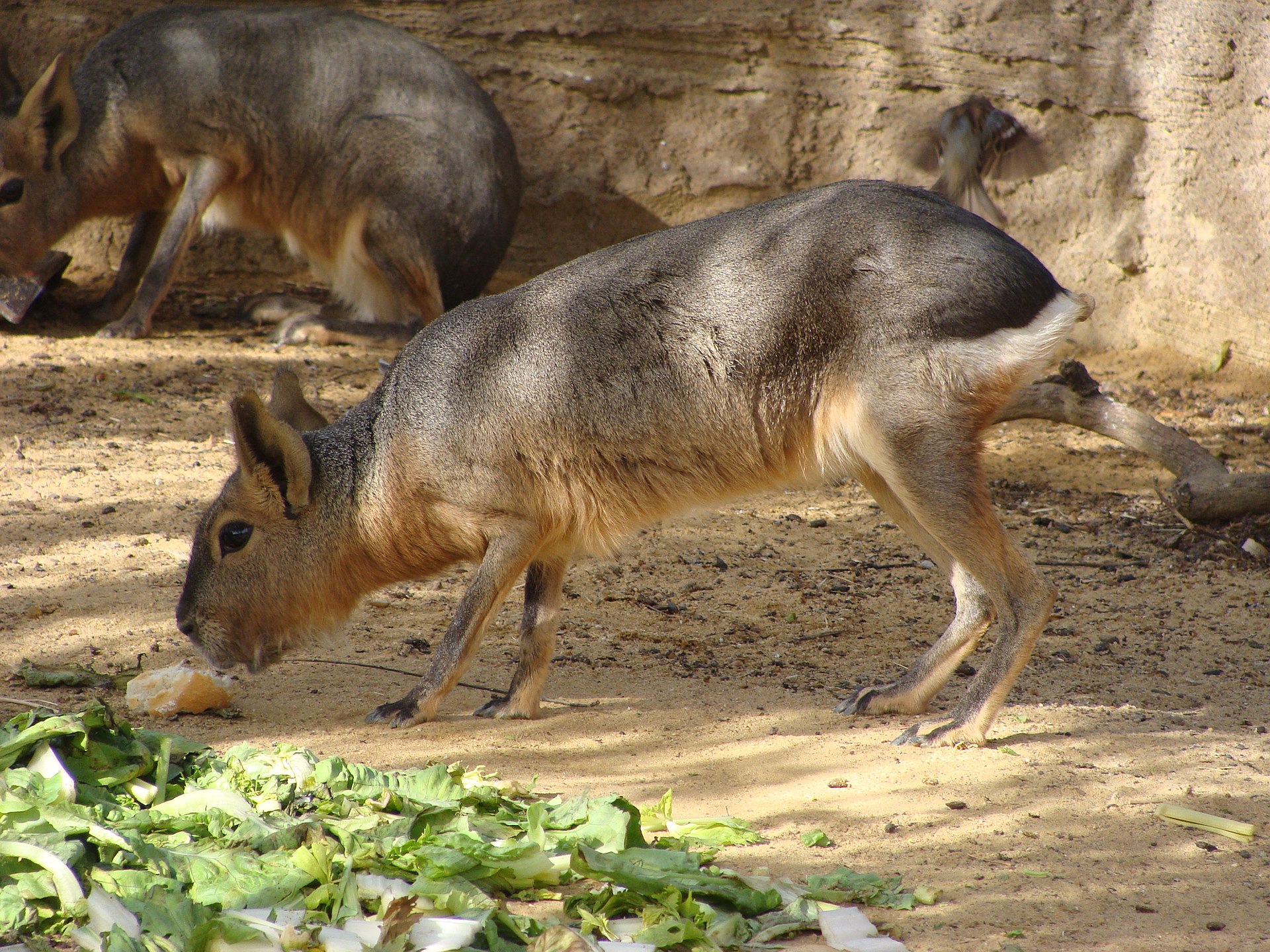
Patagonian Mara
Dolichotis patagonum
Characteristics
Temperament
Diurnal, lifelong monogamous (rare in mammals: 3-5%). Uniquely social: breeding settlements with 10-30 pairs + communal crèches. Bounding gait up to 45 km/h. Anti-predator "stotting". 4th largest rodent in the world. IUCN Near Threatened.
Diet
Herbivorous grazer: grasses, leaves, fruits, cacti, seeds. Selective: prefers specific fescues. 1-1.5 kg/day (15-20% weight). Does not drink frequently: gets water from vegetation. Practises coprophagy to absorb B/K vitamins.
The Patagonian Mara (Dolichotis patagonum), also known as the "Patagonian Hare" or "Pampas Rabbit", is a large rodent endemic to Argentina, with a form incredibly similar to a hare-deer hybrid at first sight. 69-75 cm long and weighing 8-16 kg, it is the fourth largest rodent in the world after capybara, beaver and porcupine. It lives in Patagonian steppes, in arid grasslands and shrublands. It is famous for being one of the very few mammals monogamous for life: the pair remains united for the entire life (10-14 years) and has an extraordinarily sophisticated visual communication system. It moves with a characteristic bounding gait, that can reach 45 km/h when fleeing — similar to a hare's, but with antelope body structure. The global IUCN conservation status is Near Threatened (NT) since 2008, declining by 30% in the last 30 years due to habitat loss (Patagonian deforestation) and hunting.
Classification and category
The Patagonian Mara belongs to the order Rodentia, suborder Hystricomorpha, family Caviidae (cavies — the same as guinea pig and capybara!), subfamily Dolichotinae, genus Dolichotis. The genus comprises 2 species:
- D. patagonum — Patagonian Mara (centre-south Argentina)
- D. salinicola — Chacoan Mara or "Conejo del Palar" (Bolivia, Paraguay, northern Argentina)
The species was scientifically described by Heinrich Wilhelm Schinz in 1823. The genus name "Dolichotis" derives from Greek "dolichos" (long) + "ous/otos" (ear): "long ear" — reference to the long pointed ears. The epithet "patagonum" indicates Patagonia. Phylogenetically, the mara is a close relative of the capybara (Hydrochoerus hydrochaeris) and the guinea pig (Cavia porcellus) — all members of the Caviidae family, native to South America. It is a classic case of convergent evolution with lagomorphs (hares/rabbits) of the northern hemisphere: the mara has independently developed long limbs, bounding gait, herbivorous diet — despite being a rodent.
Adult dimensions are: head-body length 69-75 cm, tail 4-5 cm (vestigial, almost invisible), weight 8-16 kg (average 11 kg), withers height 45 cm. Sexual dimorphism is minimal (females slightly smaller). Longevity is 5-7 years in nature (high predation by pumas, foxes), up to 14 years in captivity (record: 16 years at Hannover Zoo, Germany, 2007). The anatomically atypical male characteristics of Caviidae: long and slender legs, atrophied tail, long ears — very distinct from its cousin the capybara.
Habitat and distribution
The Patagonian Mara's habitat is the arid Patagonian steppe, characterised by low vegetation (calafate bushes, fescue, neneo), sandy or gravel terrain, cold-arid climate with great thermal excursions. It lives at 0-1,500 m altitude. It prefers open areas with good visibility, where it can spot predators at distance. It tolerates temperatures from -10°C (Patagonian winter) to +35°C (summer); the body shape (long legs, large ears) facilitates thermoregulation.
The distribution is limited to centre-south Argentina: Mendoza, San Luis, San Juan, La Rioja, Catamarca, southern Tucumán, La Pampa, western Buenos Aires, Neuquén, Río Negro, Chubut, Santa Cruz. The northern limit is 27°S, southern is 50°S (central Patagonia). The species has been introduced in Chile (Chilean Patagonia, residual population), and in some European countries as farm animal (Germany, France — some thousands of specimens). In Italy there are about 200-300 specimens in safari parks (Cantù, Pombia, Fasano) and in private hands: the mara has entered commerce as "exotic" since 2010, but in many regions its possession requires special permits.
The global population is estimated at 200,000-500,000 specimens in the wild, declining. The global IUCN conservation status is Near Threatened (NT) since 2008: 30% decline in the last 30 years due to: habitat loss (deforestation of Patagonian steppe for intensive agriculture and sheep farming), fur hunting (historically for mara fur, market collapsed since the 1970s — see nutria), conflict with sheep farmers (herders kill maras considered "competitors" to pasture, although real impact is minimal), predation by stray dogs (growing factor in agricultural areas), road accidents. The species is protected in Argentina by CITES Appendix II (1975) and the Argentine environmental code, but illegal kills continue.
Diet
The Patagonian Mara is a herbivorous grazer: the diet consists mainly of grasses (fescues, gramines, ammophila), leaves, sprouts, fruits (calafate, michai, introduced prickly pears), seeds, roots. It also eats cacti (calafate, thistle) to integrate water, and occasionally small insects (ants, beetles) — opportunistic behaviour to integrate protein. An important characteristic: the mara does not drink free water frequently: it gets its water requirement from fresh vegetation and cacti. It can survive weeks without drinking.
Food requirement is 1-1.5 kg of vegetation per day for an adult (15-20% of body weight). When grazing, the mara sits on its hindquarters ("sit-up posture") like a human-like squirrel, for better anti-predator vision. It also practises coprophagy (eats its own soft faeces) to reabsorb B and K vitamins — common behaviour in herbivorous rodents to maximise extraction of nutrients from cellulose difficult to digest. Exceptional adaptation: the digestive tract of the mara is 6 metres long and includes a large caecum where symbiotic bacteria decompose cellulose. An interesting food preference: maras prefer specific grasses (Patagonian fescue, crispate fescue), and graze selectively: they cut only young leaves without damaging the plant — a "natural pruning" that favours plant diversity of the steppe.
Physical features
The Patagonian Mara has a unique physique, similar to a hybrid between hare, deer and capybara. The body is elongated, slender, well-muscled; the legs are very long for a rodent, particularly the rear (unique characteristic of giant cavies). The head-body length is 69-75 cm, the withers height 45 cm. The weight is 8-16 kg, exceptionally up to 18 kg.
The head is small, elongated, with elongated triangular-shaped muzzle. The ears are long (8-10 cm), erect, with rounded pointed tip — clearly hare type. The eyes are large, dark brown, positioned laterally for wide panoramic vision (~270° total vision). The nose is black. The neck is long for a rodent, thin, giving a gazelle-like appearance.
The coat is composed of short, dense, grey-brown hair on the back, sides, head; cream-white belly contrasted. An iconic diagnostic feature is the "white-black line" on the rear: a 2 cm wide white stripe on the rump, bordered by a thin black line, that identifies the species without ambiguity. This pattern is visible even at great distances when the mara jumps: it functions as a "rear flag" for group visual communication (warning of danger, identification between couple members).
The legs are the most distinctive feature: very long and slender, similar to those of a young deer, with 4 toes per foot (anterior) or 3 toes per foot (posterior — unique feature in cavies). The soles are bare, horny, suitable for running on hard terrain (unlike the hairy paws of rabbits/hares). The structure allows 4 types of locomotion:
- Normal walk (5-8 km/h)
- Trot (15-20 km/h) — most common gait
- "Stotting" — vertical hops on all 4 legs simultaneously (impress predators), similar to gazelles
- Gallop — bounding gait up to 45 km/h for 1-2 km, for escape from predators
The tail is practically absent (4-5 cm, almost invisible under the fur) — exclusive characteristic among large rodents. The anal glands produce a characteristic smell used to mark the couple's territory.
Behaviour and curiosities
The Patagonian Mara is a diurnal, lifelong monogamous, uniquely social animal. Lifelong monogamy is the most surprising characteristic: only 3-5% of mammals are monogamous, and even fewer are so for life. Mara pairs form at 1-2 years and remain united for 10-14 years (lifespan duration). Genetic paternity studies (University of Buenos Aires, 2015) have shown that 95% of cubs are biological offspring of the male partner — one of the highest "fidelity" rates among mammals.
The social structure is extraordinarily complex for a rodent:
- Lifelong monogamous pair: male and female always move together, 1-2 m apart, never further apart. Constant communication with looks, postures, vocalisations
- "Settlements": during the breeding season (November-February), 10-30 pairs gather in a central area called a "settlement". There they deposit the cubs in common burrows dug in the ground (shared warrens)
- Communal "crèche": all the settlement's cubs (15-50 cubs) are raised in a common nursery. Mothers visit the nursery 1-2 times/day to nurse; they then return to forage with the male. It is a unique system in rodents, similar to penguin "crèche"
- Individual recognition: every mother recognises ONLY her own cubs (among 50 similar cubs) through smell, vocalisation, posture. Mothers refuse to nurse cubs not their own (see koala, where only the mother feeds her own cub)
Courtship includes: the male follows the female constantly (even at 1 m), marks the territory with urine, performs the "enurination ritual" (sprays urine on the female's rear — unique marking behaviour). The female is in oestrus only 30 minutes every 4-5 months — extremely brief window for mating. The male must watch over her constantly so as not to lose her.
Reproduction: gestation lasts 90-100 days; the female gives birth to 1-3 cubs (average 2) of brown colour with white markings. Cubs are born completely developed (precocial): open eyes, complete dentition, able to run within 1 hour of birth. They are weaned at 10 weeks. The mother nurses them in standing position (standing up) — unique behaviour in rodents. The cubs stay in common nursery for 3-4 months, then become autonomous. Sexual maturity at 8 months (females), 14 months (males).
Famous curiosities: the mara is one of the introduced animals in some European nature parks as "naturalised exotic fauna": Tafelberg Park (Netherlands, since 1985, population of 200 semi-wild specimens), Schönbrunn Zoo (Vienna), Berlin Tierpark. In Italy there are 200-300 specimens in safari parks and educational farms. Ethological curiosity: the mara's "stotting" is one of the few documented cases of "aposematic stotting" in mammals: the vertical jump on all 4 legs simultaneously signals to the predator that the mara has seen it and that the attempt to surprise it has failed — incentivises the predator to desist (similar to gazelles, dik-diks). Anatomical curiosity: the mara has a "hoof-like walk": walks on its toe tips (digitigrade), like deer and horses, unlike almost all other rodents that walk on the soles of their feet (plantigrade). Historical curiosity: the mara was the first South American rodent documented by European explorers. The voyage of HMS Beagle (1832, Charles Darwin) described the animal in Patagonia minutely, considering it "one of the most curious and extraordinary rodents in the world". Darwin wrote abundantly about it in his travel diaries. Ecological curiosity: the mara is considered an indicator of Patagonian steppe health: a healthy mara population = healthy ecosystem. Its local disappearance signals environmental problems. Etymological curiosity: the name "mara" derives from the native Mapuche language (Patagonian indigenous population) "marra", which simply means "hare". Adaptation curiosity: the mara can "hibernate light" in periods of extreme drought: reduces metabolism by 30% and slows activities to conserve energy. Not true hibernation but seasonal "dormancy".
Pros
- 4° roditore più grande del mondo dopo capibara, castoro, istrice
- Monogamo a vita: caratteristica eccezionale tra i mammiferi
- Velocità record per roditore: 45 km/h (galoppo) e 'stotting' a 6 m
- Fascino unico: 'lepre-cervo' della Patagonia, simbolo regionale
Cons
- Specie Near Threatened IUCN (-30% in 30 anni)
- CITES Appendice II: commercio regolato
- In alcune regioni italiane detenzione richiede permessi
- Vulnerabile a stress in cattività: necessari recinti molto ampi