European Hamster
Cricetus cricetus
Characteristics
Temperament
A solitary, territorial wild rodent of combative character, active mainly at dawn and dusk. It firmly defends its burrow and, if threatened, puffs up its cheeks, rears up showing its black belly and defends itself without hesitation: nothing like the docility of cage hamsters. A tireless digger and great hoarder of stores, it hibernates in winter. It is NOT a pet: it is Critically Endangered native wildlife, to be protected in its farmland habitat, the subject of conservation programmes.
Diet
Essentially granivorous and herbivorous, with a marked tendency to hoard. It feeds mainly on seeds, grains and legumes, as well as roots, tubers and the green parts of plants, and to a lesser extent on insects and other small invertebrates. It fills its huge cheek pouches with seeds and carries them to the burrow, where it stores several kilos of food in underground larders: vital reserves for surviving winter hibernation, during which it wakes periodically to feed on them.
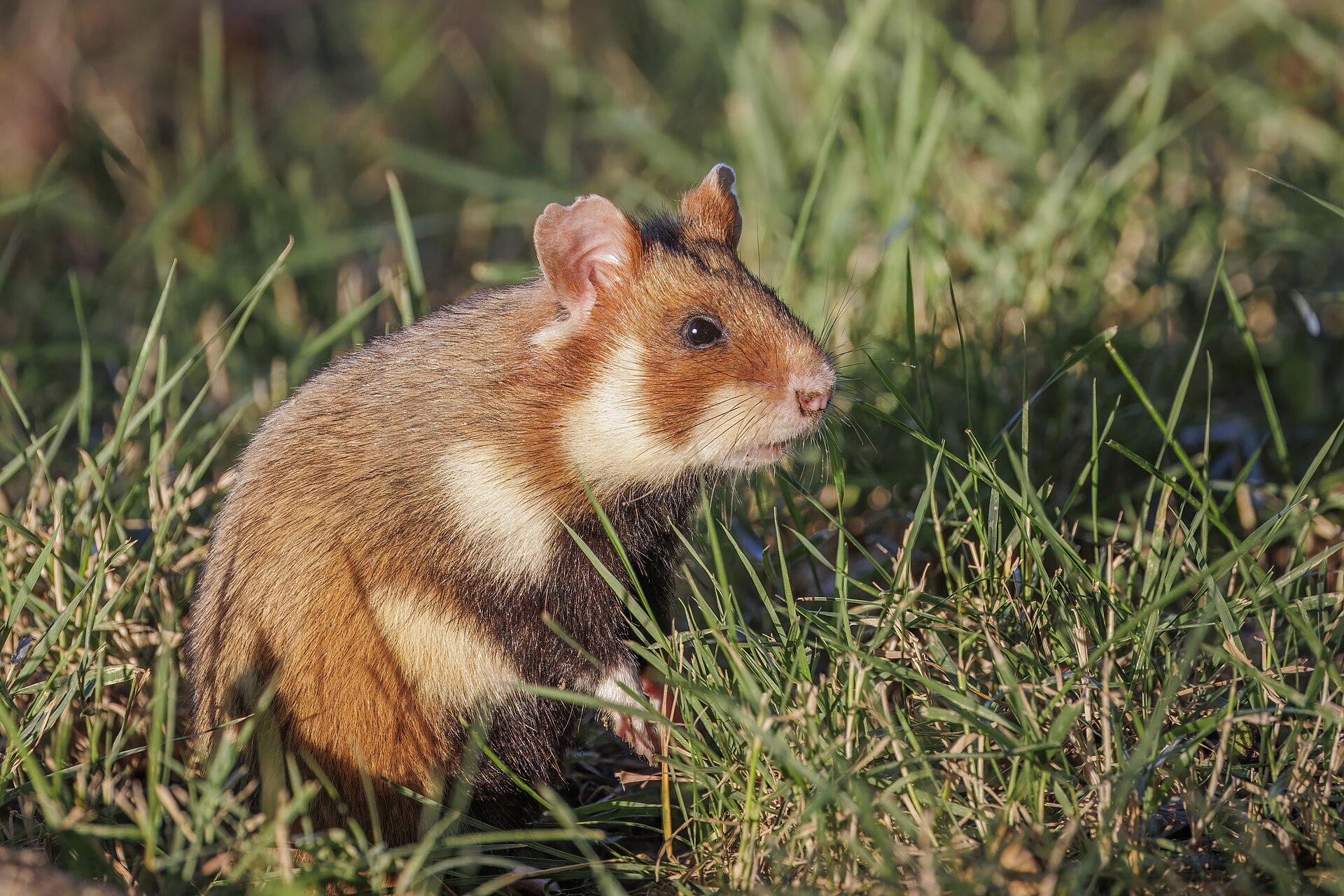
The European Hamster (Cricetus cricetus), also called the common hamster or black-bellied hamster, is the largest of the "true" hamsters and one of the most surprising: a stocky rodent of vivid colours and a dramatic recent history. Famous for:
- The black belly: unusual in the animal world, it has entirely dark underparts, in contrast with the pale back
- Its size: by far the largest of the hamsters, much bigger than the domestic ones
- "Pouch" cheeks: huge cheek pouches in which it carries and stores seeds
- Deep burrows: it digs complex tunnels with chambers for sleeping, for stores and for waste
- Hibernation: it spends winter underground, waking periodically to eat its stores
- The recent collapse: from an extremely common animal to a Critically Endangered species in a few decades
IUCN status: Critically Endangered (CR). It enters the portal in the group of Hamsters, alongside the Golden Hamster (the classic pet hamster): together they tell two opposite faces of the same group — the small cage hamster, found all over the world, and the large wild European hamster, now on the brink of extinction.
Classification and category
Order Rodentia (the rodents), family Cricetidae, subfamily Cricetinae — that of the true hamsters. It is the only species of the genus Cricetus and is the largest hamster in the world. In the portal it is placed among the Hamsters. It is important to tell it apart from the domestic hamsters, with which it has little in common beyond kinship: the Golden (or Syrian) Hamster (Mesocricetus auratus), the classic cage hamster, is much smaller, has a pale belly and is a domestic animal; the dwarf hamsters (genus Phodopus), also pets, are tiny; the European Hamster, instead, is large, wild, black-bellied and anything but docile in temperament. Etymology: the word "hamster" comes from the German hamstern, "to hoard, to stockpile" — a direct reference to the mania for storing food. Parameters: Length about 20-35 cm (plus a short tail), much larger than the domestic hamsters. Weight about 220-460 g. A stocky, robust body. Longevity rather short in the wild, generally around 2 years (more in captivity). Reproduction: historically very prolific, with several litters a year; the very decline in birth rate observed in recent decades is one of the causes of its decline.
Habitat and distribution
The European Hamster is a rodent of the Eurasian plains and steppes: its range runs from Western Europe (France, Belgium, the Netherlands, Germany) through central and eastern Europe to Russia and Central Asia. Preferred habitats: steppes, grasslands and cultivated fields, especially of cereals; deep, well-drained soils, essential for digging the burrows; and lowland farmland, where it was once extremely common. It is a fossorial animal: it spends much of its life in underground burrows that can reach over a metre and a half deep, with tunnels and specialized chambers. It is solitary and territorial, active mainly at dawn and dusk. In winter it hibernates, living off its stored food. IUCN: Critically Endangered. It is one of the most striking cases of decline in Europe: an animal once so abundant as to be fought as a crop pest has collapsed within a few decades, to the point of risking extinction. Among the causes indicated by researchers are intensive agriculture and monocultures, the reduction in the number of young per female, light pollution and other factors still under study. Conservation and reintroduction programmes are under way, particularly in France (Alsace) and the Netherlands.
Diet
The European Hamster is essentially granivorous and herbivorous, with a marked tendency to hoard. It eats: seeds, grains and legumes (the basis of its diet, especially ahead of winter); roots, tubers and the green parts of plants; and, to a lesser extent, insects and other small invertebrates. Feeding strategies: the storehouse cheeks (it fills its huge cheek pouches with seeds and carries them to the burrow); large stores (it accumulates kilos of food in its underground stores, a vital reserve for surviving winter); and waking to eat (during hibernation it wakes periodically to feed on its supplies). Crucially, food hoarding is so much part of the hamster's nature that it shaped the very name ("hamstern" in German means "to stockpile"). Its large reserves let it survive the long continental winters, but the very availability and variety of food in modern fields — increasingly poor and uniform — seem to be among the causes of its decline.
Physical features
A robust rodent of vivid, contrasting colours, very different from the "cute" image of cage hamsters. Colouring — its most surprising trait: a brown-reddish back, warm and pale; a completely black belly, an unusual feature (in animals the underparts are usually paler), hence the name "black-bellied hamster"; white patches on the flanks, cheeks and muzzle. The body: a stocky, massive build for a hamster, with sturdy legs; large, extensible cheek pouches; a short tail, small eyes and ears. Performance and behaviour: an excellent digger, building deep, articulated burrows; a combative nature (if threatened it can puff up its cheeks, rear up and defend itself firmly, anything but timid); and an extraordinary hoarding ability.
Behaviour and curiosities
The European Hamster is a solitary, territorial and mainly nocturnal-crepuscular animal. Each individual defends its own burrow and the surrounding area, and encounters between adults, outside breeding, are usually hostile. Despite its "hamster" looks, it is a wild animal of firm character, able to defend itself bravely.
The black-bellied hamster: one of the most curious features of the European Hamster is its "reversed" colouring compared with that of very many animals — in nature, animals usually have a darker back and a paler belly (a form of camouflage called countershading); the European Hamster does the opposite: a pale back and a black belly; this unusual colouring may have a defensive function: when threatened, the hamster rears up on its hind legs showing its dark belly, appearing larger and more intimidating. The name that means "to stockpile": the English and German word for hamster, hamster, comes from the German verb hamstern, meaning "to hoard, to amass, to lay in supplies"; it is a direct reference to these rodents' famous habit of storing large amounts of food; the European Hamster in particular can store several kilos of seeds and grain in its underground larders: a true "warehouseman" of the animal world. From "pest" to protected species: perhaps the most striking aspect of the European Hamster's story is its reversal of fortune — until a few decades ago it was so abundant in the European countryside as to be considered a troublesome crop pest, hunted and fought; today, following a dramatic and not yet fully explained collapse of its populations, it is classified as Critically Endangered and protected by dedicated programmes; it is a warning of how quickly a common species can become rare. The mysterious decline: scientists have long studied the causes of the European Hamster's rapid decline — among the main factors are intensive agriculture and monocultures (which impoverish and homogenize the environment), the mechanization and timing of farm work, and — a surprising finding — a drop in the number of young that females manage to raise compared with the past; the effects of light pollution and dietary changes are also under study; it is an emblematic case of how modern agriculture can affect wildlife. The wild cousin of the cage hamster: many know hamsters only as small, cute pets, usually the golden (Syrian) hamster or the dwarf hamsters; the European Hamster is their large "wild cousin": it belongs to the same family, but is much bigger, lives free in the wild, has a combative character and is not a pet at all; comparing the cage hamster and the European Hamster helps to understand the difference between a domesticated animal and its wild relative. The underground architect: like many rodents, the European Hamster is a skilful burrow-builder; its underground shelters can be deep and articulated, with separate tunnels and chambers dedicated to different functions: one for sleeping, one or more to store food, and one used as a "latrine"; different burrows, moreover, are often dug for summer and for winter, the latter deeper to protect it from frost during hibernation.
Pros
- Affascinante e poco noto: il più grande criceto del mondo, dal ventre nero
- Simbolo della crisi della biodiversità agricola europea: caso di studio per la conservazione
- Utile contrappunto "selvatico" al criceto domestico (Criceto Dorato)
- Grande scavatore: le sue tane arieggiano il terreno e ospitano altri animali
Cons
- NON è un animale da compagnia: è un roditore selvatico dal carattere combattivo
- IUCN Critically Endangered: a fortissimo rischio di estinzione in Europa
- Minacciato da agricoltura intensiva, calo della natalità e altri fattori ancora poco chiari
- Un tempo perseguitato come parassita dei raccolti: pregiudizi duri a morire