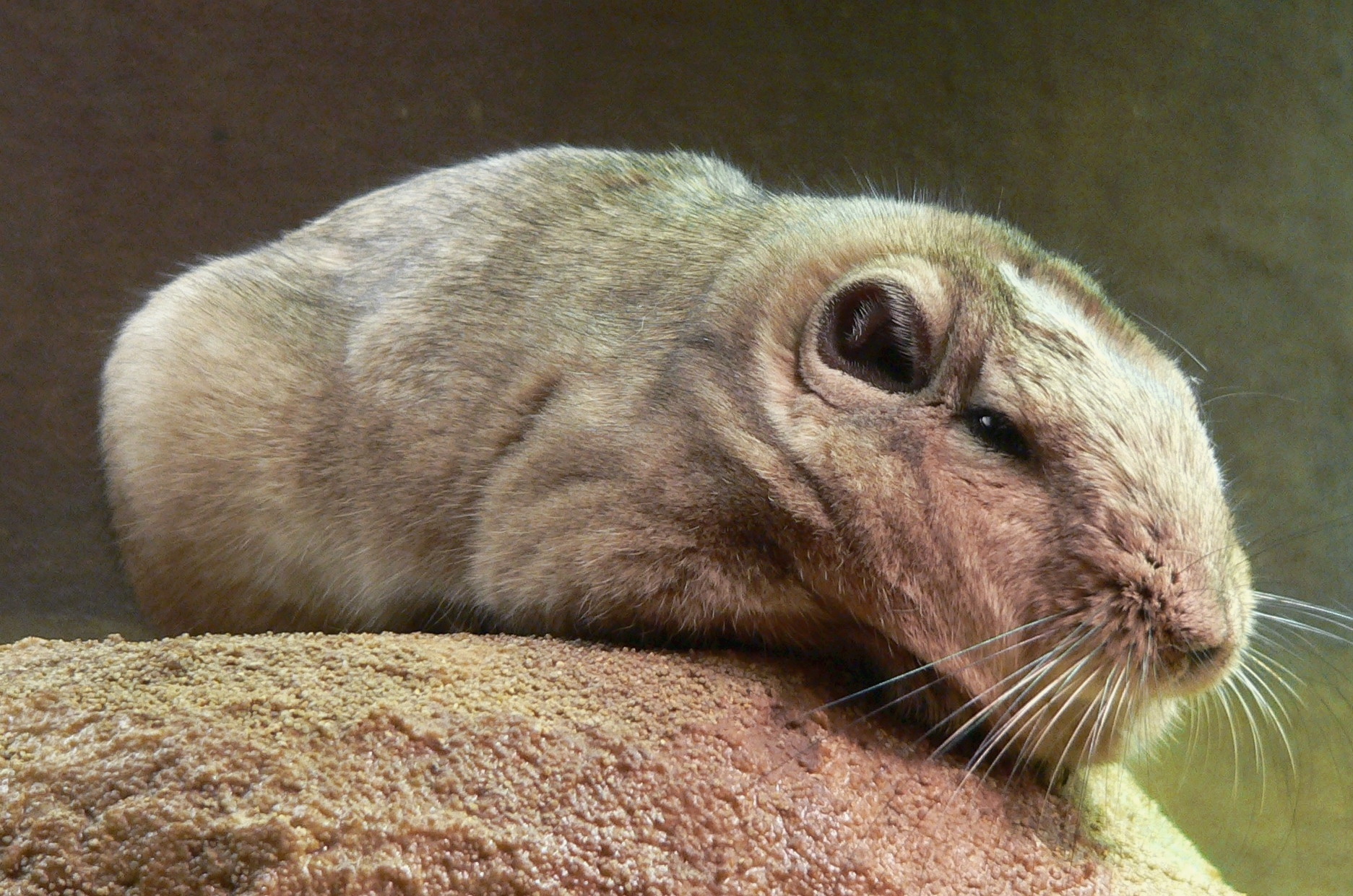
Gundi
Ctenodactylus gundi
Characteristics
Temperament
A small wild rodent, diurnal, sociable and sun-loving, perfectly adapted to life among the rocks of the North African deserts. It lives in colonies in the crevices, communicates with whistles and calls and raises the alarm at the first danger, quickly taking refuge in the cracks. An agile climber, it can flatten its body to slip into minimal spaces. It carefully alternates sunbaths and shade to regulate its temperature. It is NOT a pet: it is native wildlife, to be known and observed in its extraordinary rocky environment.
Diet
A herbivore adapted to aridity: it feeds on the leaves, stems, flowers and seeds of desert and rocky-area plants, exploiting the sparse vegetation available among the stones. Like many desert animals, it gets most of the water it needs directly from food and drinks very rarely. It feeds at short intervals, always staying close to the rocky shelters into which it can retreat at the first danger. Extreme efficiency in water use and the ability to exploit poor vegetation are its key adaptations.
The Gundi (Ctenodactylus gundi), the "common gundi" or "comb rat", is a small, fascinating rock-dwelling rodent of North Africa: a stocky, soft little animal, surprisingly like a guinea pig, perfectly adapted to life among the stones of deserts and mountains. Famous for:
- The "rock guinea pig" look: a compact body, large eyes and ears, an almost invisible tail
- The "comb" feet: stiff bristles on the hind feet used to clean the fur, hence the name
- Life among the rocks: it shelters in crevices and basks in the sun on the stones
- Sociability: it lives in colonies, communicating with whistles and calls
- Desert adaptation: it gets its water from food and rarely drinks
- The ability to "flatten": it squashes its body to slip into very narrow cracks
IUCN status: Least Concern (LC). It enters the portal as the first representative of the ctenodactylids (the small family of gundis), enriching the already vast rodent section with a little-known animal that is extraordinarily adapted to the arid rocky landscapes of North Africa.
Classification and category
Order Rodentia, family Ctenodactylidae (the gundis, or "comb rats"), a small group of rodents exclusive to Africa. The species described here is Ctenodactylus gundi, the common gundi. In the portal it opens the new category of ctenodactylids. It is useful to tell it apart from animals similar in look or habitat but of quite different nature: guinea pigs and other caviomorphs resemble the gundi in their stocky shape, but belong to different families and live on other continents; the hyraxes share the rocky habitats and the sun-basking habit, but are NOT rodents (they are a group of their own, distantly related to elephants); the pikas (also in the portal) are small rock mammals of similar appearance, but are lagomorphs (relatives of rabbits and hares), not rodents. Etymology: the family name Ctenodactylidae and the genus Ctenodactylus come from Greek and mean roughly "comb fingers", referring to the comb-like bristles of the feet; "gundi" is the North African vernacular name of the animal. Parameters: Length a body of about 17-20 cm. Tail very short and barely visible, almost hidden in the fur. Weight roughly 170-200 g. Longevity: a few years in the wild. Reproduction: the young are born already quite developed and active, an adaptation to the exposed life among the rocks.
Habitat and distribution
The Gundi is a typically North African rodent: its range covers North Africa — Morocco, Algeria, Tunisia and Libya — along the Atlas ranges and the rocky areas on the fringes of the Sahara. Preferred habitats — arid, stony, rocky environments: rocky outcrops, walls and screes; stony deserts and semi-deserts; and arid mountainous areas with crevices and natural shelters. The Gundi does not dig burrows: it shelters in the natural cracks and crevices of the rock, where it finds protection from predators and extreme temperatures. It is a diurnal, sun-loving animal: in the early morning it likes to bask in the sun on the stones, then retreats to shade or crevices during the hottest hours. Its agility among the rocks and its ability to flatten its body to slip into cracks are essential for survival in these harsh environments. IUCN status: Least Concern (LC). It is relatively widespread in its range and of no particular conservation concern, though it depends closely on the availability of suitable rocky environments.
Diet
The Gundi is a herbivore adapted to the scarcity typical of arid environments. It feeds on: the leaves, stems, flowers and seeds of desert and rocky-area plants; and the sparse vegetation it can find among the stones and at the edges of the screes. Feeding habits and adaptations: water from food (like many desert animals, the Gundi gets most of the water it needs directly from the vegetation it eats, and rarely needs to drink); "hit-and-run" foraging (it comes out to feed at short intervals, always staying close to the rocky shelters into which it can retreat at the first danger); and plant selection (it exploits the available vegetation in an environment where food is scarce and scattered). Crucially, the extreme efficiency in water use and the ability to exploit poor, sparse vegetation are the adaptations that let the Gundi thrive in habitats where few other species can live.
Physical features
A small rodent of stocky, soft, endearing appearance. The body and fur — the general look: a compact, rounded body, recalling that of a guinea pig; dense, soft, plush fur, sand or grey-brown coloured, camouflaged among the rocks; a very short tail, almost hidden in the fur. The head: large eyes, of a diurnal, alert animal; well-evident rounded ears; a short muzzle and developed whiskers. The adaptations — the distinguishing trait: "comb" bristles on the hind feet (rows of stiff hairs used to comb and clean the dense coat, hence the name "comb rat"); a flexible, "flattenable" body (it can squash itself to slip into very narrow cracks); and feet suited to climbing on rocky surfaces.
Behaviour and curiosities
The Gundi is a social, diurnal, rock-bound animal, with a life entirely shaped by the arid environment in which it lives. Its biology is a little manual of adaptations to the rocky desert.
The comb feet: the trait that gives the family its name is the presence, on the hind feet, of rows of stiff bristles arranged like the teeth of a comb; the Gundi uses them to "brush" and keep tidy its dense, soft coat, essential for thermal insulation; hence the English name "comb rat". The master of crevices: unlike many rodents, the Gundi does not dig tunnels but exploits the natural cracks of the rock; to slip into the narrowest recesses it can flatten its body to a surprising degree, sliding into minimal spaces where predators cannot follow; the rocks are at once its home, its refuge and its "thermostat". The sunbath: the Gundi is a sun-loving animal; in the cool desert mornings, the colonies come out to bask in the sun on the rocks, storing up heat before facing the day; when the sun becomes too intense, however, they quickly retreat to shade and crevices: unable to bear extreme heat for long, the Gundi carefully alternates sun and shelter to regulate its body temperature. The animal that (almost) does not drink: perfectly adapted to aridity, the Gundi gets the water it needs mainly from the vegetation it eats; in the wild it drinks very rarely, a precious adaptation in environments where free water is scarce or absent for much of the year. The whistling colony: gundis are social animals that live in groups among the rocks and communicate with a variety of vocalizations, including whistles and chirps; these calls serve to keep contact in the colony and, above all, to raise the alarm in case of danger, letting everyone quickly take refuge in the crevices. The "guinea pig" that is not a guinea pig: the stocky, soft appearance of the Gundi may recall that of a guinea pig or a small hyrax, but these are superficial resemblances; the Gundi belongs to a rodent family of its own, the ctenodactylids, exclusive to Africa: a fine example of how unrelated animals can take on similar forms by adapting to similar environments.
Pros
- Roditore affascinante e poco noto, dagli straordinari adattamenti al deserto roccioso
- Socievole: vive in colonie e comunica con fischi e richiami
- Efficientissimo nell'uso dell'acqua: vive dove poche specie riescono a sopravvivere
- IUCN Least Concern: relativamente diffuso nel suo areale nordafricano
Cons
- NON è un animale da compagnia: è fauna selvatica autoctona
- Strettamente dipendente dagli ambienti rocciosi: sensibile alla loro alterazione
- Male adattato al caldo estremo prolungato: deve alternare sole e riparo
- Schivo e poco appariscente: difficile da osservare in natura