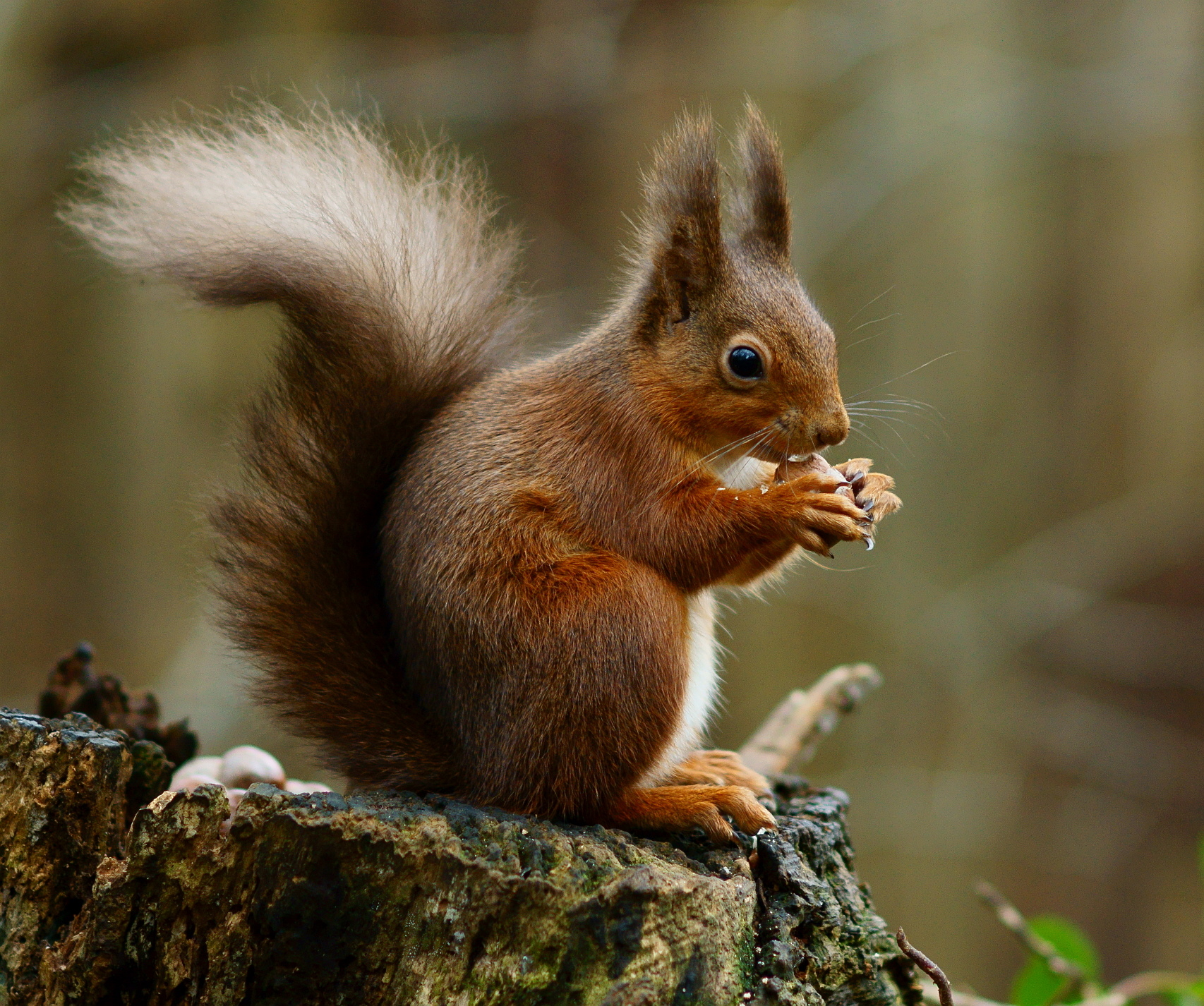
Eurasian Red Squirrel
Sciurus vulgaris
Characteristics
Temperament
Diurnal, solitary, territorial. Does not hibernate. Key species for forest seed dispersal ("ecological gardener"). Threatened by invasive grey squirrel.
Diet
Granivore: conifer seeds (pine nuts, spruce), hazelnuts, acorns, beechnuts, mushrooms. 80-120 g/day. Autumn caching of thousands of seeds buried in territory.
The Eurasian Red Squirrel (Sciurus vulgaris) is a small arboreal mammal of the Sciuridae family, present in all the forests of Eurasia. Recognisable for its tawny-reddish coat, long bushy tail and characteristic winter ear tufts, it is one of the most beloved species of European wildlife. Despite a global "Least Concern" conservation status, populations in much of Western Europe are in dramatic decline due to competition with the American grey squirrel (Sciurus carolinensis), illegally introduced by humans.
Classification and category
The Red Squirrel belongs to the order Rodentia, family Sciuridae, subfamily Sciurinae, genus Sciurus. The genus comprises over 30 species of tree squirrels distributed worldwide (except Australia and Antarctica). S. vulgaris is the quintessential European species, with at least 23 recognised subspecies varying in colour and size. It is a small rodent: body length is 19-23 cm, with a tail of 15-20 cm; average adult weight is 250-340 g, with males and females of similar size (modest sexual dimorphism).
Habitat and distribution
The natural habitat of the Red Squirrel consists of mature coniferous forests, mixed forests and broadleaf woods rich in seed-producing trees (firs, pines, beeches, oaks, hazels). It prefers continuous forest areas with high tree cover but has adapted well to urban parks in many European cities where there is no competition with the grey squirrel.
The Palearctic range covers the entire Eurasia, from the Iberian Peninsula to Japan: all of Europe (excluding Iceland, part of southern England and Wales), Siberian Russia, northern China, Mongolia, Korea and Hokkaido. Conservation status is listed as Least Concern (LC) by the IUCN globally, but with populations in dramatic decline in the United Kingdom, Ireland, part of northern Italy and southern Switzerland due to the invasion of the Grey Squirrel (Sciurus carolinensis), which competes for resources and transmits the parapoxvirus, lethal for reds but harmless for greys. In many countries conservation programmes and active grey removal are underway.
Diet
The Red Squirrel is mainly granivorous, with a diet dominated by conifer seeds (pine nuts, spruce, larch) and dried fruits of broadleaf woods (hazelnuts, acorns, beechnuts, chestnuts). It supplements the diet with mushrooms (of which it is a great consumer, both fresh and dried and stored in caches), berries, shoots, soft bark, flowers and occasionally eggs and nestlings.
A key characteristic is caching behaviour: in autumn it buries thousands of seeds in small hiding places scattered around the territory (up to 30 a day!), managing to find them in winter thanks to extraordinary spatial memory. Only a portion is actually recovered: forgotten seeds germinate and contribute to the natural regeneration of the forest. The Red Squirrel is therefore a key ecological "gardener" for forest seed dispersal. Daily energy requirement is about 80-120 grams of equivalent food.
Physical features
The Red Squirrel has a slender, flexible body, perfectly adapted to arboreal life. The coat varies considerably in colour: the classic form is tawny rust-red on the back, white on the belly, but variations exist from intense red to greyish-brown to almost black (especially in Alpine and Siberian populations). Colour also varies seasonally: the spring moult produces a lighter, shorter coat, the autumn one a darker, thicker coat with the characteristic ear tufts (long-haired tufts on the ears, visible only in winter).
The tail, as long as the body, is covered with long, thick hairs that make it "plumed": it serves for balance during leaps between branches, visual communication (alarm signals) and thermoregulation (wrapped over the body during winter sleep). Hind legs are very developed and powerful, capable of horizontal jumps up to 3 metres; forelegs, shorter but agile, are equipped with sharp claws to climb even upside down. The incisor teeth are orange, continuously growing and self-sharpening.
Behaviour and curiosities
The Red Squirrel is a solitary, diurnal and territorial animal. Each individual occupies a 2-10 hectare territory (depending on food availability), marking it with secretions from ocular and plantar glands. Communication is complex: it includes vocalisations (chatters, alarm whistles), tail postures and foot stomps against the trunk to signal presence.
It builds characteristic nests called dreys: 30-50 cm diameter spheres woven with twigs, leaves, moss and down, placed in the fork of a large tree at 6-12 metres height. A female may have 2-3 active nests that she uses alternately for safety. Sexual maturity is reached at 10-12 months; gestation lasts 38-39 days, the female gives birth to 3-6 young (called kits) twice a year. The Red Squirrel does not hibernate: it remains active even in winter, living on buried food caches and those stored in a nest chamber. Lifespan in the wild is short (3-7 years on average, with very high juvenile mortality), while in captivity it can reach 12 years.
Pros
- Specie iconica delle foreste europee
- Ruolo ecologico chiave per la rigenerazione forestale
- Facile da osservare in parchi urbani
- Non va in letargo, attivo tutto l'anno
Cons
- Specie selvatica protetta, NON è un animale da compagnia
- In declino in molti paesi europei
- Vulnerabile al parapoxvirus trasmesso dal grigio
- Vita molto breve in natura (3-7 anni)