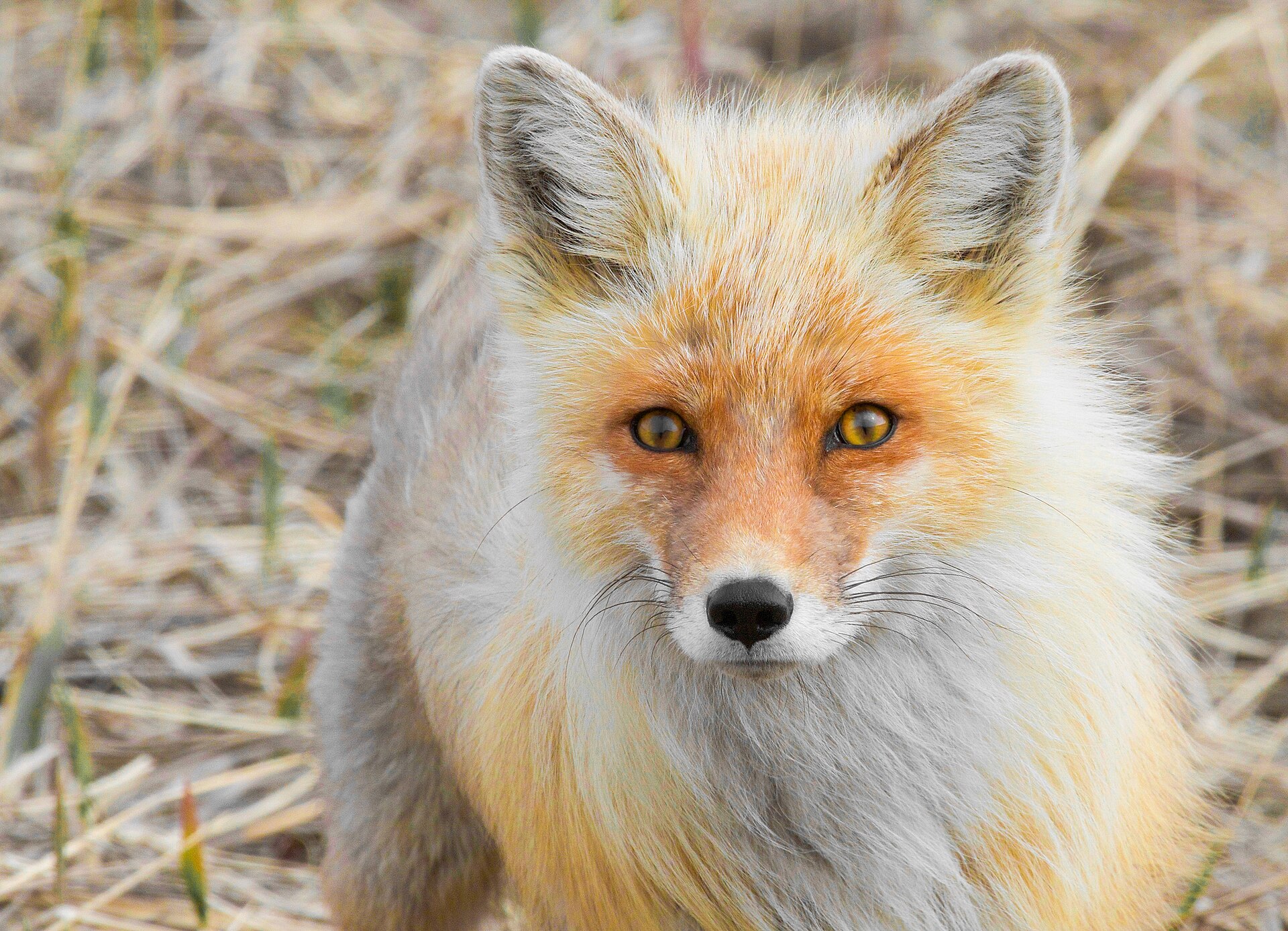
Red Fox
Vulpes vulpes
Characteristics
Temperament
Solitary, crepuscular-nocturnal, territorial. Extremely intelligent and adaptive. Famous "mousing leap" vertical jump up to 2 m. Monogamous pair in breeding season.
Diet
Opportunistic omnivore: rodents (main food, "mousing leap"), rabbits, birds, wild fruit, carrion, urban scraps. 500-700 g/day. Caching behaviour (underground caches).
The Red Fox (Vulpes vulpes) is the most widespread terrestrial carnivore in the world. Recognisable for its tawny coat, bushy white-tipped tail and pointed muzzle, it is a small solitary canid, opportunistic and endowed with extraordinary adaptive intelligence. It lives in virtually every environment of the boreal hemisphere — from arctic taiga to semi-deserts, from forests to city outskirts — and is one of the few predators that has managed to increase its population despite human expansion.
Classification and category
The Red Fox belongs to the order Carnivora, family Canidae, subfamily Caninae, genus Vulpes. The genus comprises twelve fox species distributed on every continent except Antarctica, and V. vulpes is by far the largest and most widespread. It is a small-to-medium mammal: body length ranges from 60 to 90 cm, plus a 30-50 cm tail (called a "brush"). Average adult weight is 4-10 kg, with males noticeably larger than females; northern populations tend to be larger than southern ones (Bergmann's rule).
Habitat and distribution
The Red Fox's habitat is the broadest of any carnivore: it includes boreal and temperate forests, grasslands, steppes, mountains up to 4,500 metres, moorlands, tundra, semi-deserts, farmland and urban environments. It is one of the very few wild species to have successfully colonised European cities (London hosts about 10,000 urban foxes; Berlin, Rome, Zurich have stable populations).
The natural range covers the entire boreal hemisphere: all of Europe, North America (except some southern areas), all of Asia (except the south-eastern tropics) and North Africa. Introduced by humans to Australia in the 19th century for sport hunting, it is today considered one of the worst invasive species on the continent, responsible for the extinction of numerous native marsupials. Conservation status is listed as Least Concern (LC) by the IUCN: with over 50 subspecies and a global population estimated in many millions, it is the most abundant carnivore in the world.
Diet
The Red Fox is an opportunistic omnivore: its diet is extraordinarily flexible and changes according to local availability. It feeds mainly on small rodents (mice, voles, rats), which it hunts with the famous "mousing leap" technique: a vertical jump up to 2 metres high that allows it to plunge onto prey from above, even through a layer of snow.
It supplements the diet with rabbits, hares, birds and their eggs, reptiles, amphibians, insects, wild fruit (blackberries, blueberries, apples), carrion and — in urban foxes — food scraps and rubbish. Daily food requirement is about 500-700 g. The Red Fox is famous for caching behaviour: when it has caught more food than necessary, it buries it in small hiding places scattered around its territory, memorising the position and returning over the following days.
Physical features
The Red Fox has a slender, flexible body with relatively short legs, pointed muzzle, erect triangular ears and yellow eyes with vertical pupils (a rarity among canids, normally with circular pupils). The coat varies considerably in colour: the classic form is tawny-red on the back, white on the belly and tail tip, black on the legs and behind the ears; but natural colour mutations exist such as the silver fox (black with silver tips), the cross fox (with a black cross on the back) and the rare white fox.
The tail, long and bushy, has multiple functions: balance during running, visual communication (positional signals), coverage of the paws during winter sleep. There are two moults per year; the winter coat is exceptionally warm, which is why the species was historically intensively hunted for fur. The Red Fox is also an excellent swimmer and climbs with relative agility on low trees and walls.
Behaviour and curiosities
The Red Fox is a mostly solitary, crepuscular-nocturnal and territorial animal. It forms monogamous pairs in the breeding season (January-February); the female generally gives birth to 4-6 cubs (called kits) in a burrow that is dug or repurposed. Cubs stay with the parents up to 6-7 months, after which they disperse. Some adult females ("aunts") may stay to help the mother raise the young — an interesting case of cooperative breeding in canids.
Vocalisations are rich and varied: barking for territorial calls, screaming typical of mating rituals (a sharp, prolonged scream that often alarms those living near woods), gekkering in aggressive interactions, brief howls. Lifespan is short in the wild (2-5 years on average, rarely over 10), while in captivity it can reach 10-14 years. A Soviet experiment begun in 1959 by geneticist Dmitri Belyaev on a population of silver foxes demonstrated that canid domestication can occur in just a few generations by selecting only for docility — the "Siberian fox experiments" are today considered one of the most important contributions to our understanding of the domestication of dogs and other animals.
Pros
- Specie iconica e adattabile
- Carnivoro più diffuso al mondo
- Esempio classico di intelligenza animale
- Facile da osservare in ambienti rurali e urbani
Cons
- Specie SELVATICA, NON è un animale da compagnia (illegale in molti paesi)
- Vettore di rabbia ed echinococcosi in alcune zone
- Invasiva in Australia
- Vita breve in natura (2-5 anni)