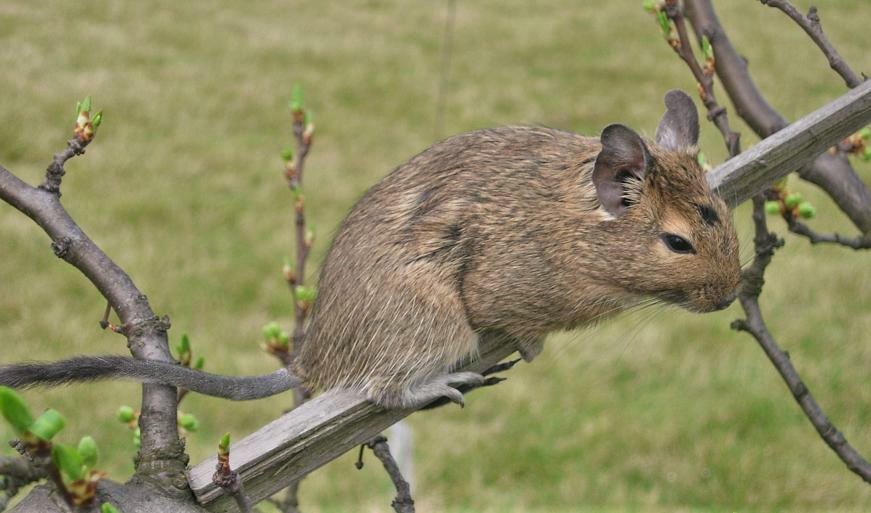
Degu
Octodon degus
Characteristics
Temperament
Diurnal, highly social (matriarchal colonies 6-20), extremely intelligent (15+ distinct vocalisations). Ability to use tools (rakes). Cognitive abilities similar to dogs. NEVER keep alone (dies of depression). Important scientific model (Alzheimer, diabetes).
Diet
Strict herbivore SUGAR INTOLERANT (develops type 2 diabetes in 3-6 weeks). Only sugar-free specific pellets, meadow hay, green vegetables, safe twigs. PROHIBITED sweet fruit, refined cereals, biscuits.
The Degu (Octodon degus), also known as the Common Degu or Brush-tailed Rat, is a small diurnal rodent endemic to the central Andes of Chile. Although little known in Europe, it is one of the most fascinating animals among modern rodents for three reasons: (1) it has an exceptional social life, with matriarchal colonies, complex vocal communication and cognitive abilities comparable to those of dogs; (2) it is a fundamental scientific model for the study of Alzheimer's disease (it is one of the few non-primate animals that naturally develops beta-amyloid plaques typical of the human disease) and type 2 diabetes (extremely sensitive to sugars); (3) it is today a popular exotic pet in Europe and North America, particularly appreciated for its diurnal activity (unlike nocturnal hamsters and rats) and superior intelligence.
Classification and category
The Degu belongs to the order Rodentia, suborder Hystricomorpha, family Octodontidae (the "octodonts", South American rodents), genus Octodon. The genus comprises 4 species all Chilean; O. degus is the most widespread species and the only one significantly studied. Body length is 12-20 cm, to which is added a tail of 8-12 cm with a characteristic "terminal brush" of black hair. Average adult weight is 170-300 g (males slightly larger than females). The scientific name Octodon derives from Greek and means "eight teeth", referring to the particular "8" shape of the molar teeth, a diagnostic feature of the genus. The family Octodontidae includes other South American genera such as Octodontomys (Bolivian Octodont), Spalacopus (subterranean Octodont), and Tympanoctomys (giant Octodont). The Degu was scientifically described by Johann Friedrich Wilhelm Herbst in 1782.
Habitat and distribution
The habitat of the Degu is limited to the central Andes of Chile, between 0 and 2,000 metres altitude, in the regions of Coquimbo, Valparaíso, Metropolitan of Santiago, O'Higgins, Maule. The climate is Mediterranean semi-arid type: hot and dry summers, cool winters with limited rainfall. The Degu lives in matriarchal colonies in arid shrublands, Chilean matorral, abandoned agricultural lands and open pastures. It digs a complex network of underground galleries with multiple exits: a colony can occupy a tunnel system over 200 metres long, with common chambers, dormitories, food stores, and nests for young.
The total population is abundant (estimated in millions), and the conservation status is listed as Least Concern (LC) by the IUCN. Local threats include: agricultural and urban expansion (loss of natural habitats), predation by domestic animals (cats, dogs), capture for pet trade (legal in Chile but regulated). Chilean Degus were introduced as laboratory animals in the 60s (models for cardiology and neuroscience), and as exotic pets in Europe and North America from the 80s. In Italy the price of a Degu in a specialised shop is 30-80 euros, but it is recommended to adopt them at least in pairs (never alone: they die of depression in isolation). Note that the Degu is prohibited as a pet in some American states (California, Connecticut, Georgia, Hawaii, Nevada, New York, Pennsylvania, Utah) due to the risk of colonisation of local habitats (potentially invasive species).
Diet
The Degu is a strict herbivore with a highly specialised natural diet. In nature it feeds on: leaves and dry herbs of Andean bushes (Acacia caven, Baccharis, Lithraea), barks, seeds, arid fruits, roots, rare insects (occasional, 1-2% of diet). The digestive system is optimised for fibrous plant material poor in sugars: long intestine, extensive caecum, ability to assimilate cellulose thanks to specialised bacterial flora.
The most important characteristic for those who keep Degus as pets is the total sugar intolerance: the Degu is one of the very few mammals that develops type 2 diabetes mellitus with extreme rapidity (in 3-6 weeks) if fed with sugary foods. The correct diet in captivity must be: specific pellets for Degu or chinchilla (without molasses, honey, fruit), meadow grass hay (always available, basis of the diet), small quantities of green vegetables (lettuce, celery, parsley), fresh twigs of safe trees (willow, apple, birch). To be absolutely avoided: sweet fruit (bananas, grapes, apples), refined cereals, biscuits, vegetables rich in sugar (carrots, corn), nuts (high fat content). Even small amounts of sugar cause cataract within a few days. Water must always be available in drip bottles (not open, to avoid contamination). The Degu is coprophagous: it produces two types of faeces (caecal and final) and ingests the former to recover essential nutrients, normal and essential behaviour for health.
Physical features
The Degu has a stocky body, covered with soft and thick fur. The coat colour in nature is grey-brown agouti (mix of grey, brown and blackish hairs that provide camouflage in arid shrublands). In captive specimens there are several selected colour variants: blue, sand, black, pied (bicolour with white markings), fawn. Juveniles are greyer than adults. The head is large in proportion to the body, rounded, with elongated muzzle. The eyes are large, dark, well protruding — adaptation for diurnal vigilance against raptors. The ears are medium, well spaced, rounded.
The most recognisable characteristic is the tail: 8-12 cm long (less than the body, unlike mice and rats), covered with short hair, with a characteristic "brush" of long black hairs at the end (in the form of pompon or brush). Like many rodents, the tail has the capacity of caudal autotomy (like lizards): if grabbed by a predator, the skin of the tail easily detaches leaving the vertebrate intact to the Degu that escapes. The tail never regrows after autotomy. The incisor teeth are of bright yellow-orange colour with continuous growth: the colour derives from a film of iron-rich enamel (diagnostic health feature, pale teeth indicate disease). The Degu must have continuous access to materials to gnaw (wood, mineral blocks) to avoid excessive growth of incisors (malocclusion, fatal pathology if not treated). The forelegs are short but dexterous (object manipulation capacity like a small raccoon), the hindlegs longer (for rapid running). The plantar pads are bare.
Behaviour and curiosities
The Degu is famous for being one of the most social and intelligent rodents in the world. It lives in matriarchal colonies of 6-20 individuals with a complex hierarchical structure: a dominant female ("queen") and several subordinates, adult reproductive males, and shared offspring. Females practice collective care of young (alloparenting): several females indistinctly nurse and care for the offspring of the entire colony. Communication is one of the most complex ever documented in a rodent: it includes a repertoire of over 15 distinct vocalisations (contact clucks, alarm whistles with different tones depending on the type of predator — aerial or terrestrial, "songs" during courtship), urinary pheromones, body postures.
The cognitive abilities of the Degu are comparable to those of dogs: they can learn to recognise their own name, perform tricks (stand on hind legs, do rolls, cross obstacles), solve complex spatial problems, and — a rare feature in rodents — use tools. Experiments from the University of Tokyo (2018) have shown that Degus can learn to use small rakes to retrieve food out of reach, a capacity previously documented only in primates, corvids and elephants. Longevity in captivity is 6-8 years (with records of 10-13 years), exceptionally long for a rodent of only 200 g: in nature life is short (1-2 years) due to predation.
Scientifically, the Degu is a fundamental biomedical model: it is one of the few non-primate mammals that naturally develops beta-amyloid plaques and neurofibrillary tangles typical of human Alzheimer's (starting from 4-5 years of age). For this reason it is widely used in laboratories to test new anti-Alzheimer's drugs. It is also a model for type 2 diabetes (extreme sugar intolerance), cataract, atherosclerosis, circadian rhythms (it is one of the few diurnal rodents, useful for chronobiological studies). Anthropological curiosity: the Degu was part of the diet of the ancient Mapuche and Incas, hunted for meat and considered a precious food. Even today in some rural areas of Chile it is still consumed (tradition in decline). In Chile the Degu is not loved by farmers because it damages crops (fruits, vegetables); it is in fact also considered a local agricultural pest.
Pros
- Intelligenza eccezionale (paragonabile al cane)
- Attività diurna (a differenza di criceti/ratti)
- Longevità lunga per un roditore (6-8 anni)
- Sociale e affettuoso se ben curato in coppia
Cons
- MAI da tenere singolo (deve vivere in coppia o gruppo)
- INTOLLERANTE agli zuccheri (diabete tipo 2 letale)
- Vietato come pet in 8 stati USA (specie invasiva)
- Necessita gabbie ampie e materiale da rosicchiare costante