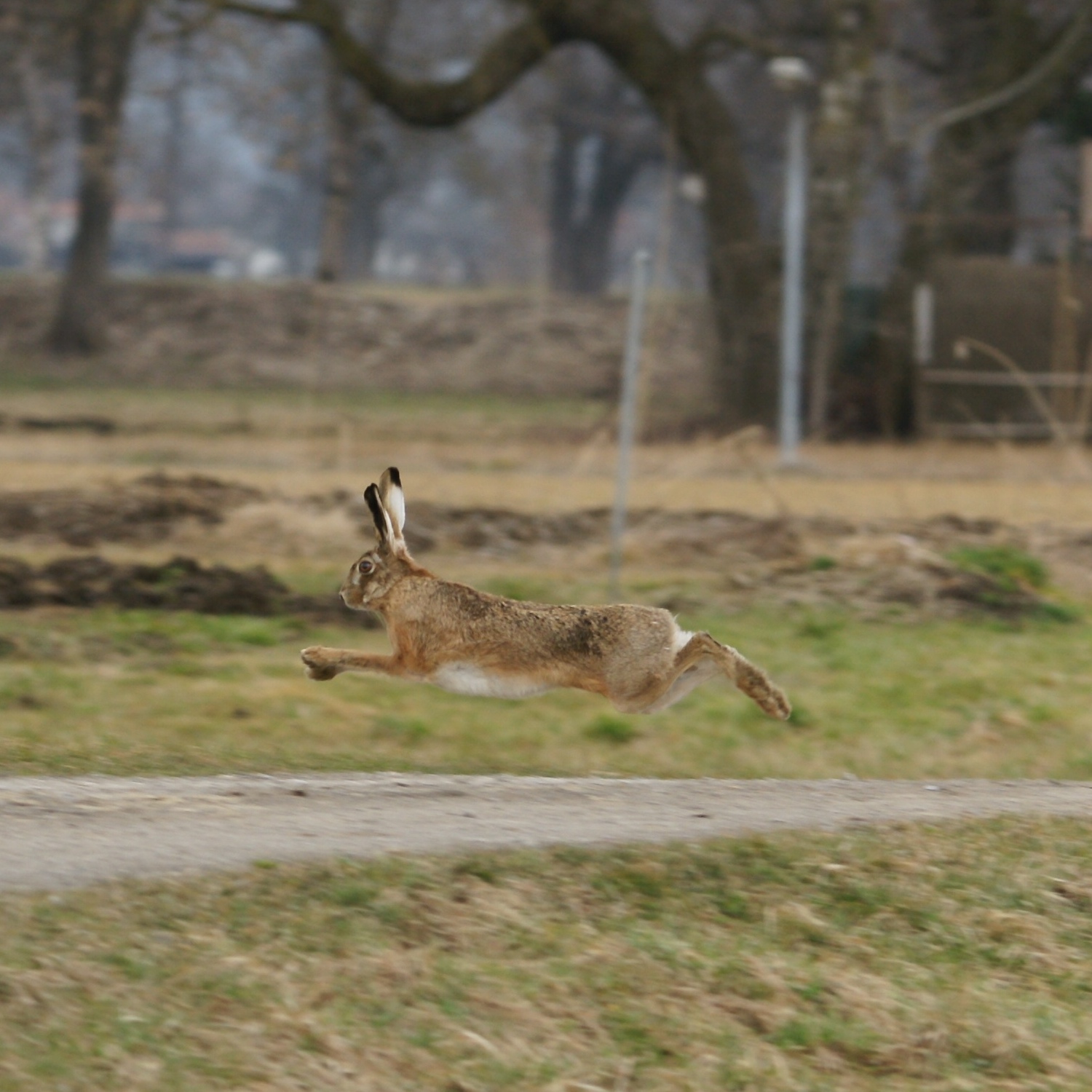
European Hare
Lepus europaeus
Characteristics
Temperament
Solitary, territorial, crepuscular-nocturnal. Very fast (70 km/h, 3 m jumps). Does NOT dig burrows: uses surface "forms". Precocial leverets (open eyes, fur, autonomous in 1 month). "Boxing" behaviour between males in March. Origin of Easter Bunny folklore (Germanic Osterhase). Obligatory caecotrophy.
Diet
Strict herbivore. Grasses (50-60%), legumes, cultivated cereals (agricultural conflicts), leaves, barks in winter. Obligatory caecotrophy (retakes caecotrophs from anus for second digestion). 0.4-0.8 kg/day (10-15% body weight). Meals at dusk/dawn. Almost never drinks free water.
The European Hare (Lepus europaeus), also called the brown hare, is the most widespread and iconic lagomorph of the European continent, distributed from Spain to western Russia, and now introduced worldwide (Americas, Australasia). Often confused with the European rabbit (Oryctolagus cuniculus), the hare is actually a completely different species: larger (weight 3-5 kg vs 1.2-2 kg of the rabbit), with longer ears (10-12 cm with black tips), much more developed hind legs (for running), and solitary (the rabbit is colonial). The most surprising feature is its speed: in flight it reaches 70 km/h in bursts, sustainable for 1-2 km, with horizontal jumps of up to 3 m. Iconic in European folklore: protagonist of Aesop's fable "The Hare and the Tortoise", origin of the Easter myth (Easter Bunny — derived from the Germanic lunar hare "Osterhase"), and of the English idiom "mad as a March hare" (the "boxing" behaviour between males during the March breeding season). The cubs, called "leverets", are precocial: they are born with open eyes, full fur, and can run hours after birth. Life expectancy: 3-4 years in nature, up to 12 in captivity. IUCN status: Least Concern (LC), but declining in many European regions.
Classification and category
The European Hare belongs to the order Lagomorpha (lagomorphs — not rodents!), family Leporidae, genus Lepus. Important distinction: lagomorphs are phylogenetically separated from rodents by about 40 million years; the similarities are due to convergent evolution. Lagomorphs have 2 pairs of upper incisors (the second small pair behind the first) — a unique feature; rodents have 1 pair.
The genus Lepus comprises 32 species of hares spread across all continents except Antarctica, Australia (introduced), Madagascar and Southeast Asia. Lepus europaeus was scientifically described by Pallas in 1778. There are 16 recognised subspecies, based on geographical variations of colour and size. Phylogeny shows close kinship with the Iberian Hare (Lepus granatensis), the Mountain Hare (Lepus timidus), and the Corsican Hare (Lepus corsicanus). Hybridisation possible with other Lepus species in contact zones.
The morphological parameters are: weight 3-5 kg (record 7 kg in Slovakia); body length 60-75 cm; ears 10-12 cm (longer than the head); tail 7-11 cm (black above, white below); hind legs 14-15 cm. The longevity: 3-4 years in nature (high juvenile mortality of leverets — 70% do not survive the first year), 12 years in captivity. Sexual maturity: 7-8 months. Gestation: 41-42 days; litter of 2-4 leverets (up to 4 litters/year). Unique feature: the female can be "superfetated" — she conceives a second litter even before giving birth to the first (overlapping pregnancy, rare phenomenon in mammals).
Habitat and distribution
The European Hare prefers open environments: grasslands, cultivated fields, meadows, steppes, heaths, sparse woodlands, forest edges. It is an animal of agricultural and semi-natural landscapes. Unlike the rabbit (which digs complex underground burrows — "warren"), the hare does NOT dig burrows: it sleeps in a natural depression in the ground called a "form" (the hare lies still in it for hours, camouflaging itself). The form is created by rubbing the body in low vegetation, generating a depression of 30-40 cm. The hare changes forms several times a day to avoid predators.
Historical distribution: central and western Europe, from England/Ireland (introduced ~1850) through Spain, France, Germany, Italy, Balkans to western Russia. North limit: southern Scandinavia; south limit: southern Spain, Turkey. From about 1850-1900 it was introduced in:
- Argentina (1888) — today a population of millions, considered an invasive species
- Chile, Uruguay, southern Brazil
- United States (New York, 1893; Ontario)
- Canada (1912)
- New Zealand (1851), Australia (1837) — invasive, agricultural damage
Global population: estimated 10 million individuals (IUCN). Global conservation status: Least Concern (LC). However, significant regional declines:
- UK and Ireland: 75-80% decline since 1880 (industrialisation, loss of meadows)
- Germany, France, Italy: 50-70% decline since 1960 (intensive agriculture, pesticides, mechanical harvesting)
- Netherlands, Belgium: in decline, possible local extinction
Causes of the decline: agricultural intensification (monocultures, loss of hedges, pesticides), predation (fox, raptors, domestic cat), hunting (10 million hares killed per year in Europe), tularemia (bacterial disease), EBHS (European Brown Hare Syndrome, viral disease). In Italy it is a huntable species from 15 September to 31 December. CITES: not listed.
Diet
The European Hare is a strict herbivore with a diet exclusively vegetable (unlike some omnivorous rodents). It feeds mainly on:
- Grasses (50-60% of the diet in spring-summer): grasses, legumes (clover, alfalfa), composites
- Cultivated plants: cereals (wheat, barley, oats), beets, carrots, cabbages — source of conflict with farmers
- Leaves and twigs: in winter it eats buds, bark of young trees (causes damage to seedlings), berries
- Roots and bulbs: rarely digs, but can take tender roots
- Mushrooms (occasionally)
Feeding technique: the hare browses (cuts quickly with its teeth) vegetation, chewing only later; this strategy minimises exposure time to predators. Meals: 1-2 hours at dusk and dawn (crepuscular-nocturnal animal). Quantity: 0.4-0.8 kg of vegetables per day (10-15% of body weight). It almost never drinks free water — hydration comes mainly from fresh vegetation.
Unique feature in lagomorphs (and in some rodents): caecotrophy — the hare produces two types of droppings:
- Caecotrophs: soft pellets, covered in mucus, produced at night. The hare takes them directly from the anus and ingests them. They contain bacteria from the caecum that have fermented cellulose, vitamins B/K, and bacterial proteins — they are a second digestion
- Faecal pellets: dry, spherical, produced after the second digestion, left on the ground
Caecotrophy is essential for nutrition: lagomorphs cannot digest cellulose well on the first pass. Without caecotrophy, the hare would die of malnutrition.
Physical features
The European Hare has a slender, athletic body, built for speed and endurance. The head is elongated, with a pointed muzzle; the nostrils have a "Y" nasal slit (characteristic of lagomorphs). The eyes are large, prominent, laterally positioned on the head, allowing a visual field of almost 360°; round pupils, brown-yellowish colour. The vision is excellent for movement (detects a predator at 1+ km), less for details. The ears are iconic: 10-12 cm long, longer than the head (diagnostic feature), with black tip. They are independently mobile, rotate 270° to locate precise sounds. The ears also serve for thermoregulation: the large blood vessels dilate to dissipate heat.
The hind legs are the real secret of speed: very long (14-15 cm), muscular, with wide foot pads. They allow horizontal jumps of up to 3 metres and vertical jumps of 1.5 m. The front legs are shorter. The movement: in flight the hare alternates powerful jumps with sudden changes of direction ("zig-zag"), a behaviour called "jinking" that disorients the predator. All 4 legs are always lifted from the ground during fast running (galloping).
The coat is the most geographically variable feature:
- Back: brown-grey-reddish, grizzled (hairs with light and dark tips)
- Flanks: lighter brown
- Belly: cream white
- Tail: black above, white below (in flight the hare raises its tail showing the white — a "flag" signal for conspecifics)
- Ears: brown, black tip
- Hair extremities (in winter some northern populations become lighter, not white like the alpine hare)
The hairs are of two types: undercoat dense, insulating; guard hairs long, shiny. The fur moults twice a year: spring moult (March-June, shorter summer coat), autumn moult (August-November, thicker winter coat).
Behaviour and curiosities
The European Hare is a solitary, territorial, crepuscular-nocturnal animal. Unlike the rabbit (a colonial animal that lives in groups), the hare lives alone, except during the breeding season. Territory: 20-60 hectares per individual, overlapping with those of others. Marking: faeces, urine, secretions from the chin glands rubbed on branches. Communication: the hare is almost mute — it emits sounds only in extreme situations (high-pitched screams if caught by a predator — one of the most harrowing sounds in nature). Visual communication: ear position, tail movements, "freezing" (total stillness for camouflage).
The defensive behaviour is based on:
- Stillness: the hare lowers itself in the form, ears back, eyes half-closed; the coat camouflages perfectly with the dry ground. It can remain motionless for hours
- Explosive flight: when detected, it suddenly bursts at maximum speed (70 km/h), runs 1-2 km with "jinking" (zig-zag)
- Lateral jumps: to break the olfactory trail of the dog/fox
- Hind kicks: if grabbed, it kicks with powerful hind legs — can kill a young fox
Reproduction is the most spectacular period: from January to September (peak February-March). Iconic behaviour called "boxing": the males in competition for females, or females rejecting persistent males, rise on their hind legs and strike each other with their front legs — looks like a boxing match. Hence the English idiom "mad as a March hare" — describes apparently mad behaviour in spring. The "boxing matches" last 10-30 seconds and rarely cause serious injuries. Males compete for females by chasing them for hours in "March chases" — sprints of 1-2 km. After mating, the female gives birth to 2-4 leverets on the surface (no den), each in a separate "form" to reduce the risk of total predation. The leverets are precocial: they weigh 100-130 g, have open eyes, full fur, teeth, can jump hours after birth. The mother visits them only once a day to suckle them (3-5 minutes), then leaves — anti-predator tactic (does not leave olfactory traces). Suckling for 21-25 days. The leverets are completely independent at 1 month.
Famous curiosities: the Easter folklore derives from the hare. In the pre-Christian Germanic tradition, the hare was the sacred animal of the goddess Eostre (goddess of spring, fertility, dawn — hence "Easter"). Celtic/Germanic lunar cults associated the hare with the moon (the lunar "spots" are interpreted as a hare, not a rabbit, in many cultures). The "Easter rabbit" (Osterhase) therefore derives from the hare, not the domestic rabbit — the confusion is recent. First written reference: Georg Franck von Frankenau (1682) in Heidelberg. "Boxing" curiosity: it was wrongly described for centuries as "fighting between males". Ethological studies in the 1980s have shown that most boxing is between a female rejecting a persistent male — it is a "female selection". "March chases" curiosity: during courtship sprints, hares can cover 4-5 km in 10-15 minutes, with the male chasing the female running at maximum speed to test her physical condition. Speed curiosity: 70 km/h is the sprint speed; the hare can sustain 50 km/h for 5-10 minutes (endurance). Comparison: the greyhound reaches 70 km/h but only for 30 seconds, losing the hare. Hunting with greyhounds (today banned in many countries) was based on endurance: two greyhounds chased the hare alternating. Brain curiosity: the hare has a relatively large brain for a herbivore (3-4 g, 0.08% body weight) — necessary for complex flight with "jinking" and for the mental map of the territory. Linguistic curiosity: in English "hare" and "rabbit" are completely different words; in Italian "lepre" and "coniglio" are distinguished; in French "lièvre" and "lapin"; in German "Hase" and "Kaninchen". In many Middle Eastern languages the same word is used for both. Religious curiosity: in antiquity, the hare was a symbol of lust and fertility (Aristotle believed it was hermaphroditic); in medieval Christianity, it became a symbol of Christ fleeing persecutors, and a symbol of the Resurrection (hence the link to Easter). Aesop curiosity: the fable "The Hare and the Tortoise" (~ 6th century BC) uses the hare as a symbol of speed and arrogance, defeated by tortoise perseverance. Alice in Wonderland curiosity: the "March Hare" by Lewis Carroll (1865) is inspired by the idiom "mad as a March hare" and personifies spring madness. Human consumption curiosity: the hare is hunted and consumed in many European regions. The French dish "civet de lièvre" (jugged hare) and the Italian "pappardelle al sugo di lepre" are classics. The meat is dark, rich in iron, intense in flavour. Argentina curiosity: introduced in 1888 near Buenos Aires, today the hare is an invasive species with a population of 10+ million. Argentina is the world's largest exporter of hare meat: 8,000-10,000 tons/year to Germany, Italy, Belgium. White Hare curiosity: in northern European populations, the common hare does NOT turn white in winter (unlike the Alpine/Variable Hare, Lepus timidus, which turns completely white). Variable vs European Hare curiosity: where their ranges overlap (Alps, Scandinavia), they hybridise; the hybrids are fertile. Climate change: the Variable Hare is losing ground to the European (more adaptable). Fur curiosity: the "hare fur" was used for felt hats until the 20th century (see Alice's "Mad Hatter" — the mercury used in processing caused poisoning, hence the idiom "mad as a hatter"). Sports curiosity: the "greyhound racing" (greyhound racing) traditionally chased a simulated mechanical hare; today replaced by a dummy in many races.
Pros
- Iconica del folklore europeo (Esopo, Pasqua, Alice)
- Straordinaria velocità (70 km/h) e agilità (salti di 3 m)
- Leveretti precoci e autonomi in soli 30 giorni
- Importante per gli ecosistemi delle praterie e agrosistemi
Cons
- In declino regionale 50-80% per agricoltura intensiva
- Vulnerabile a tularemia ed EBHS (sindrome virale)
- Non adatta alla cattività (anziché coniglio)
- Invasiva quando introdotta (Argentina, Australia)