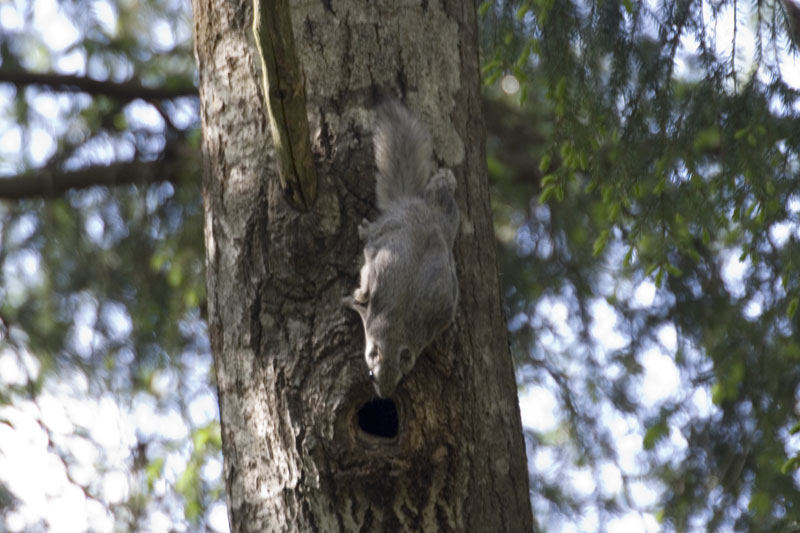
Siberian Flying Squirrel
Pteromys volans
Characteristics
Temperament
Nocturnal, solitary, territorial, arboreal. Glides up to 50-80 m thanks to the patagium (skin membrane between legs). Always lands on vertical trunks (never on the ground). Strictly protected EU species (Habitats Directive).
Diet
Seasonal herbivore folivore: leaves, flowers, catkins, buds, seeds, acorns. Prefers pre-rotten leaves in autumn (70% diet). 20-40 g/day. Practices autocoprophagy to absorb vitamins B/K. Does not drink: gets water from dew.
The Siberian Flying Squirrel (Pteromys volans), also known as pteromys, is a small sciurid, nocturnal and arboreal, widespread in the boreal and mixed forests of northern Eurasia, from Finland to the Russian Far East, China, Japan and Korea. It is famous for its extraordinary gliding flight ability: between its front and rear legs it has a skin membrane (called "patagium") that stretches like a parachute when the animal takes off from a tree, allowing it to glide for 30-50 metres (record 80 m) between one plant and another. It does not actively fly like bats or birds — it is a glider — but manoeuvres with great precision by modifying the inclination of the patagium and using the tail as a rudder. It weighs only 130-200 g and is 13-20 cm long. The global IUCN conservation status is Least Concern (LC), but European populations (Finland, Estonia) are declining due to loss of primary forests.
Classification and category
The Siberian Flying Squirrel belongs to the order Rodentia, family Sciuridae, subfamily Sciurinae, tribe Pteromyini ("flying squirrels"), genus Pteromys. The tribe Pteromyini comprises about 50 species of gliding squirrels distributed throughout the world, all characterised by the presence of the patagium. The species are divided between Old World (Pteromys, Petaurista, Aeromys, etc.) and New World (Glaucomys: American flying squirrels). Pteromys volans was scientifically described by Linnaeus in 1758. The generic name derives from Greek "pteron" (wing) + "mys" (mouse): "wing-mouse". The specific epithet "volans" means "flying" in Latin.
Adult dimensions are: body length 13-20 cm, tail 9-14 cm (almost equal to body), weight 130-200 g. Females are slightly larger than males (reverse sexual dimorphism, rare in mammals). Longevity is 5-7 years in the wild, 13 years in captivity (record). The species is strictly protected in Europe (Habitat Directive 92/43/EEC, Annex IV and II — strict protection); in some countries (Finland, Estonia) it has had an active conservation programme since 2000.
Habitat and distribution
The habitat of the Siberian Flying Squirrel is the mixed boreal forest (taiga) — characterised by Norway spruce (Picea), Scots pine (Pinus), birch (Betula), aspen (Populus tremula), alder (Alnus). It prefers mature forests with large trees (at least 80-120 years old) that present natural cavities for the nest (old woodpecker holes, cracks of fallen trees, abandoned nests of other birds). It lives at elevations of 0-2,000 m. The primary forest is essential for the species: tall trees allow long glides (a 5 m sapling is not enough), and cavities serve as refuge and for rearing young. Deforestation and intensive forestry (cutting before maturity) are the main threats.
The global distribution includes: Finland (main European population, 110,000-150,000 specimens, Protected since 2000), Estonia (critical population, ~150 specimens left), Russia (most extensive distribution, from Belarus to the Pacific — total population: millions), northern Mongolia, north-eastern China (Heilongjiang, Jilin, Liaoning), North and South Korea (Korean population ~5,000), Japan (Hokkaido, "ezo-momonga" population, small form: P. v. orii). In the past the species was present in Latvia, Lithuania, Poland but today extinct. The global IUCN conservation status is Least Concern (LC) since 1996, but with populations declining by 30-50% in European areas in the last 25 years. The species is considered a health indicator of primary boreal forests: its presence signals a mature, balanced forest ecosystem, rich in old hollow trees.
Diet
The Siberian Flying Squirrel is a seasonal herbivore folivore with a diet that varies dramatically based on the season:
- Spring-Summer: young leaves (preferred: birch, aspen, alder), flowers (catkins), buds, insects (occasionally, to integrate protein).
- Autumn-Winter: male catkins (reproductive parts of deciduous trees — aspen is the favourite), buds, tender barks, conifers (pine and spruce seeds), acorns, hazelnuts.
An interesting characteristic is the "consumption of only its own droppings" (caecotrophy): flying squirrels produce two types of faeces — normal dry faeces (excretion) and caecotrophs (soft faeces rich in vitamins B/K produced by the caecum). They eat caecotrophs directly from their own anus (behaviour called "autocoprophagy"), to reabsorb vitamins and nutrients — common in lagomorphs (hares, rabbits) but less common in sciurids.
The most surprising characteristic of the diet is the "rotten leaves" autumnal preference: in autumn, the flying squirrel prefers already rotten leaves to fresh leaves! This is due to the different composition of rotten leaves — the yeasts and bacteria of decomposition produce B group vitamins, and the cellulose is pre-digested by fungi, making it assimilable. Finnish studies have documented that 70% of the autumn diet is composed of naturally pre-digested leaves. Food storage: in winter flying squirrels store seeds and buds in hollow trunks, similar to their diurnal cousins. Food requirement: 20-40 g of vegetation per day (15-20% of weight). It does not drink: it gets water from dew and leaves. It also practises geophagism (eating clay) to neutralise tannins from leaves.
Physical features
The Siberian Flying Squirrel has a stocky, compact, almost spherical-shaped body when curled up. Dimensions are modest: head-body length 13-20 cm, tail 9-14 cm, weight 130-200 g. Sexual dimorphism is slightly reverse (females 3-5% larger than males), characteristic rare in mammals. The head is rounded, with large protruding black eyes 1 cm in diameter — the largest in proportion to the skull among placental mammals of small size. The large eyes are an adaptation to nocturnal life: they have the tapetum lucidum to amplify minimal light (vision 6× more sensitive than ours in the dark). The iris is dark, the pupil round.
The most distinctive feature is the patagium (gliding membrane): elastic skin covered with hair, extended between the front wrist and the rear ankle (lateral to the body). When the animal stretches to glide, the patagium tightens like a rectangular parachute of about 30-40 cm² of surface. An exclusive feature: at the wrist there is a cartilaginous bone called "styliform" (1.5 cm long) — a unique bone extension in flying sciurids, which acts as a "7th extended finger" to expand the patagium surface during flight. Recent studies (2019, University of Helsinki) have shown that this structure is an independent evolutionary invention, appeared 3 times convergently in gliding mammals (flying sciurids, Australian flying phalangers, Southeast Asian colugos). The tail is long, flat dorso-ventrally and well furred: during flight it acts as aerodynamic rudder and stabiliser (depth rudder). The coat is the characteristic grey-silver above (light grey with silver reflections), cream-white on the belly, with a black line separating the two colours. In summer the coat is shorter and brown-greyish; in winter it is thicker and silvery — adaptation to the cold of the taiga (down to -40°C). The legs are equipped with 5 front toes and 4 rear toes, with sharp claws for climbing.
Behaviour and curiosities
The Siberian Flying Squirrel is strictly nocturnal and crepuscular: it leaves the den 30 minutes after sunset and returns before dawn. Solitary and territorial: adult males defend territories of 4-8 ha, females of 1-3 ha. Males' territories overlap with 2-3 territories of females, but rarely with other males. Communication occurs through high-pitched vocalisations (over 30 kHz, ultrasounds partly perceptible only by conspecifics), pheromones in urine, and olfactory markings of trunks. It is a silent animal for humans: its presence is detected almost only by the characteristic faeces (yellow/yellow-green, 4-7 mm long, typical only of this species among forest mammals) on the ground under trunks.
The gliding flight is the most fascinating feature. Typical procedure:
- The animal climbs up to the highest possible branch (10-30 m).
- Evaluates the distance to the target with binocular vision (excellent — the large eyes are frontal, 80% visual field overlap).
- Takes off detaching all 4 legs simultaneously.
- In the air, stretches its legs in an "X" shape, the patagium tightens, the animal glides at an angle of 25-30° relative to the horizontal.
- Speed reaches 40-50 km/h; typical distance 30-50 m, record 80 m (Finland 2012).
- To land, it raises its front feet (brakes), rotates into a vertical position, and grasps the target trunk with its claws — landing always on the vertical trunk, never on the ground.
The energy efficiency of gliding is extraordinary: compared to walking on a branch or jumping, gliding consumes 50-70% less energy to cover the same distance. The squirrel can change direction in flight by modifying the patagium (raising one leg to turn). Landings always occur on vertical trunks (never horizontal) — this specialisation allows avoiding ground predators (foxes, martens).
Reproduction: season March-April (first mating), June-July (second). Gestation lasts 35-40 days. The female gives birth to 2-5 cubs (average 3) in a den located in tree cavities (preferably old woodpecker nests). The cubs are born naked, blind, weighing 5-10 g. They open their eyes at 3 weeks, begin to glide at 6-8 weeks (under maternal guidance), are autonomous at 3-4 months. The female can have 2 litters per year. Nest curiosity: the female uses Usnea lichen ("old man's beard") as the main nest material — it is soft, insulating and antibacterial due to the natural properties of the lichen.
Famous curiosities: the flying squirrel has been the state animal of Finland for many years (together with the whooper swan). It is a national symbol of the Finnish boreal forest. An important environmental-economic controversy in Finland has concerned the forestry-flying squirrel conflict: the species is protected by the EU Habitats Directive (Annex IV), but Finnish forests are the foundation of the economy (cellulose, paper). The "Liito-orava conflict" (1998-2010) has led to specific laws limiting forestry in reproductive areas. Ethological curiosity: flying squirrels glow in ultraviolet! 2017 studies have shown that their fur is fluorescent under UV: white light makes it appear grey, but under UV (wavelength 365 nm) the coat takes on a bright pink-fuchsia tone. The function is not clear: hypotheses include camouflage from raptors that see UV, sexual recognition (females fluoresce more intensely). Mythological curiosity: in Siberia, the indigenous Evenki populations believed that the flying squirrel carried messages between the earthly world and the spirits of the forest — its presence in a tree "sanctified" the tree. Linguistic curiosity: the Finnish name "liito-orava" literally means "gliding squirrel" ("liito" = glided, "orava" = squirrel). In Japan it is called "ezo-momonga" — the Hokkaido form is considered a distinct subspecies (P. v. orii). Pop culture curiosity: the famous "Rocky" from the cartoon "Rocky and Bullwinkle Show" (1959-1964) is an American flying squirrel (Glaucomys, close relative of Pteromys), one of the most famous animated characters in the USA.
Pros
- Adattamento al volo planato spettacolare (50-80 m, 40-50 km/h)
- Longevità eccellente per piccolo roditore (5-7 anni)
- Fluorescenza UV: pelo rosa-fucsia sotto luce ultravioletta
- Indicatore biologico di foreste boreali primarie sane
Cons
- Specie strettamente protetta UE (Direttiva Habitat Allegato IV)
- Difficile da osservare: notturno, silenzioso, vive nelle chiome
- In declino in zone europee (-30-50% in 25 anni)
- Dipendente da foreste mature: cavità di tronchi vecchi essenziali